Robert J. Williams
Meme coins are cryptocurrencies built around an internet joke, an animal mascot, a celebrity, or a viral trend. Their price moves mostly on community hype and social media attention, not on any product or on profits. Dogecoin started the category in 2013 as a joke, and is still the largest meme coin today.
This guide explains what a meme coin is, how meme coins work, which ones lead the market, why people buy them, and what can go wrong. It ends with the checks our team runs before touching any new token.
Key Takeaways
- Meme coins run on hype and community rather than on a product, so their price can swing wildly within hours.
- Dogecoin still leads the category, while most newer coins fade within weeks of launch.
- Anyone can create a meme coin in minutes, which is why scams are so common.
- US regulators treat meme coins more like collectibles, so buyers don’t get securities law protection.
- Only use money you can afford to lose, and buy through a trusted platform or a carefully checked wallet.
What Is a Meme Coin?
A meme coin is a crypto token whose value comes mainly from a joke, an image, or an online community. Most meme coins don’t offer a product, a service, or a share of any profits. People buy them because they expect more people to want them later.
The US Securities and Exchange Commission (SEC) described meme coins in a February 2025 staff statement as crypto assets “inspired by internet memes, characters, current events, or trends.” The same statement compared them to collectibles.
This comparison is the simplest answer to what meme coins are in practice. A meme coin is closer to a trading card than to a share in a company. Its price depends on how many people want it and how much attention it gets.
A Short History of Meme Coins
Meme coins began as a joke about crypto itself. Dogecoin’s founders created it because they felt crypto was “being taken far too seriously,” according to the official history of Dogecoin. Since then, each wave of meme coins has been bigger and faster than the last.
| Year | Coin or event | What happened |
| 2013 | Dogecoin (DOGE) | Billy Markus and Jackson Palmer launched it on 6 December, based on the “Doge” Shiba Inu meme. |
| 2020 | Shiba Inu (SHIB) | A pseudonymous developer called Ryoshi launches an Ethereum token with 1 quadrillion coins. |
| 2021 | Meme coin boom | Social media buzz, including Elon Musk’s posts about Dogecoin, pushes DOGE and SHIB to record prices. |
| 2023 | Pepe (PEPE) | A frog-themed token on Ethereum becomes the next breakout meme coin. |
| 2024 | Pump.fun | A Solana launchpad lets anyone create a token from a web page. Millions of tokens follow. |
| 2025 | Official Trump (TRUMP) | A token tied to the US president launches on Solana on 17 January. |
Elon Musk is still the main name linked to Dogecoin. We cover that story in our guide to the Elon Musk crypto coin.
How Do Meme Coins Work?
Most meme coins are tokens that lie on an existing standard blockchain, such as Ethereum, Solana, BNB Chain, or Base. They follow that network’s token rules and use its wallets and exchanges. Dogecoin is the main exception, because it runs on its own blockchain.
How a New Meme Coin Is Created
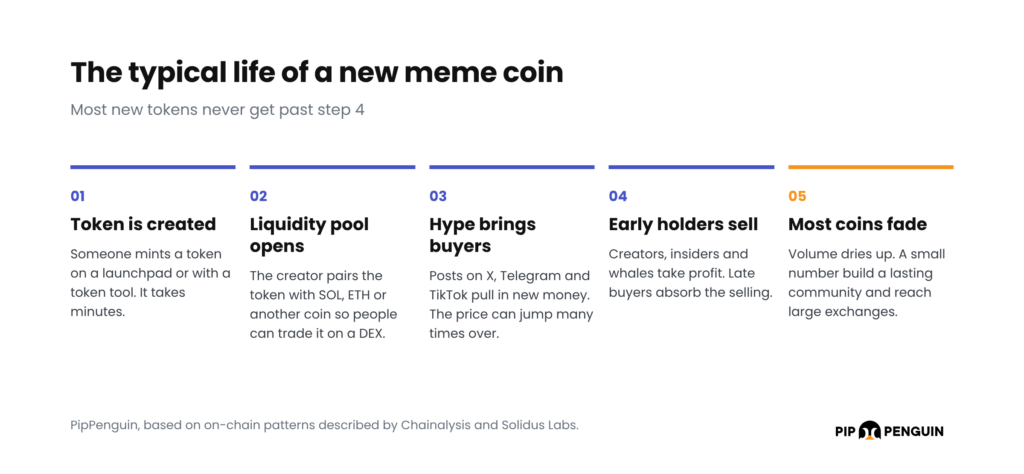
Creating a meme coin takes minutes and very little money. Launchpads such as Pump.fun let anyone pick a name, upload an image, and create a token from a web page. Many people who look up how to make a meme coin are surprised by how simple it is.
This ease of creation is the main problem. More than 7 million tokens were issued on Pump.fun between its launch in January 2024 and May 2025, based on Solidus Labs data. Chainalysis found that more than 3 million tokens were launched across networks in 2024 alone, and only a small fraction were still actively traded months later.
Supply: Why the Price per Coin Is So Low
Many meme coins create billions or even trillions of units. Shiba Inu launched with 1 quadrillion tokens. Dogecoin doesn’t have a supply cap and adds about 5 billion new coins every year.
A huge supply keeps the price per coin tiny, often a fraction of a cent. Though a low price feels cheap, it can mislead you. What matters more is market capitalisation, the price multiplied by the number of coins in circulation.
Take SHIB as an example. About 589 trillion SHIB are still in circulation after token burns. At $1 per coin, SHIB would be worth more than $500 trillion, several times the size of the world economy. So, a cheap coin is not the same as an undervalued coin.
What Affects the Price
A new meme coin usually trades first on a decentralised exchange (DEX) through a liquidity pool. A liquidity pool is a pot of two tokens, such as the meme coin and SOL, that lets people swap one for the other. The ratio between the two tokens sets the price.
Three things move that price:
- Attention: posts on X, Telegram, TikTok, and Reddit bring in new buyers.
- Big holders: a few wallets, often called whales, can hold a large share of the supply. When they sell, the price drops fast.
- Exchange listings: a listing on a large centralised exchange opens the coin to far more buyers.
Meme Coins vs Bitcoin vs Utility Tokens
Meme coins, Bitcoin, and utility tokens are all crypto assets, but they exist for different reasons. The table below shows the main differences:
| Meme coins | Bitcoin | Utility tokens | |
| Main purpose | Entertainment and community | Digital money and a store of value | Pay for or run a specific network or app |
| What drives the price | Hype, social media and big holders | Adoption, demand and wider market conditions | Use of the network, plus speculation |
| Supply | Often huge, sometimes uncapped | Capped at 21 million coins | Set by each project |
| Risk level | Very high | High | High |
| Examples | DOGE, SHIB, PEPE, BONK | BTC | ETH, SOL, LINK |
Some coins blur the line. Solana’s SOL is a utility token, yet the Solana network hosts thousands of meme coins because transactions are fast and cheap.
Top Meme Coins by Market Cap
The meme coin category was worth about $33.5 billion in early October 2026, according to CoinGecko’s meme coin list. Dogecoin alone made up more than 40% of that total.
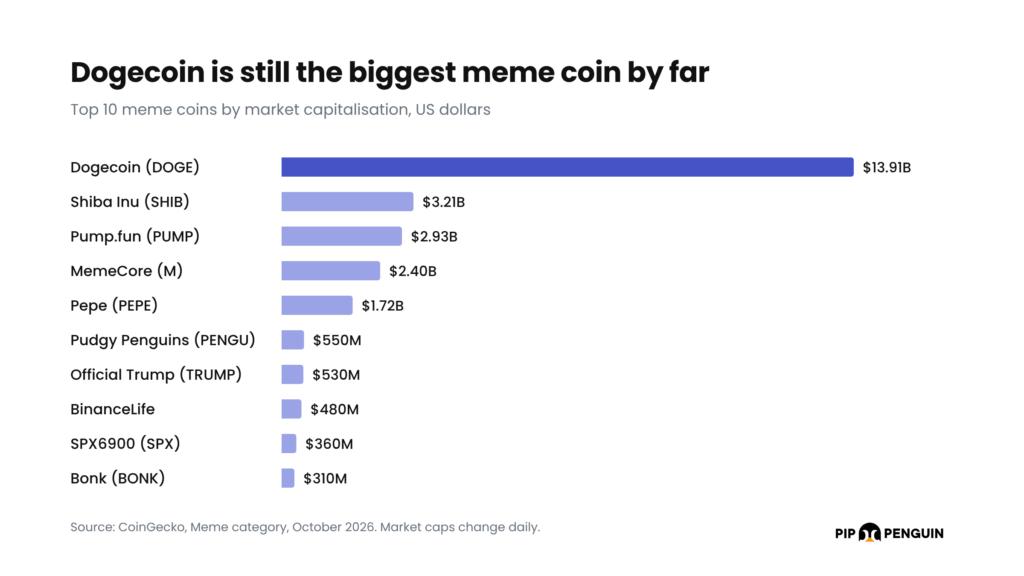
Dogecoin and Shiba Inu
Dogecoin is the oldest and largest meme coin. It is listed on almost every major exchange, and some merchants accept it as payment. Shiba Inu started as a self-styled “Dogecoin killer” and later launched its own network, Shibarium.
SHIB also has one of crypto’s best-known supply stories. In 2021, Ethereum co-founder Vitalik Buterin received about half of all SHIB. He burned 410 trillion tokens and gave the rest to charity, according to Decrypt. Our meme coin price prediction looks at where DOGE and SHIB could head next.
Newer Meme Coins: Pepe, Bonk and Pudgy Penguins
Pepe on Ethereum and Bonk on Solana show how fast a new coin can grow once a community forms around it. Pudgy Penguins’ PENGU token grew out of an NFT collection, which shows how close meme coins and NFT trading have become.
For a shortlist of the coins we rate today, see our guide to the best meme coins to buy. If you want to find new coins early, read how to identify a meme coin before it goes viral.
Celebrity and Political Meme Coins
Official Trump (TRUMP) launched on Solana on 17 January 2025. Two companies linked to Donald Trump, CIC Digital LLC and Fight Fight Fight LLC, hold 80% of its 1 billion tokens, which unlock gradually over three years. By early October 2026, it traded about 97% below its all-time high, according to CoinGecko.
Celebrity coins carry an extra risk because a small group controls most of the supply and can sell at any time. If you still want exposure, read how to buy Trump coin without getting scammed. Trump’s earlier digital trading cards were NFTs rather than coins, but they follow the same fan-driven model.
Why People Buy Meme Coins
Most people buy meme coins for one of four reasons:
- Low entry price: a small amount buys millions of coins, which feels exciting.
- Fast gains: stories of early buyers turning a few hundred dollars into a fortune spread quickly.
- Community: holders share jokes, memes, and a sense of belonging.
- Fun: many people treat it as a game rather than an investment.
Vitalik Buterin wrote about this appeal in a March 2024 blog post on memecoins. He argued that most memecoins simply move money between traders and “contribute nothing of value in their wake.” He also saw a better path built around fun:
“Money is zero sum, but fun can be positive sum.”
Vitalik Buterin, co-founder of Ethereum
In plain terms, every dollar one trader wins on a meme coin is a dollar another trader loses. The fun is real, but the money side is a contest.
Meme Coin Risks Every Beginner Should Know
Meme coins are among the riskiest assets in crypto. Solidus Labs flagged 98.6% of tokens launched on Pump.fun as scams or as showing fraudulent trading activity, as reported by BeInCrypto in May 2025.
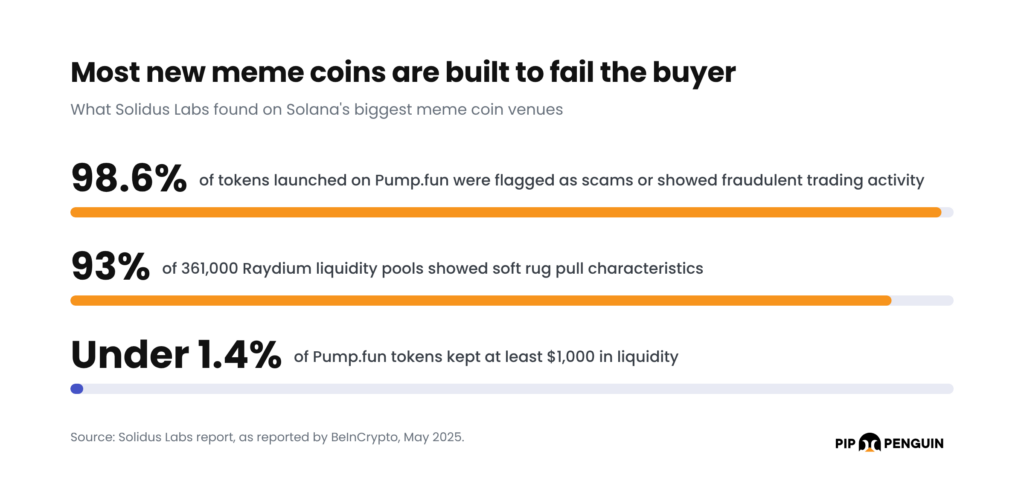
Data graphic showing 98.6% of Pump.fun tokens flagged as scams or fraudulent trading, 93% of 361,000 Raydium pools with soft rug pull traits, and under 1.4% of tokens keeping $1,000 in liquidity
These are the main risks to understand before you buy:
- Rug pulls: the creator pulls the liquidity or dumps their coins, and the price collapses. Chainalysis found that nearly 90% of the suspected DEX pools it flagged in 2024 were “rugged” by the address that created them.
- Honeypots: the token’s code lets you buy but blocks you from selling.
- Thin liquidity: in a small pool, one large sale can crash the price, and you may not be able to sell at the price you see on screen.
- Pump and dump schemes: insiders hype a coin, then sell into the rush of new buyers. Our guide to pump and dump schemes explains how they work.
- Weak investor protection: the SEC staff said in 2025 that “neither meme coin purchasers nor holders are protected by the federal securities laws.” Fraud can still be pursued under other laws, but getting your money back is difficult.
How to Buy Meme Coins Safely
Meme coin trading is easy to start and easy to get wrong. These five steps cut out the most common mistakes.
- Pick where you buy: for most beginners, the best meme coin trading platform is a large, regulated exchange that lists established coins such as DOGE, SHIB, and PEPE. Brand-new coins usually trade only on DEXs, which need a self-custody wallet. Compare your options in our guide to the best crypto trading platforms.
- Set up the right wallet for a DEX: Solana tokens need a Solana wallet such as Phantom, while Ethereum and Base tokens work with wallets such as MetaMask. Learn the difference between hot and cold wallets before you hold larger amounts.
- Get the contract address from an official source: fake tokens often copy the name and logo of popular coins. Take the address from the project’s official channels or a trusted tracker such as CoinGecko, never from a reply or a direct message.
- Check the token before you buy: look at the size of the liquidity pool, how the supply is spread across wallets, and whether the liquidity is locked. Token scanners can also flag honeypot code.
- Start small and plan your exit: decide how much you can afford to lose completely. Set a price at which you will take some profit, and stick to it.
| How the PipPenguin team checks a new meme coin
Our research team tracks new meme coin launches as part of our crypto coverage. Before we write about any token, we run the same short routine. We confirm the contract address against at least two official sources. We check whether the top 10 wallets hold most of the supply. We look for locked liquidity and confirm the token can actually be sold. Then we test with a very small buy and sell before trusting any chart. Most new tokens we review fail at least one of these checks within minutes. That is the main reason we rarely point beginners toward brand-new launches. |
Conclusion
Meme coins are internet culture turned into tradable tokens. A few, led by Dogecoin, have lasted for years and built real communities. Most new ones don’t last, and many are designed to take money from late buyers.
If you decide to buy, treat meme coins as a high-risk bet, not a savings plan. Stick to coins with deep liquidity, use a trusted platform, check every contract, and only use money that you can afford to lose.
FAQs
Is Dogecoin a meme coin?
Yes. Dogecoin is the original meme coin. It launched in December 2013 as a joke based on the Doge meme, and is still the largest meme coin by market cap.
Is XRP a meme coin?
No. XRP is the native token of the XRP Ledger, a network built for payments and transfers. It has a large online fan base, but it was not created as a joke.
Is Solana a meme coin?
No. SOL is the native coin of the Solana blockchain and pays for transactions on it. Solana hosts many meme coins, such as BONK and TRUMP, because its fees are low.
Are meme coins a good investment?
Meme coins are speculation rather than a long-term investment. Prices depend on hype, and most new coins lose nearly all their value. If you want to invest in meme coins, keep them to a small share of your money.
How can I tell if a meme coin is a scam?
Watch for an anonymous team, promises of guaranteed returns, unlocked liquidity, and a few wallets holding most of the supply. If a test sale fails, treat the token as a honeypot and walk away.
Do you pay tax on meme coin profits?
In most countries, yes. Profits from meme coins are usually taxed like other crypto gains. In India, for example, gains are taxed at a flat 30%, plus 1% TDS on transfers. See our guide to crypto tax in India, and check your local rules.
About Author