Robert J. Williams
Meme coin risks go well beyond sharp price swings. Many of the heaviest losses come from three traps built into a token or the market around it: rug pulls, where the people behind the coin drain the money; honeypots, where the code lets you buy but blocks you from selling; and liquidity traps, where the market is too thin to pay you the price on your screen.
This guide explains how each trap works, walks through two well-known collapses, and gives you a checklist to run before you buy. If you are new to these tokens, start with our guide to meme coins for the basics.
Key Takeaways
- A rug pull happens when a token’s creators drain its liquidity or sell a hidden supply, leaving holders with coins nobody will buy.
- A honeypot is a token whose contract allows buying but blocks, taxes, or freezes the sale.
- In a thin market, your own sale pushes the price down, so the value shown in your wallet may be far above what you can sell for.
- Most of these traps leave on-chain clues: who controls the contract, whether liquidity is locked, and how concentrated the supply is.
- Free scanners and a small test sale catch many problems. A clean result lowers the risk without removing it.
Why Meme Coin Risks Run Higher Than Other Crypto
Meme coins are riskier than established cryptos such as Bitcoin or Ethereum because they lack most of what protects buyers in those markets: a long track record, widely distributed ownership, deep trading markets, and utility beyond trading. The following five differences explain this gap:
- Anyone can launch a meme coin: Launchpads such as Pump.fun let a person create a token in minutes without writing code, paying for an audit, or revealing who they are. Large coins have years of trading history and are listed on major exchanges.
- Few wallets hold most of the supply: When the creator and a small group of insiders own a large share, their selling alone can crash the price.
- Thin markets: Most new tokens trade in small pools on decentralised exchanges, so a modest sale can move the price sharply. Established coins trade in deep markets across many major exchanges.
- Price depends upon attention: A meme coin seldom has revenue, a product or a use beyond trading, so its price rises and falls with social media buzz.
- Less legal protection: In February 2025, staff at the US Securities and Exchange Commission (SEC) said they generally do not view meme coins as securities. As a result, buyers can’t rely on the disclosure rules that apply to shares and funds.
These conditions make meme coins easy to exploit, and the data shows how often that happens. Solidus Labs reviewed more than 7 million tokens deployed on Pump.fun between January 2024 and March 2025 and found that about 98.6% showed rug pull or pump-and-dump traits. On Raydium, 93% of the 388,000 liquidity pools it examined showed signs of a soft rug pull (Solidus Labs, 2025 Rug Pull Report). Chainalysis found that in nearly 90% of the suspected pump-and-dump pools it flagged in 2024, the wallet that created the pool was the one that later drained it (Chainalysis data via crypto.news).
SEC Commissioner, who disagreed with the staff view, summed up the problem:
“Fraudulent schemes to manipulate demand through pump-and-dumps or rug pulls are not uncommon.” – Caroline A. Crenshaw, Commissioner, U.S. Securities and Exchange Commission, February 2025
Rug Pulls: How Creators Drain a Meme Coin
A meme coin rug pull happens when the team behind a token takes the money buyers have put in and leaves. The price collapses because the funds that supported it are gone.
What Is a Rug Pull in Crypto?
In crypto, a rug pull is an exit scam. Most new meme coins trade on decentralised exchanges, where the price comes from a liquidity pool: a smart contract holding the token alongside SOL, ETH, or a stablecoin. When you buy, you add SOL to the pool and take tokens out, which pushes the price up.
The creator usually supplies the first liquidity and receives LP (liquidity provider) tokens, which act as a claim on everything in the pool. If those LP tokens aren’t locked or burned, the creator can redeem them at any moment and walk away with the SOL that every buyer paid in.
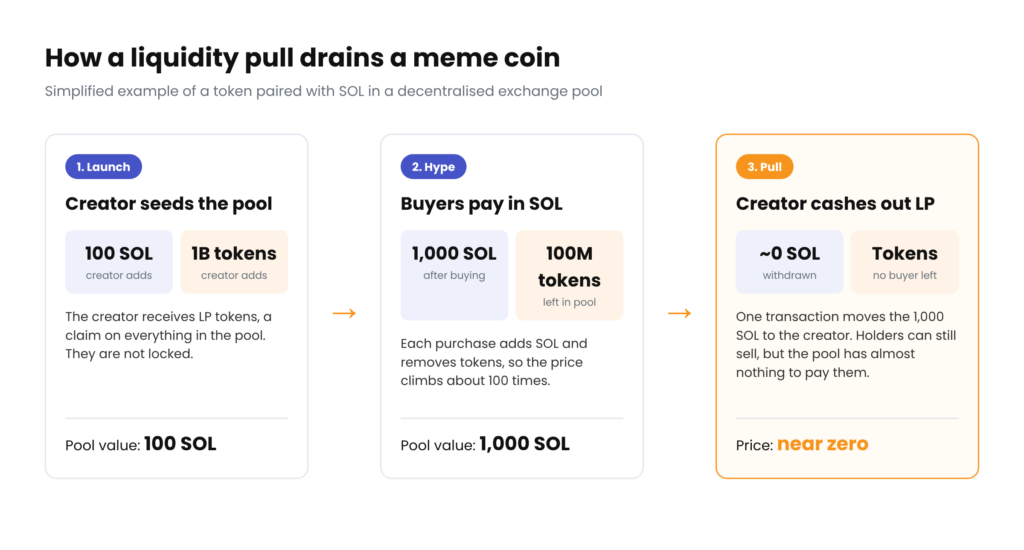
In simple words, buyers put SOL into the pool, the creator takes it out in a single transaction, and holders are left with tokens the pool can no longer pay for.
Quick vs Slow Rug Pulls
Some rug pulls take seconds. Others play out over weeks while the coin is still being promoted. The three common forms look like this:
| Type | How it works | Warning sign |
| Liquidity pull | The creator withdraws the SOL or ETH from the pool in one transaction | Liquidity is unlocked or held by the deployer wallet |
| Mint and dump | The creator issues new tokens and sells them into the pool | Mint authority is still active, or the owner can change supply |
| Slow insider selling (soft rug) | Team wallets sell steadily over days or weeks while promoting the coin | A few linked wallets hold a large share and show regular outflows |
The first two are usually clear-cut theft. The third is murkier, because selling your own tokens is legal in many places. It can become a fraud if the team misleads buyers about its plans.
Case Study: The LIBRA Token
On 14 February 2025, Argentine President Javier Milei promoted the LIBRA token on X. Within hours, its market value passed $4.5 billion. Blockchain analysts at Lookonchain then reported that eight wallets linked to the launch team had cashed out about $107 million, and the price fell roughly 95% from its peak. Bubblemaps had already found that a small cluster of wallets controlled 83% of the supply (The Block). Milei deleted the post, and the firm behind the launch denied profiting from the crash.
The warning sign was visible on-chain before most people bought, and holder concentration is one of the checks in the list below.
Honeypots: Coins You Can Buy but Can’t Sell
A honeypot is a token whose smart contract lets anyone buy but forbids most holders from selling. The chart keeps climbing because only buy orders go through, and that steady rise pulls in more buyers until the creator drains the pool.
How Honeypot Code Works
Honeypot crypto contracts hide the trap in a few common ways:
- Blocked sells: The transfer function checks who is selling and makes the transaction fail for anyone outside an approved list.
- Blacklists: The owner can add wallets to a list that can’t move tokens, often right after they buy.
- Adjustable sell tax: A tax that starts small can be raised by the owner, sometimes to 99% or 100%, so a sale returns almost nothing.
- Freeze authority: On Solana, if a token’s freeze authority hasn’t been revoked, whoever holds it can freeze any holder’s tokens.
- Hidden control: A contract that looks renounced may still route power through a proxy or a second admin function.
Since sales fail at the contract level, a honeypot often looks healthy. Volume and holder numbers rise together, and the chart shows few red candles.
Case Study: The Squid Game Token
SQUID launched on 26 October 2021 at about one cent, riding the popularity of the Netflix series. Over six days, it rallied by as much as 75,000%, passing $2,850 on 1 November. Holders who tried to sell on PancakeSwap found that they couldn’t; the developers had described the block as “anti-dumping technology.” Within minutes of the peak, the price dropped to a fraction of a cent, and about $3.38 million was drained (Cointelegraph).
Liquidity Traps: When You Can’t Sell at the Price You See
A liquidity trap occurs when a token’s pool is too small to absorb your sale. Your wallet shows the price of the last trade. What you receive depends on how much money is on the other side of the pool.
Thin Liquidity and Slippage
Every sale into a pool moves the price, and the move grows with the size of your order compared with the pool. Slippage is the gap between the price you expect and the price you receive.
Take a pool holding $10,000 worth of SOL. If your tokens show a value of $1,000 and you sell them all at once, the pool’s pricing formula returns about $909 before fees, around 9% less. In a pool holding $500,000 of SOL, the same sale costs about 0.2%. For the most common pool design, the rule of thumb is simple: the share you lose equals your sale divided by the pool’s SOL side plus your sale.
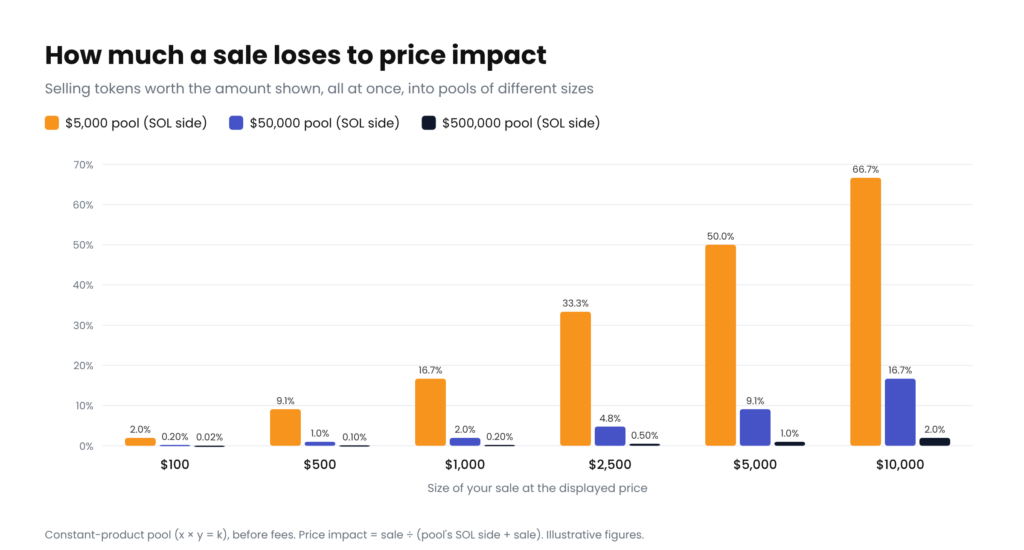
The chart shows the pattern: in a $5,000 pool, a $1,000 sale loses about 17% and a $5,000 sale loses half its value, while the same sales barely move a $500,000 pool.
Swap apps let you set a slippage tolerance. A high setting helps a trade go through on a volatile token, but it also lets bots buy just ahead of you and sell straight back at your expense, generally called a sandwich attack. Keep the setting as low as the trade allows.
Locked Liquidity and Its Limits
Locked liquidity means the LP tokens are in a time-locked contract, so the creator can’t withdraw the pool until the lock expires. Burned liquidity means the LP tokens were sent to an address nobody controls, so the pool cannot be withdrawn.
Both stop the simplest liquidity pull. Neither stops the team from selling a large token allocation into the pool, minting new supply if the mint authority is still active, or leaving when the lock ends. Check how much of the pool is locked and when it unlocks. A lock that ends next week offers little comfort.
How Buyers Become Exit Liquidity
Exit liquidity is the money late buyers bring in that lets early holders sell. Insiders and whales holding large positions need buyers on the other side, or their own selling would crash the price before they got out.
A coordinated pump and dump runs on the same mechanics: paid promoters and group chats build urgency, and the organisers sell into the rush. If a coin has risen several times over in a day because influencers are posting about it, ask who is selling to you.
How to Spot a Rug Pull or Honeypot Before You Buy
You can screen most new tokens in about ten minutes with free tools. Paste the contract address into a scanner, then confirm the key points yourself:
- Verify the contract address: Copy it from the project’s official account or a block explorer such as Solscan or Etherscan. Scammers launch copycat tokens with the same name and ticker.
- Check who controls the token: On Ethereum, Base, and BNB Chain, look for a verified contract and renounced ownership. On Solana, both mint authority and freeze authority should be revoked.
- Confirm liquidity is locked or burned: Note the share of the pool that is locked and the unlock date. RugCheck shows this for Solana tokens, and scanners such as Token Sniffer cover EVM chains.
- Look at holder concentration: Bubblemaps groups linked wallets together. If a few connected wallets hold a large share of the supply outside the pool, they can drain it by selling.
- Run a honeypot checker: Honeypot.is simulates a buy and a sell on EVM chains and reports both taxes. A rug pull checker such as RugCheck flags risky permissions on Solana.
- Read the taxes: A buy or sell tax above about 10%, or a tax the owner can change, is a warning sign.
- Make a small test sale: Buy a small amount and sell part of it straight away. If the sale fails or returns far less than expected, stop there.
- Weigh the social signals: An anonymous team, brand-new social accounts, paid influencer posts, and pressure to buy before a countdown ends all raise the risk.
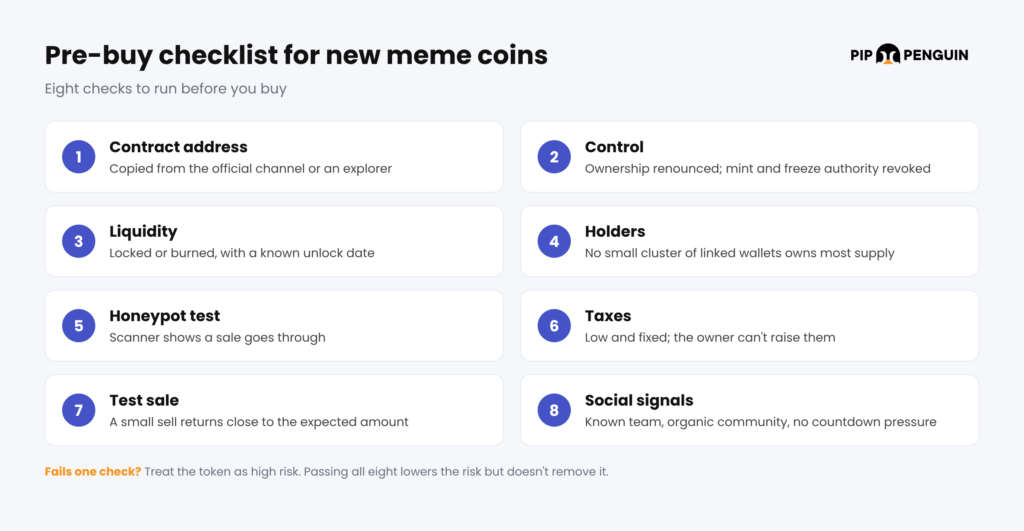
Scanners read the contract as it stands today. An owner with upgrade rights can change it tomorrow, and a token that passes every check can still go to zero once the hype fades. Our guide to identify a meme coin before it goes viral covers the research on potential upside.
The following checklist covers the downside.
| What our team sees most often
PipPenguin’s research team screens new meme coin launches as part of our crypto coverage. The same patterns turn up again and again: • Copycat tickers: Within hours of a coin trending, dozens of tokens with the same name appear, and many buyers lose money on a copy before they find the original. • Renounced on paper: Ownership is renounced, but one wallet received a large share of supply at launch and spread it across fresh wallets. • Short locks: Liquidity is locked for a few days, timed to expire soon after the promotion peaks. • Bot-built charts: Steady volume and a rising holder count come from a cluster of new wallets funded from the same source. |
What to Do If You Get Rug Pulled
If a token you hold has been rugged, or you can’t sell it, act quickly to protect the rest of your wallet and keep evidence for a report.
- Stop buying: Don’t add funds to average down, and never pay a fee that someone claims will unlock your sale.
- Revoke token approvals: Use a tool such as Revoke.cash for EVM wallets, or your Solana wallet’s connected-apps settings, to cancel permissions you gave the token or its website. If you think your seed phrase was exposed, move the remaining funds to a new wallet; a cold wallet adds another layer of protection.
- Keep records: Save the contract address, transaction hashes, wallet addresses, screenshots of the project’s posts, and any messages from the team.
- Report it: In the US, file a complaint with the FBI’s Internet Crime Complaint Center (IC3). In the UK, use Report Fraud, the service that replaced Action Fraud. Elsewhere, contact your national police fraud unit or financial regulator. Reports help investigators link cases, even when a single loss is small.
- Ignore recovery offers: People who message you promising to get your crypto back for an upfront fee are almost always running another scam. Police don’t charge victims to investigate.
Conclusion
New meme coins launch faster than anyone can review them, and the people behind many of them plan their exit before the first buyer arrives. Treat every new token as unproven until its contract, liquidity, and holder list say otherwise, and only use money you can afford to lose. If you still want exposure, our list of the best meme coins to buy is a more measured place to start.
FAQs
Is a rug pull illegal?
It depends on the facts and the country. Draining a pool after promising to keep it, minting hidden supply, or lying about a project can amount to fraud, and prosecutors in several countries have charged such cases. Abandoning a token or selling your own allocation may not break any law, so recovery through the courts is uncommon.
Can you get your money back after a rug pull?
Rarely. Blockchain transactions can’t be reversed, and the people behind most rug pulls stay anonymous. Funds are sometimes recovered when an exchange freezes stolen coins or police trace and seize them, which is a key reason to report a loss quickly. Anyone who guarantees recovery in exchange for a fee is likely running a scam.
How do I check if a token is a honeypot?
Paste the contract address into a honeypot checker such as Honeypot.is for Ethereum, Base, or BNB Chain tokens, or RugCheck for Solana tokens. These tools simulate a sale and show the sell tax and any risky permissions. Then, confirm the result with a very small sale of your own before you commit more money.
What does exit liquidity mean in crypto?
The phrase comes from trader slang: if you are someone’s exit liquidity, your purchase is what lets them cash out. It applies most to hyped tokens where insiders hold large bags. A quick test is to open the token’s top holders on a block explorer; heavy recent selling from those wallets is a warning sign.
Can a coin with locked liquidity still rug pull?
Yes. A lock protects the pool only from a direct withdrawal, and only until it expires. Insiders who hold a big share of the supply can drain the same pool by selling into it, and an active mint authority lets them create fresh tokens to sell. Treat a lock as one check among several before you buy.
Are all meme coins scams?
No. Dogecoin, Shiba Inu, and a few others have traded for years on major exchanges with deep markets. Most new launches, though, lose nearly all their value within days, and many are designed that way. A sensible default is to treat any new token as high risk until on-chain checks and its trading history suggest otherwise.
About Author