Alexandra Winters
 Beatrice Quinn
As per our research, you find meme coins early by filtering a decentralized exchange screener for pair age, liquidity, and holder count, then checking who deployed the token and which wallets bought it in the first minute. The chart tells you almost nothing in the first hour. The wallets tell you most of it.
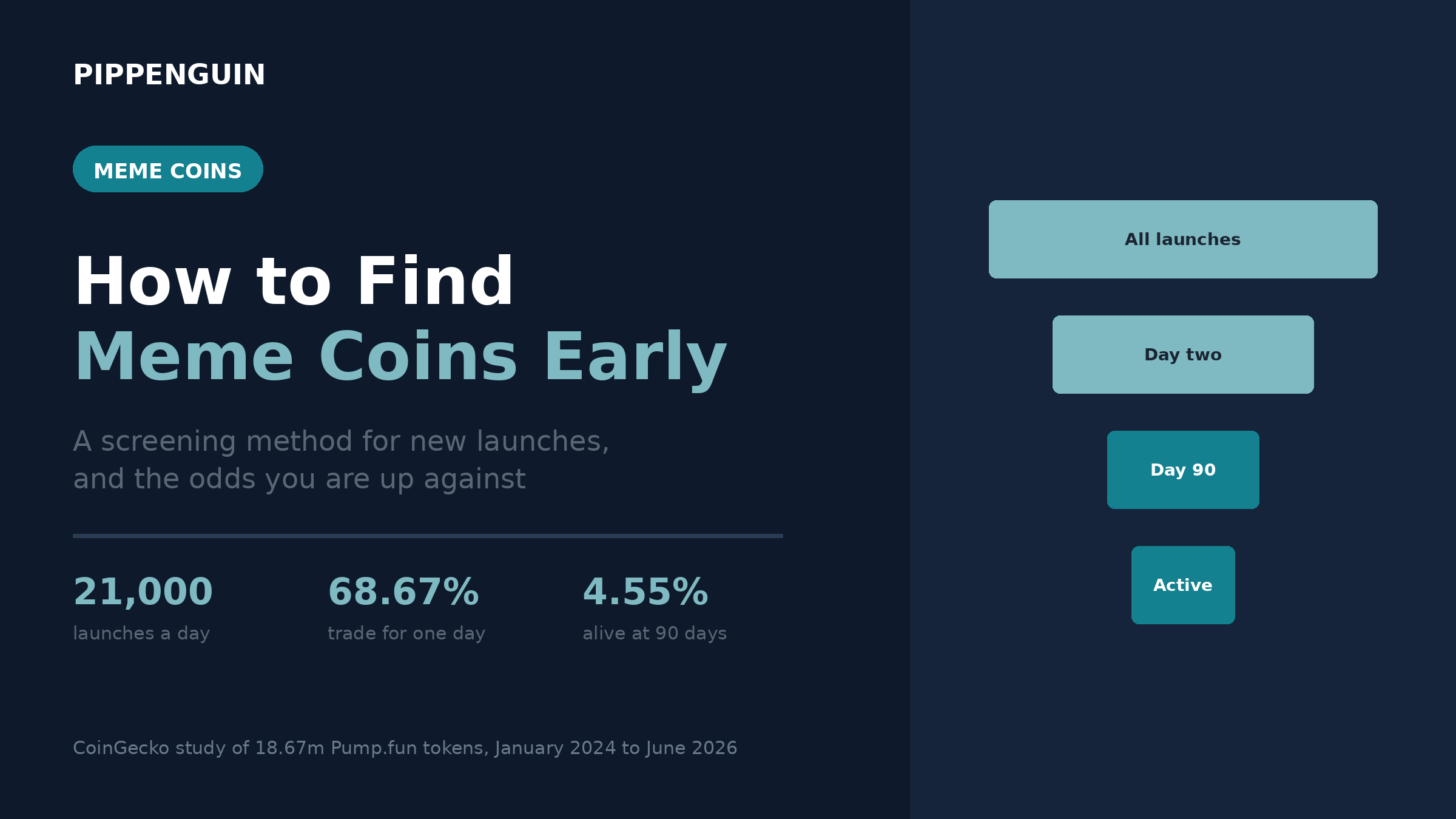
Spotting a new token is the easy part. Pump.fun alone has averaged more than 21,000 launches a day since January 2024, so the supply of candidates has never been the constraint. A CoinGecko study of 18.67 million of those tokens found 68.67% recorded their last trade on the day they launched. The actual work is deciding which few are worth a second look.
If you are new to these tokens, start with our beginner’s guide to meme coins. If you would rather buy coins that already have a trading history, our list of the best meme coins to buy is a steadier place to start.
Key Takeaways
- Most tokens trade once: CoinGecko put the launch-day-only share at 68.67% across 18.67 million tokens, and Bitquery at 79% on a more recent sample.
- Filters do the first cut: Pair age, a liquidity floor, holder count, and the buy-to-sell ratio remove most of a day’s launches in seconds.
- The deployer wallet carries the actual signal: A wallet with a trail of abandoned tokens behind it is the clearest warning available before a chart exists.
- Bundled buying is visible: Wallets funded from one source that buy in the same block show up on a cluster map, and they look like organic demand on a chart.
Where New Meme Coins Actually Appear
Nearly every new meme coin now starts on a launchpad, not a conventional listing. Pump.fun, Meteora, Raydium LaunchLab, and several rivals let anyone mint a token in a minute for a few dollars, without code or audit.
A new token opens on a bonding curve, a pricing formula that stands in for an order book. Early buyers push the price along a fixed path and the money collects inside the curve. Once the curve fills, the token graduates: its liquidity moves to a decentralized exchange, where it trades against actual buyers and sellers for the first time.
Most tokens never get there. The Block’s on-chain tracker put graduation between 2.5% and 6.7% a day across late July 2026, a Dune dashboard puts the all-time rate near 1.4%, and CoinGecko’s analysts put it below 2%. Those measures count different things over different windows, so read 1.4% to 6.7% as an estimate, not a measurement.
Bitquery tracked what happens afterwards, across 8,984,141 Pump.fun tokens launched between 1 November 2025 and 7 October 2026. It found 79% traded on launch day and never again, well above CoinGecko’s 68.67% on a longer and older sample. Four weeks later, only 1.5% of the Bitquery tokens were still trading, and 0.2% had recorded ten or more trades.
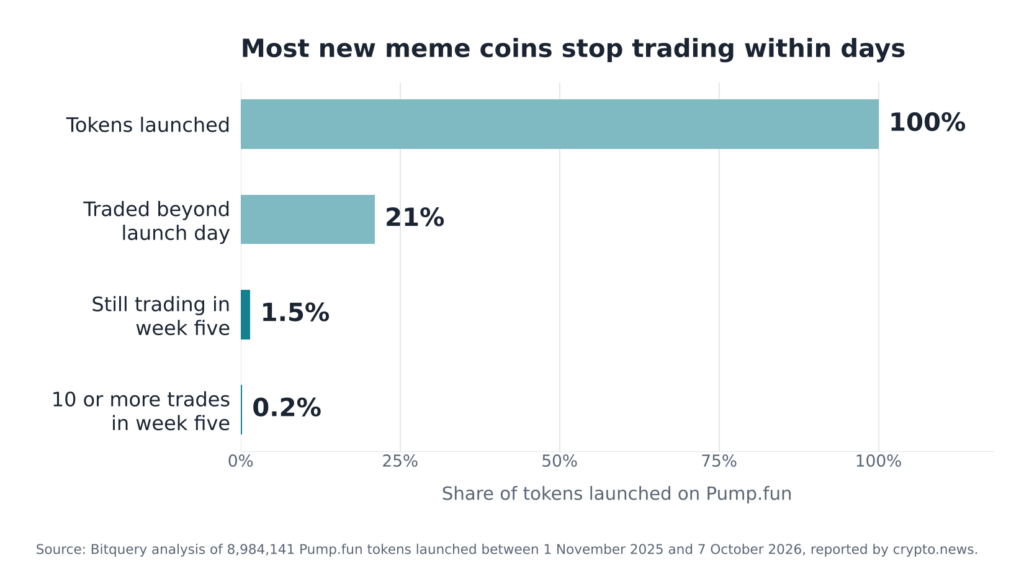
CoinGecko’s own sample found 4.55% still active past 90 days, which is above Bitquery’s week-five figure because it counts a different population over a different period. CoinGecko also warned that its number may undercount tokens that migrated to other exchanges. Both studies measure abandonment, and not fraud.
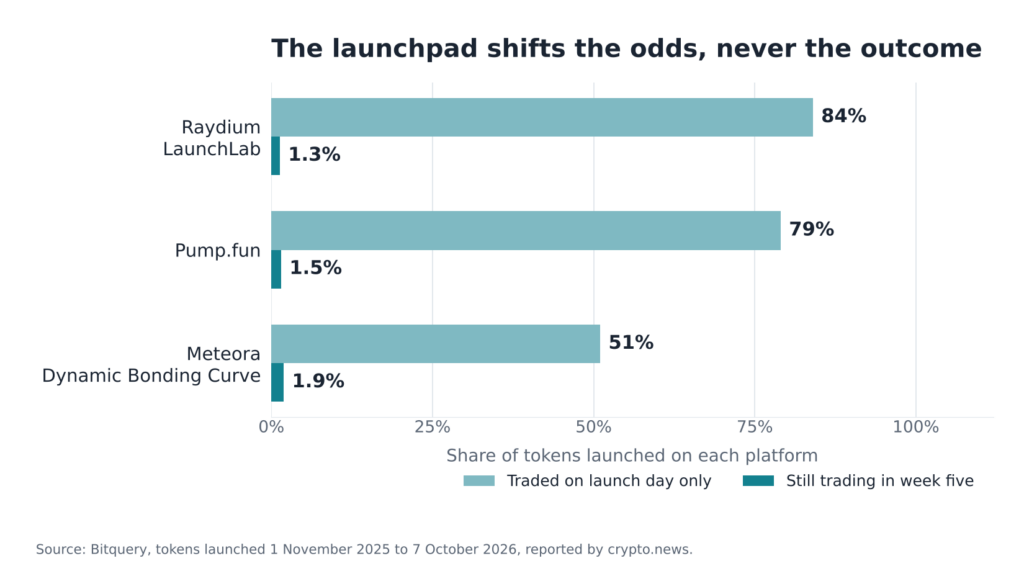
Switching launchpad moves the first number more than the second. On the same Bitquery data, Meteora’s Dynamic Bonding Curve had 51% of tokens trading for a single day against Raydium LaunchLab’s 84% and Pump.fun’s 79%, and yet all three are between 1.3% and 1.9% alive in week five. Where a token launched tells you far less than what happened in its first hour.
Spotting a Narrative Before It Peaks
Meme coins run on attention, so a token attached to a story people are already telling has an advantage over one that needs the story explained first. Naming what is trending today would be useless by the time you read it, so what follows is the test rather than the answer.
Three things separate a narrative that is still arriving from one that has already peaked. The first is where it sits, because a reference spreading inside a community that is not primarily about crypto has further to travel than one that started on crypto X. The second is how many tokens already carry the name, since a dozen copies of the same idea means the trade is crowded and you are choosing between imitations. The third is whether the price moved before the story did, which usually means somebody built the story around a position they already held.
How to Screen New Launches on a DEX Screener
A screener such as DEX Screener or DEXTools lists every new pair across chains as it appears, with liquidity, volume, and transaction counts attached. Both have free tiers. The filters matter more than the tool, and we apply them in this order:
| FILTER | SETTING WE USE | WHAT IT REMOVES |
| Pair age | 1 hour to 7 days | The first-minute sniping window, and anything that has already had its move |
| Liquidity | Above $30,000 | Pools too thin to exit without moving the price |
| 24-hour volume | Above 2x liquidity | Dormant pairs with a price but no trading |
| Holders | More than 300 | Tokens held by the deployer and a few bots |
| Buy-to-sell ratio | Between 0.8 and 1.5 | One-sided books, usually built by bots |
See these numbers as a starting point. Raise the liquidity floor in a quiet week and the list empties; lower it in a busy one and the list fills with noise. The filter set exists to take a day of launches down to a few names you can actually look at.
The volume rule determines most of it here. A pool holding $50,000 with $8,000 of daily volume is a price with nobody behind it. The same pool turning over $100,000 has traders on both sides, which is what you need in order to leave.
What the Chart Cannot Tell You
A screener gets you a shortlist, and everything that decides whether a token is worth anything is in the transaction history behind it. Four checks clarify most of this:
The Deployer’s History
Every token has a deployer wallet, and a block explorer such as Solscan shows what else that wallet has created. A deployer with a trail of abandoned tokens behind it is the clearest single signal available this early. People who launch and walk away tend to repeat the pattern from the same wallet.
Bundled Supply at Launch
Bundling means several wallets funded from one source buying in the same block, which makes a concentrated position look like organic demand. Cluster maps on Bubblemaps draw the funding links between holders, so the pattern is visible before a chart exists. Invezz reported in September 2026 that the firm had rebuilt its platform around a pre-screened token feed with an insider score attached to each entry, which is a fair measure of how routine this check has become. “People have been using Bubblemaps for years to understand tokens before they buy,” said Nicolas Vaiman, its chief executive and co-founder.
Sniper Concentration
Snipers are bots that buy inside the first block or two of a launch. A few of them are normal. A token where those first-minute buyers still hold most of the supply has a ceiling on it, because they sell into any rally that arrives. Open the top holders on a block explorer and compare their wallet creation dates against the token’s own.
Liquidity Depth Against Market Cap
A $2m market cap on a $30,000 pool is not a $2m token. Market cap multiplies the last traded price by the supply, and that last price came from the pool. Divide the pool by the market cap: below about 2% and the headline valuation is overstated, because the pool cannot pay it.
A Ten-Minute Check Before You Buy
Once a token clears the filters, these six steps take about ten minutes:
- Copy the contract address from the project’s own account or a block explorer, never from a search result, because copycat tokens use the same name and ticker.
- Open the deployer wallet on Solscan or Etherscan and read its history of previous tokens.
- Load the token into Bubblemaps and look for wallet clusters funded from one source.
- Divide the pool by the market cap and work out what a realistic exit returns.
- Check the first-minute buyers on the holder list and see whether they are still holding.
- Buy a small amount and sell part of it straight away, because a sale that fails or returns far less than expected ends the process there.
Contract permissions, liquidity locks, and honeypot code are outside this list on purpose. They belong to a token’s code rather than its launch.
| What our team sees most often
PipPenguin’s research team screens new launches as part of our crypto coverage. Four patterns come up often: • Graduation on wash volume: A token reaching an actual market on turnover that is almost entirely the same wallets trading with each other. • Liquidity added and pulled inside a session: A pool deep enough to pass a filter in the morning and gone by the evening. • Holder counts built from empty wallets: Three hundred holders that turn out to be three hundred addresses created in the same hour and funded with dust. • Volume that arrives before the story: Turnover climbing hours ahead of any social mention, which usually means the mention was paid for. |
Sizing and Exits for Early Entries
Position sizing matters more here than token selection, because the median outcome on the published numbers is a near-total loss. Our team applies these three rules for it:
- Decide the amount before you choose the token: Pick a figure you can lose in full without changing any plan you have, then split it across several positions.
- Size against the pool, not the market cap: A position worth more than 1% of a pool shifts the price on the way out, so your exit price is not the one on the screen.
- Set the exit multiple before you buy: Decide in advance at what point you take your original stake back out, and write it down where you can see it.
How to Find Meme Coins Early: The Bottom Line
Finding a new meme coin takes a screener and ten minutes. Finding one worth buying takes the deployer history, the holder map, and the pool arithmetic, and most candidates fail at least one of the three.
The published numbers set the context for all of it. Between 1.3% and 1.9% of tokens on the three largest launchpads were still trading in week five, so size every position as money you can lose in full. For the rare token that survives and that you plan to hold, our comparison of hot and cold wallets sets out where to keep it.
Frequently Asked Questions
How do I find meme coins early?
Use a decentralised exchange screener such as DEX Screener to list new pairs, then filter by pair age, a liquidity floor, holder count, and the buy-to-sell ratio. This leaves a short list, and the on-chain checks on the deployer and the holders come afterwards.
What is the best site to find new meme coins?
DEX Screener and DEXTools both list new pairs across chains at no cost, and traders pair them with RugCheck for contract risk and Bubblemaps for holder clusters. No single site does all three jobs well, so most people run two or three together.
How many new meme coins succeed?
Very few. CoinGecko found 68.67% of 18.67 million Pump.fun tokens last traded on their launch day, with 4.55% still active past 90 days. Bitquery put the launch-day-only share at 79% on a newer sample. Graduation runs between about 1.4% and 6.7%.
What does it mean when a meme coin graduates?
It means the token has filled its bonding curve and its liquidity has moved to a decentralised exchange. Before that point buyers trade against a pricing formula. Afterwards they trade against each other, which is when a price starts to mean something.
Is it safer to buy before or after a coin reaches an exchange?
Neither is safe, and they fail differently. Pre-graduation entries are cheaper and come without any trading history. Post-graduation tokens have a chart and real liquidity, and you are buying after the earliest holders are already positioned.
How do I check if a meme coin is a scam?
Read the contract permissions, confirm whether the liquidity is locked, and run a honeypot check before anything else. Learn more from our guide to meme coin risks.
About Author