Robert J. Williams
Swing trading vs day trading is a choice about time, capital, and risk. A swing trade is any position held overnight, for days or weeks. A day trade opens and closes within one session. Swing trading suits someone with a few set hours a week who can accept overnight gaps. Day trading is for someone who can watch the market through the session and meets the account rules. None of the studies below compare their returns, so your hours, account, and costs should decide.
This guide takes you through that choice in order, from your hours to the evidence on returns. It is written for a learning trader with a day job and a small account in India, the US, the UK or the EU. For the wider set of styles, see types of traders.
Key Takeaways
|
Swing trading vs day trading: Overview
Where a market doesn’t close each day, such as forex, use your broker’s daily cut-off as the end of the session.
| DAY TRADING | SWING TRADING | |
|---|---|---|
| Holding time | Opened and closed within one session | Held overnight, for days or weeks |
| Time needed | 30 minutes to 1.5 hours a day taking trades, plus review (one source’s estimate) | About one hour a week to one hour a day (same source) |
| US margin account | $25,000 minimum equity under the old rule; $2,000 under the new rules | $2,000 minimum equity |
| Main risk | A stop fill away from your stop price | An overnight gap past your stop |
| Costs | Charged per order, so cost rises with the number of trades | Fewer orders; CFDs add an overnight funding line |
| Best fit | Fixed time in the session and capital that meets the account rule | Spare hours outside the session; orders placed in advance |
Day trading and swing trading also differ in account rules and weekly costs, covered below.
Start with Your Available Time
List your free hours in a normal week and when they fall, then find your case. The cut-offs are this article’s working thresholds, built from the lowest estimates below, and they are not measured figures.
- Under one hour a week: Neither style yet. One hour a week is the lowest swing estimate that names a period.
- A fixed window of 30 minutes or more in the session each trading day: Swing trading fits. Day trading fits only on the lowest estimate, so see it as a stretch.
- Free time only outside the session, or session time you can’t fix: Swing trading, with orders placed outside the session.
The sources give these ranges, and they are estimates, not measurements. NinjaTrader (2026), a futures broker, says day trading futures typically needs screen time across the 9:30 am to 4:00 pm ET US cash session, while swing trading futures can be managed in 15 to 30 minutes a day. Cory Mitchell of Trade That Swing (2026) puts swing trading at about one hour a day to one hour a week, and day trading at 30 minutes to 1.5 hours a day, plus review. They disagree, so see each as that source’s own estimate.
Mitchell adds that some swing traders trade during the day, which would count as day trading here, while others, himself included, review charts after the close and place orders for the next day. He says that low-time process may not suit someone who can’t enter or exit trades near the close. If that is you, pick a swing method that doesn’t need one. The best time frame for swing trading page covers chart time frames.
Check Your Broker’s Account Rules
Margin is the deposit a broker holds while a position is open, and 5:1 leverage means a position worth five times that deposit. A CFD (contract for difference) is a contract with a broker that follows the price of a share, currency or index.
Investor.gov’s bulletin on margin rules for day trading gives the FINRA definition of a day trade: buying and selling, or selling and buying, the same security on the same day in a margin account. It doesn’t define a swing trade, so here it is any position held overnight.
The old pattern day trader rule flagged a customer after four or more day trades in five business days, when those trades were more than 6% of the account’s trades in that period, and a flagged account needed $25,000 minimum equity. On 14 April 2026, the Securities and Exchange Commission (SEC) approved FINRA’s change replacing these provisions with intraday margin standards, and its order removes the $25,000 minimum. Investor.gov says the new requirements took effect on 4 June 2026, with a transition to 20 October 2027, so a broker may keep the old rules until it moves. Some brokers also use a broader definition, so ask yours.
Find your market and account, then take your case:
- US shares in a margin account (one where the broker can lend against your holdings): Ask which day-trading rule your broker applies. Under the old rule with equity below $25,000, you can’t day trade at that pace, whatever your hours. Otherwise, go on to sizing, using the $2,000 minimum equity the order cites as the floor, which your broker may raise.
- US shares in a cash account: Ask your broker, since these rules cover margin accounts.
- Any other market in the table: The figures are leverage and margin, not a minimum-equity rule like the US one. Margin is the cash a position ties up (see leverage in futures trading), so use your broker’s stated margin.
Account Rules and Margin Requirements by Market
| MARKET AND ACCOUNT | CLOSED THE SAME DAY | HELD OVERNIGHT | SOURCE AND DATE |
|---|---|---|---|
| US shares, margin account | Old rule until your broker moves: $25,000 minimum equity for a pattern day trader. New rules: not required; the $2,000 minimum equity applies | $2,000 minimum equity | SEC order, 14 April 2026; Investor.gov, read 26 October 2026 |
| EU retail CFDs | Opening leverage from 30:1 on major currency pairs to 2:1; 5:1 on single shares, whatever the holding time | Same limit | ESMA, 2018 (temporary; current status unconfirmed) |
| UK share CFD at IG (Ford) | 20% margin (5:1), from 1 share; not split by holding period | Same figure | IG UK, read 26 October 2026 |
| Indian shares at Zerodha | 20% of the trade’s value; Zerodha can reduce leverage during the day | No figure found | Zerodha, read 26 October 2026 |
| Micro E-mini S&P 500 futures, TradeZero | $50 a contract until 16:45 ET | $2,862.88 a contract | TradeZero America, 16 September 2026 |
The futures row shows the capital contrast most plainly: holding a contract overnight ties up much more cash than closing it the same day.
Choose a Trade Size That Fits Your Budget
Fix your risk per trade as a share of your account before you enter. Your size is that risk divided by your stop distance per unit, rounded down. If one unit of the smallest position your market allows risks more than your cap at the stop, skip the trade. Then compare the cash the position ties up with your account, and skip the trade if it is more than the account holds.
TradeNation (2025) says most traders prefer not to risk more than 1-2% of their account on a single trade, and more aggressive traders might go to 5%. That is one broker’s rule of thumb, not a survey result.
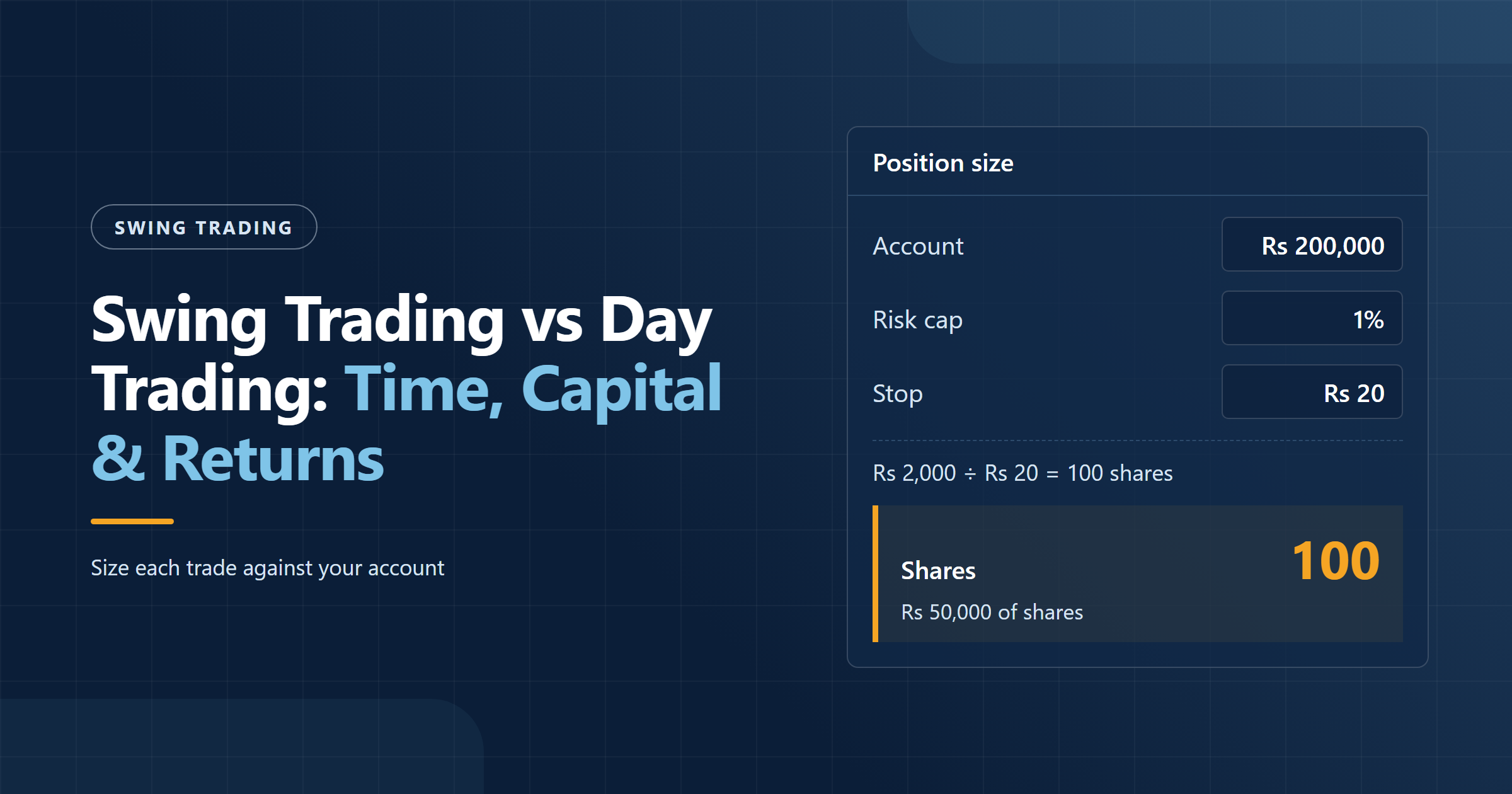
Here is the sum with round numbers. An account of Rs 200,000 with a 1% cap risks 1% × Rs 200,000 = Rs 2,000 per trade. With a stop Rs 20 below entry, Rs 2,000 ÷ Rs 20 = 100 shares. At Rs 500 a share, that is 100 × Rs 500 = Rs 50,000 of shares, with the stop at Rs 480. Rs 50,000 is less than the Rs 200,000 account, so the trade passes. On margin at Zerodha’s 20%, the same position ties up 20% × Rs 50,000 = Rs 10,000, but the planned risk stays Rs 2,000, because the cap and the stop distance set the size.
Compare the Weekly Costs of Each Style
Cost your week line by line from your broker’s published charges: per-order lines times orders, per-trade levies times round trips (one buy and one sell), and per-night lines times nights held. A line marked zero leaves the other lines in place.
Zerodha’s charges page, read on 26 October 2026, lists intraday brokerage at Rs 20 or 0.03% per executed order, whichever is lower, and Rs 0 on equity delivery. It lists STT (India’s securities transaction tax) at 0.1% on both the buy and the sell for delivery, and 0.025% on the sell side for intraday. Other statutory charges and stamp duty are separate lines.
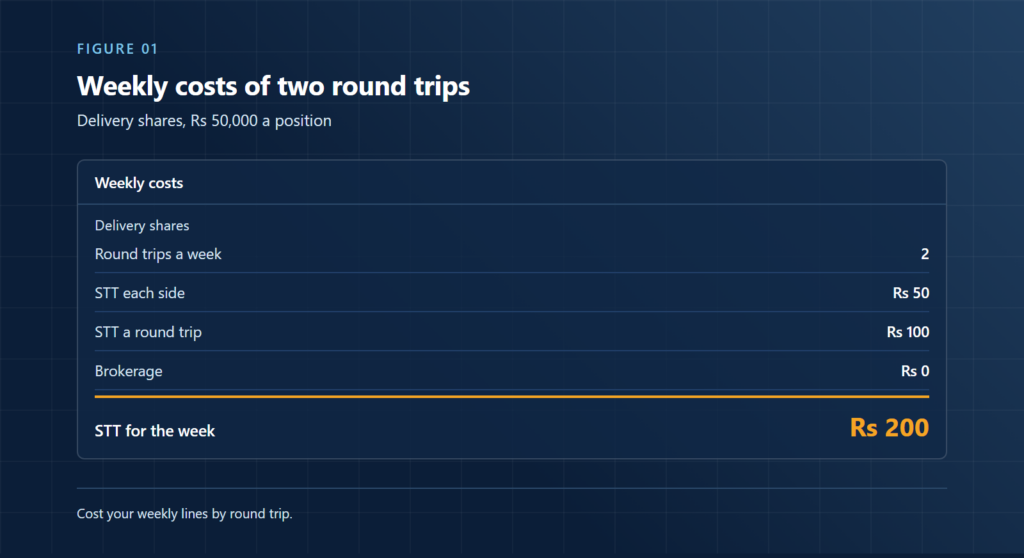
Take the Rs 50,000 position above. On delivery, STT is 0.1% × Rs 50,000 = Rs 50 a side, so Rs 100 a round trip, and two round trips a week cost Rs 200 of STT and Rs 0 of brokerage. Five intraday round trips of the same size cost Rs 15 of brokerage per order (0.03% × Rs 50,000), so Rs 30 a round trip and 5 × Rs 30 = Rs 150 a week, plus STT of Rs 12.50 a round trip (0.025% × Rs 50,000), so Rs 62.50 a week. These sums show how to calculate a week’s cost, not which style is cheaper.
Funding is the overnight charge or credit on a CFD. IG UK applies it to a forex CFD opened before 22:00 London time and still open after 22:00. Its own charge is at most 0.0022% a day on top of the tom-next rate (an overnight interbank rate), which its page doesn’t publish, so take that line from your broker’s own figures. A position closed before 22:00 isn’t charged funding. CFD vs futures costs compares financing by product.
Understand the Risks of Holding Trades Overnight
An overnight gap is a price that opens away from where it last traded. Before you hold overnight, work out the loss if each position opens past its stop by your stop distance again, which is twice your planned risk. Hold the full size only if the total is within the most you’d accept from one bad open. Otherwise, cut the size. Twice the stop distance is this article’s working assumption, and a real gap can be larger.
Mitchell writes that large moves, including overnight gaps, can occur against a swing trader. Day traders face a different risk: the SEC’s investor bulletin on stop orders says a stop price is a trigger that turns the order into a market order, and the fill can deviate significantly from it. This is staff guidance for stocks and doesn’t mention overnight gaps. NinjaTrader says futures day traders often avoid overnight gap risk by closing before the session ends. So you can size an overnight gap before you hold, while an intraday stop fill can be allowed for but not sized.
For the 100 shares above, the test is 100 × 2 × Rs 20 = Rs 4,000. If the most you’d accept from one bad open is 2% of the Rs 200,000 account, which is Rs 4,000, the position passes. A second position of the same size would double the test to Rs 8,000, so you would cut the size until the total fits.
Is swing trading more profitable than day trading?
The evidence doesn’t say. None of the studies below measures swing traders, so none can show that either style earns more. Don’t set a return target from any page or study, and judge your own trial by its four-week readings instead.
What the studies measured
| STUDY | WHO WAS MEASURED | WHAT IT FOUND | WHAT IT CAN’T TELL YOU |
|---|---|---|---|
| Barber and Odean, Journal of Finance, 2000 | 66,465 US households at one discount broker, 1991-1996 | The most active earned 11.4% a year, while the market returned 17.9% | Holding periods in days |
| Chague, De-Losso and Giovannetti, working paper, February 2020 | Brazilian equity-futures day traders who began in 2013-2015 and lasted 300 days or more | 97% lost money, and 0.4% out-earned a bank teller’s US$54 a day | Traders who quit earlier |
| ESMA, March 2018 | EU retail CFD accounts | 74-89% of retail accounts typically lose money | A split by holding period |
| SEBI investor-education page, undated | Individual equity F&O (futures and options) traders, FY 2018-19 and FY 2021-22 | 9 in 10 had net losses | Cash shares or swing trades |
The groups measured mostly lost money, but they differ in market, period, and size, and only Barber and Odean give a return, so none of this ranks one style above the other. When a page tells you 97% of day traders lose money, ask who was measured, where and when. This figure comes from Chague, De-Losso and Giovannetti’s working paper on Brazilian day traders. Moneysmart, run by Australia’s regulator ASIC, says that for CFDs sold in Australia, generally the more a CFD trader trades, the more they lose, especially after fees.
Test Your Trading Strategy Before Using Money
Trial your routine on paper in your real hours, logging each planned session and each trade’s risk and stop. The thresholds below are working thresholds chosen for this article. Every four weeks, read your log in this order:
- Under three in four planned sessions kept: Stop, rewrite your hours, and redo the hours test before testing any style. At four sessions a week, you plan 16 in four weeks and need to keep at least 12.
- Under 10 closed paper trades: Too few to read, so carry on for four more weeks.
- A trade in the last four weeks broke your cap or skipped its stop, or your paper result so far, after your cost lines, is below zero: Hold, and stay on paper for four more weeks.
- Otherwise: Go with real money at half your risk cap for four weeks. Read your real-money log in the same order. Rule 1 still stops you, rules 2 and 3 each keep you at half risk for four more weeks, and a second go reading lifts you to the full cap.
Start at half the risk, because actual orders can fill at prices a paper trial can’t show. Which swing methods to trial is covered in swing trading strategies for beginners.
Moneysmart’s checklist before trading CFDs asks, “Do I really have the time to be monitoring my positions regularly?” The SEC’s day-trading page (last reviewed April 2005) says to risk only the money you can afford to lose, never the money needed for living expenses or retirement.
Swing Trading vs Day Trading: The Bottom Line
Start with your available hours, then check the account rules where you trade. Size each trade, test the overnight gap, and price a week from your broker’s lines. If both styles are still open, start with the cheaper week that also passes the gap test, and if the two are close, start with the one that asks fewer of your hours. That is this article’s own rule, not a study’s finding. Your first step fits in this week: write down your free hours by time of day, next to your market’s session times.
Frequently Asked Questions
Can I day trade and swing trade in the same account?
Under the old FINRA rule, as Investor.gov states it, a long position held overnight and sold the next day, before any new purchase of the same security, isn’t a day trade. A position you open and close on the same day is, so it counts toward the pattern day trader test. The sources here don’t show how the new rules count it, so ask your broker.
How much money do you need to swing trade?
It depends on your stop and your market’s smallest position. Divide the risk on one unit at your stop by your risk cap to find the smallest account that works. CME Group’s contract page, read on 26 October 2026, puts one Micro E-mini S&P 500 futures contract at $5 per index point. A 10-point stop risks 10 × $5 = $50, so a 1% cap needs an account of at least $50 ÷ 1% = $5,000, and the $2,862.88 overnight margin in the table would tie up more than half of it. For US margin accounts, the SEC’s April 2026 order also cites a $2,000 minimum equity, and brokers may ask for more.
Are day trading and swing trading taxed differently?
It depends on your country. In the US, the Internal Revenue Service (IRS) says on its capital gains and losses page (read 26 October 2026) that, generally, an asset held one year or less gives a short-term gain or loss, taxed as ordinary income at graduated rates. This article’s reading is that day trades and swing trades normally both fall there, though the page names exceptions, so futures may differ.
In India, the Income-tax Act, 1961 calls a share deal settled without delivery speculative, and this article’s reading is that intraday share trades fall under it. The Income Tax Department says such losses carry forward for four years against speculative income only, if the return is filed on time. Check the latest Income-tax Act or how delivery trades are taxed, or ask the Income Tax Department or a tax adviser for accurate information.
What should I ask a broker before I start day trading?
Ask how many of its clients lost money and how many made profits, as the SEC’s day-trading page (last reviewed April 2005) advises for US day-trading firms, and think twice if it doesn’t know or won’t say. For UK CFDs, the Financial Conduct Authority (FCA) says (page modified 13 June 2025) to check the firm’s regulatory status and read its terms to find the entity you’d actually contract with and where it’s incorporated.
Can I lose more than the money in my account?
It depends on the account. ESMA’s temporary 2018 measures gave EU retail CFD accounts negative balance protection, which caps losses at the money in the account. In Australia, Moneysmart says a “pro” account may remove that protection, so you can owe the provider money. Check how your broker will classify you. The sources here cover CFD accounts only, so ask about shares and futures.
About Author