Beatrice Quinn

Forex trading tax in India has a short answer for one route. The broker m.Stock (30 July 2026) says that income treated as business income is usually taxed at the applicable slab rate. For the assessment year 2026-27, the department’s page says ITR-3 applies to an individual with business income who is not eligible for ITR-1, ITR-2 and ITR-4. Your route, and the date your trades closed, decide which rules are yours. Take Rohit, an invented trader; his figures are made up to show the method. He has a salaried job, one SEBI-registered broker, and a position in USDINR futures.
Key Takeaways
- Route first: steps 3 to 8 describe exchange-traded currency futures and options; step 2 and the FAQ on a foreign account cover offshore.
- Then disclosure: an asset abroad adds a schedule; money reaching a platform abroad raises a question tax cannot close.
- Then the head and the year: the contract note is one condition of the speculation test; on this article’s reading, the closing date decides the Act.
- Then the sum, the audit limit, and advance tax.
- Last, the form, which decides whether a loss stays usable. Without a time-stamped contract note, no figure in steps 3 to 8 applies.
1. Check Which Forex Route Your Account Is On
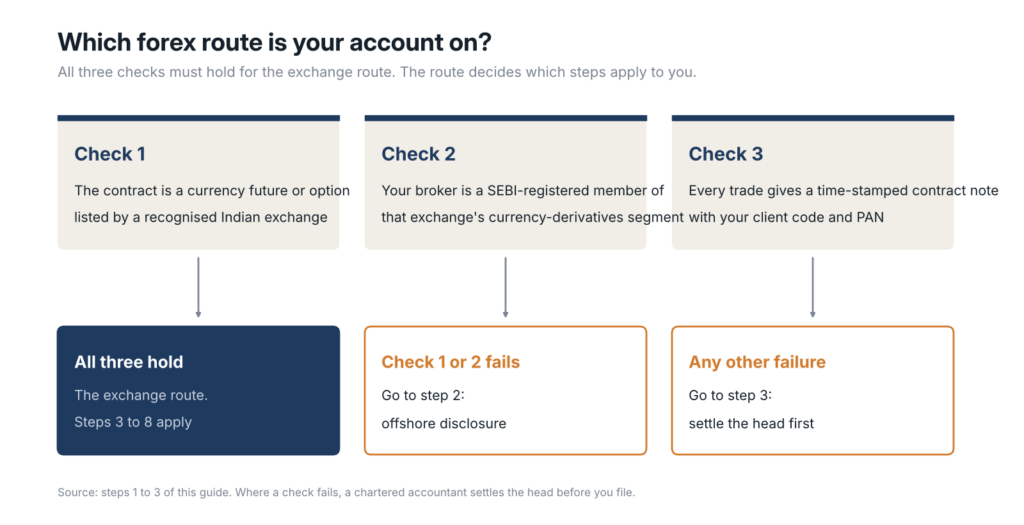
Treat your account as the exchange route only if all three hold:
- The contract is a currency future or option listed by a recognised Indian exchange
- Your broker is a SEBI-registered member of that exchange’s currency-derivatives segment
- Every trade gives you a time-stamped contract note with your client code and PAN
Fail check 1 or 2 on any trade, and it goes to step 2; any other failure goes to step 3.
NSE’s undated contract specification page, read 19 October 2026, lists USDINR, EURINR, GBPINR and JPYINR futures, cash settled in Indian rupees, in units of 1,000 USD, 1,000 EUR, 1,000 GBP and 100,000 JPY. BSE’s Know Your Broker directory gives each member’s name, code and SEBI registration number, though the rows read showed no segment column, and NSE takes membership segment by segment: ask your broker first.
On 30 March 2026, the Finance Ministry told the Lok Sabha that residents may buy or sell foreign exchange only for permissible transactions, and only with RBI-authorised persons. The same reply says no entity can operate an electronic trading platform for foreign-exchange transactions in India without the RBI’s prior authorisation.
Rohit’s note is time-stamped, carries his client code and PAN, names the currency-derivatives segment, and his broker’s SEBI number is in the directory. All three use the exchange route.
My own index CFD trading went through an offshore broker’s own offshore entity while resident in India for tax. This was not a future or option on a recognised Indian exchange, so check 1 sends it to step 2.
2. Decide What You Must Disclose If You Used an Offshore Platform
Answer two questions for the year. Did you hold an account or asset outside India at any time? Did money of yours reach a platform abroad?
A yes to the first question brings three things. Section 139(1) of the Income-tax Act, 1961 (the law for years before 1 April 2026) makes a resident other than a not ordinarily resident with an asset or signing authority abroad file a return anyway. Schedule FA, undated, asks for the country, the asset’s nature and ownership, the account, its value, and income. And under section 43 on assets and income outside India, an officer may direct a penalty of ₹10 lakh on such a resident for wrong or missing particulars in a filed return. Section 43 here is not section 43(5) in step 3. That penalty may not be directed where non-immovable foreign assets total ₹20 lakh or less, from 1 October 2024.
A yes to the second question raises exchange control under the Foreign Exchange Management Act, or FEMA, which tax cannot answer. The SAFEMA Appellate Tribunal upheld an individual’s FEMA contravention for forex-derivative trading on an overseas portal funded by card remittances from 2011 to 2018, about ₹5.21 crore of transactions, per TaxGuru’s summary. It cut the penalty from ₹5.20 crore to ₹20 lakh, noting his losses and absence of profit: one case, not a typical penalty. In the same summary, ignorance of the law was no answer. The Lok Sabha reply also says the Directorate of Enforcement is authorised to investigate suspected FEMA contraventions and to impose penalties; no source read says declaring the profit changes that. For details, check out our page on unauthorised forex trading risks.
Both answers are no for Rohit: one Indian broker, nothing abroad.
3. Choose the Head Your Trading Result Is Reported Under
A head is the category of income a result is taxed under. Report the result as non-speculative business income where step 1’s three checks hold for every trade and each was placed electronically on a screen-based system. Where one check fails, do not pick a head for that trade: let a chartered accountant settle it before you file.
Under section 43(5) of the 1961 Act, an eligible transaction in derivatives on a recognised stock exchange is not deemed speculative. Eligibility has two conditions: step 1’s third check, a time-stamped contract note showing your client identity number and PAN, and the added one that the trade is carried out electronically on screen-based systems through a SEBI-registered intermediary. Section 43(5) is from the 1961 Act, so for a trade, step 4 falls under the 2025 Act; ask your accountant for that Act’s version. Both Acts treat a business made of speculative transactions as distinct and separate from any other business (section 28, 1961; section 26, 2025).
In Vinay Prakash (HUF, a Hindu undivided family) v ACIT, pronounced 26 May 2022, the Delhi ITAT, an income-tax appeals tribunal, held that currency-derivative trades on the BSE currency segment through a SEBI-registered broker met that proviso. The loss was therefore not speculative, whereas the officer and the first appeal had called it speculative and usable only against speculative profit.
Rohit’s notes pass step 1’s three checks and his trades were placed on screen, so the step 5 profit is non-speculative business income.
4. Work Out Which Act and Which Year You Are Filing
From this article’s reading, take the date each trade closed. In financial year 2025-26, which ended on 31 March 2026: the Income-tax Act, 1961, assessment year 2026-27, the old forms. On or after 1 April 2026: the Income-tax Act, 2025, tax year 2026-27, and trades on both sides mean two returns. A trade still open at 31 March 2026 is one for your accountant.
A tax year is the twelve months of the financial year beginning 1 April, replacing “previous year”; “assessment year” is discontinued. The 1961 Act still governs every tax year that began earlier, the department says.
| WHAT THE YEAR IS CALLED | WHICH ACT | WHICH RETURN | WHEN IT IS DUE |
|---|---|---|---|
| Assessment year 2026-27 (income of 2025-26) | The 1961 Act | The old forms | In 2026, step 8 picks the day |
| Tax year 2026-27 (income of 2026-27) | The 2025 Act | Its own return | Not due until July 2027 |
The portal’s notice on payment challans says that a payment for a period before tax year 2026-27, such as assessment year 2026-27, falls under the 1961 Act. Rohit’s last trade closed in March 2026: assessment year 2026-27 under the old Act, with advance tax on the year in progress under the new one.
5. Work Out the Tax on Top of Your Salary
Section 37(1) of the 1961 Act allows spending laid out wholly and exclusively for the business, apart from capital and personal items, and names no trading cost: ask your accountant which of yours qualifies. NSE’s pages, undated, read 19 October 2026, list GST of 18% on broker services, collected from clients, and stamp duty of 0.0001% on currency derivatives, payable by the buyer.
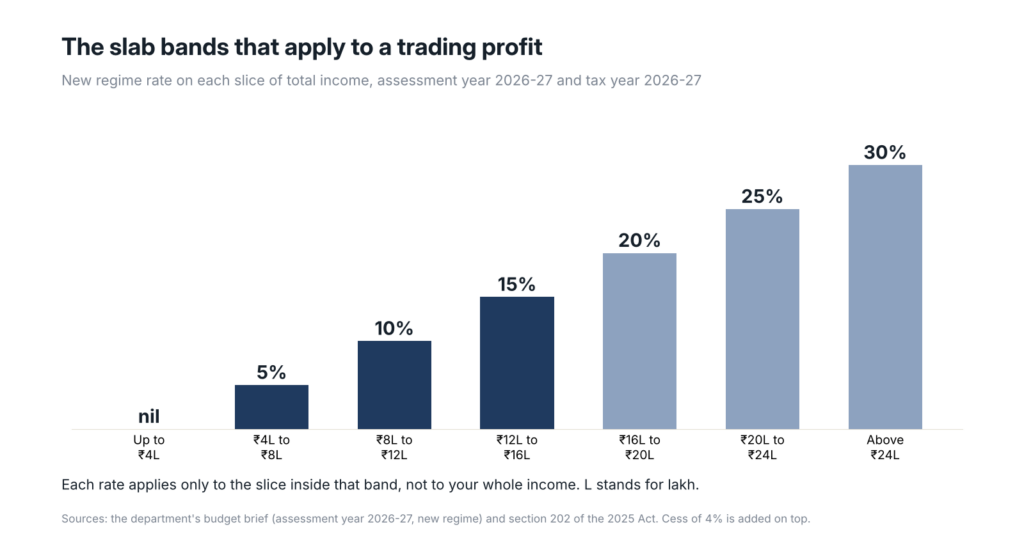
Rohit’s return is for assessment year 2026-27, so his bands are the first column below: the department’s budget brief for that year, new regime. The old regime stays open for it (tax rates), unused here. The second column is the year in progress, where section 202 of the 2025 Act makes the new regime the default. With business income, you opt out only by the return due date, and may withdraw once. The page does not show whether the Finance Act, 2026 changed them.
| BAND | ASSESSMENT YEAR 2026-27, NEW REGIME | TAX YEAR 2026-27 (SECTION 202) |
|---|---|---|
| up to ₹400,000 | nil | nil |
| ₹400,000 to ₹800,000 | 5% | 5% |
| ₹800,000 to ₹1,200,000 | 10% | 10% |
| ₹1,200,000 to ₹1,600,000 | 15% | 15% |
| ₹1,600,000 to ₹2,000,000 | 20% | 20% |
| ₹2,000,000 to ₹2,400,000 | 25% | 25% |
| above ₹2,400,000 | 30% | 30% |
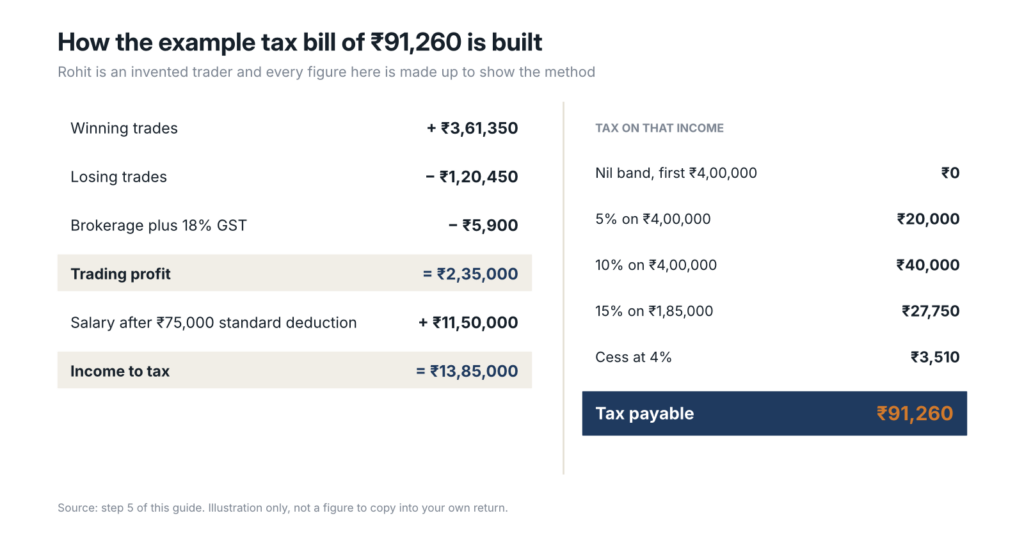
Suppose his notes show losing trades of ₹120,450, with winners three times that: 3 × ₹120,450 = ₹361,350. Net, ₹361,350 − ₹120,450 = ₹240,900. Say brokerage was ₹5,000, a cost the example assumes his accountant accepts, with its GST, which adds 18% of ₹5,000 = ₹900. Stamp duty is left out. Broker cost: ₹5,000 + ₹900 = ₹5,900. Trading profit: ₹240,900 − ₹5,900 = ₹235,000. A salaried taxpayer’s ₹75,000 standard deduction comes off salary first (m.Stock, a broker, 30 July 2026, new regime, financial year 2025-26). If his salary was ₹1,225,000: ₹1,225,000 − ₹75,000 = ₹1,150,000. Income to tax: ₹1,150,000 + ₹235,000 = ₹1,385,000.
The nil band takes the first ₹400,000. Next slice: ₹800,000 − ₹400,000 = ₹400,000, costing 5% of ₹400,000 = ₹20,000. Next: ₹1,200,000 − ₹800,000 = ₹400,000, costing 10% of ₹400,000 = ₹40,000. Last: ₹1,385,000 − ₹1,200,000 = ₹185,000, costing 15% of ₹185,000 = ₹27,750. Add: ₹20,000 + ₹40,000 = ₹60,000, then ₹60,000 + ₹27,750 = ₹87,750. Cess of 4% adds 4% of ₹87,750 = ₹3,510, so his tax is ₹87,750 + ₹3,510 = ₹91,260. No rebate: the ₹60,000 rebate stops at ₹1,200,000 of taxable income, and the tax-rates page starts surcharge at ₹50 lakh.
6. Decide Whether You Need a Tax Audit, and How to Count Turnover
In Sanjay Marotrao Modak v DCIT, an order of 21 November 2022 on equity futures and options, the ITAT Mumbai recorded ICAI’s, the chartered accountants’ institute’s, method: favourable and unfavourable differences added together, plus premium received on sale of options and differences on reverse trades, each buy and each sell an independent transaction across the year. For want of a statutory rule, it relied on that guidance note, and deleted a section 271B penalty. Currency derivatives are not covered: ask a chartered accountant how to count yours.
Under section 44AB of the 1961 Act, turnover at or under ₹1 crore needs no audit under that clause. Above it, an audit is needed, unless cash receipts and cash payments are each within 5%, in which case the limit is read as ₹10 crore. Under section 63 of the 2025 Act, it is ₹1 crore, subject to clause (b), whose higher limit is for your accountant.
Section 44AD of the 1961 Act lets a resident individual, HUF, or partnership firm declare profit on a presumed basis, where an eligible business has turnover up to ₹2 crore. The limit is ₹3 crore where cash receipts are within 5%. Section 44AB does not apply while you declare under it. Declaring profit outside it within five assessment years brings in section 44AB(e), an audit above the maximum amount not chargeable to tax, and a five-year lock-out. Its exclusions name commission, brokerage, and agency business, not derivatives, so a currency trader’s case is left open; ask your accountant.
Only as an assumption, to show the sum, the example uses the ICAI method for his currency futures: ₹361,350 + ₹120,450 = ₹481,800, so no audit on that clause, and he has never declared under the scheme.
7. Plan the Advance Tax You Pay During the Year
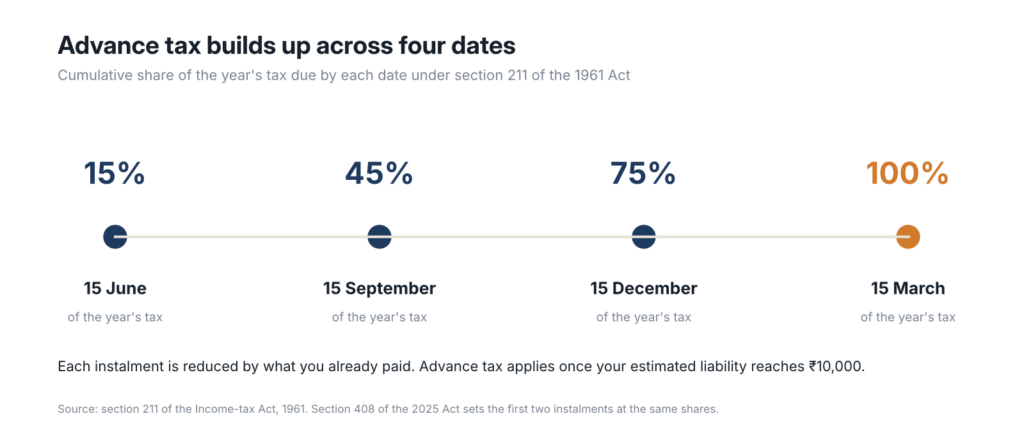
If your estimated tax liability for the year is ₹10,000 or more, the department’s explainer on the 1961 Act says you must pay advance tax. The same page elsewhere words it as “exceeds ₹10,000”, so an estimate on the line is one for your accountant. Section 211 of the 1961 Act sets them cumulatively: not less than 15% by 15 June and 45% by 15 September. Then 75% by 15 December, and the whole amount by 15 March, each reduced by what you paid before.
Section 408 of the 2025 Act sets the first instalment at not less than 15% by 15 June and the second at not less than 45% by 15 September. Its later instalments are for your accountant.
Section 234B of the 1961 Act charges simple interest of 1% for every month or part of a month where advance tax went unpaid, or fell below 90% of the assessed tax.
As an illustration under the 2025 Act’s rule, ignoring tax deducted at source, if the year in progress looks like the one he filed, his total paid by 15 September must reach 45% of ₹91,260 = ₹41,067, so the instalment is that total less what he paid by 15 June.
8. Pick Your Form and Deadline, and Keep a Loss Alive
For assessment year 2026-27, the department’s page says ITR-3 applies to an individual or HUF with business income who is not eligible for ITR-1, ITR-2 and ITR-4. A foreign asset rules out ITR-1, a loss you want to carry forward rules out ITR-4, and the nudge page says foreign assets bar both. The 1961 Act’s dates for that year are 31 July, or 31 October if your accounts must be audited, subject to any Board extension. By October 2026, 31 July has passed: if you have not filed, ask an accountant. For tax year 2026-27, the department says new forms will be notified before the due dates.
Under the 1961 Act, a non-speculative business loss is set off against business profits and carried forward up to eight assessment years; a speculation loss is set off only against speculation profit, for four. 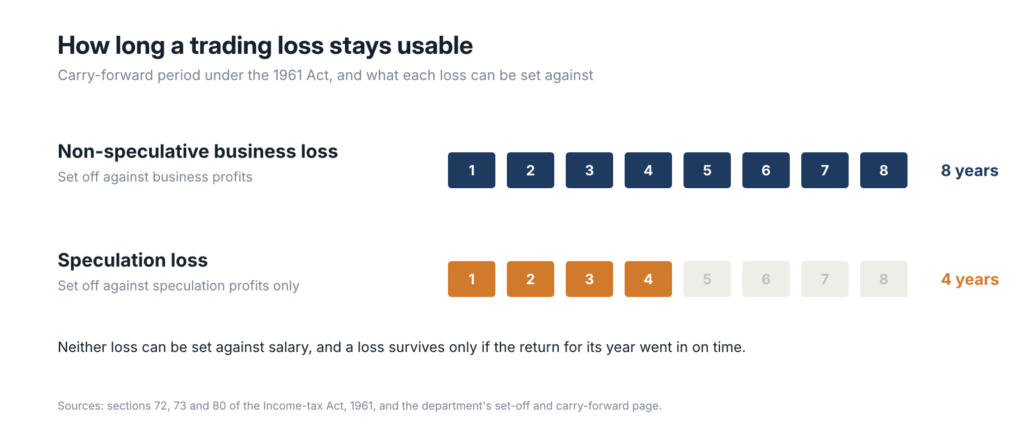
Neither comes off salary, and a loss survives only if the return for its year went in on time: one not determined in such a return cannot be carried forward. The department says a loss brought forward from a tax year that began before 1 April 2026 is carried forward, as the 1961 Act’s matching provisions say, counted from its original year.
Rohit files for assessment year 2026-27 on ITR-3: business income, and no presumptive profit. Step 6 put him outside audit, so his date was 31 July 2026, and he filed on it with nothing to carry. Had he lost a fifth of his profit instead, ₹235,000 ÷ 5 = ₹47,000, filed on time, that loss would wait for business profit and never touch salary.
The Bottom Line on Forex Trading Tax in India
The short answer is conditional. The broker m.Stock says income treated as business income is usually taxed at the slab that applies; step 3’s test and your accountant decide whether your result is business income. Rohit’s ₹91,260 is the example’s invented figure. So open one note today, run step 1’s three checks, and write down each closing date. Rules for other market and crypto are their own subjects; more forex guides are here.
Frequently Asked Questions
Which currency pairs can I trade on an Indian exchange?
NSE’s undated page, read 19 October 2026, lists the four rupee pairs of step 1 and cross-currency futures on EURUSD, GBPUSD and USDJPY, cash settled in rupees, NSE states.
Do I pay GST on my trading profit?
The broker m.Stock’s page of 30 July 2026 says individual traders do not usually pay GST on personal trading profits alone, though GST may apply to brokerage or service charges.
Will my trades show up in my AIS?
Your trades may not all show. The department says the Annual Information Statement holds the information presently available with it, that other transactions may not show, and that you must report fully and accurately.
Is there a scheme for a foreign account I never disclosed?
There is a tax scheme for undisclosed foreign assets; the department’s FAQ does not say whether profit on an unauthorised platform fits it, and it is not an exchange-control fix. Under the Foreign Assets of Small Taxpayers Disclosure Scheme, 2026, a Category 1 declaration pays 30% plus an equal further amount, an effective 60% of what is declared. Category 1 covers an undisclosed foreign asset, valued at 31 March 2026, and income together of ₹1 crore or less, declared from 16 August to 31 December 2026.
When is the audit report due, and in which form?
One month before the return: Section 44AB of the 1961 Act sets the specified date as one month before the due date under Section 139(1). For tax year 2026-27, the department says the report is filed in Form No. 26 under the Income Tax Rules, 2026, merging Forms 3CA, 3CB and 3CD, due on 30 September 2027.
About Author