Robert J. Williams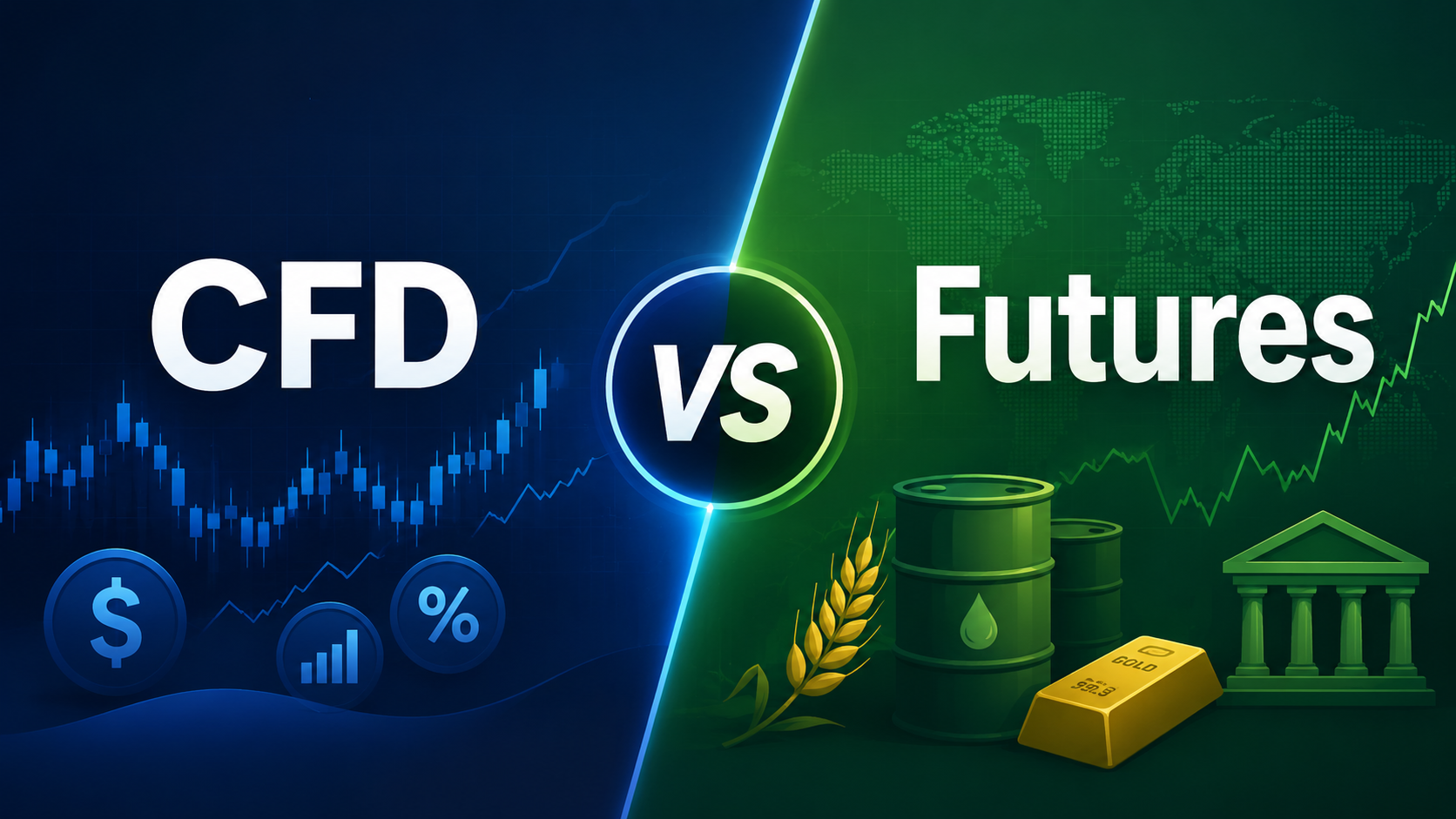
CFD vs futures, in one line: both let you trade price moves with leverage, but CFDs are off-exchange contracts with your broker, while futures are standardised contracts traded on a regulated exchange.
Key Takeaways
- Leverage is capped for retail CFD traders in the UK and EU (30:1 down to 2:1), while futures leverage is set by the exchange margin on each contract.
- Costs differ in shape: CFDs charge spreads plus daily overnight financing, while futures charge a commission and exchange fees with no overnight funding.
- Tax is the big divider. In the US, futures get the 60/40 split under Section 1256; CFDs don’t (and aren’t even available to US retail traders). In the UK, both are usually taxed as capital gains.
- There’s no universal winner. CFDs suit smaller, shorter-term retail accounts, while futures suit larger, longer-horizon or tax-sensitive traders.
If you trade indices, gold, or oil, the CFD vs futures question lands on your desk sooner or later. Both products track the same underlying markets and both use leverage, so on the surface they look interchangeable. They aren’t. The differences in tax treatment, leverage limits, and cost structure can quietly decide whether a strategy is profitable. Here’s how the two stack up, with the numbers that actually matter.
CFD vs futures: the short answer
CFDs and futures are both leveraged derivatives, but they sit in different worlds: CFDs trade over-the-counter directly with a broker, while futures trade on a centralised exchange. That structural split is worth taking seriously, given EU regulators found 74–89% of retail CFD accounts lose money (ESMA, 2018). Pick the instrument that matches your account size, holding period, and tax residence.
Use this as a rough guide before we get into the detail:
| If you… | Lean toward |
|---|---|
| Trade small size, hold for hours or days | CFDs |
| Want a fixed, transparent cost per contract | Futures |
| Are a US-based retail trader | Futures (CFDs aren’t available to you) |
| Want the US 60/40 tax break | Futures |
| Want to trade niche markets with tiny stakes | CFDs |
What is a CFD?
A contract for difference (CFD) is an agreement between you and a broker to exchange the difference in an asset’s price between opening and closing a trade, without ever owning the asset. You can go long or short, and you trade on margin. There’s no expiry date, so a position stays open until you close it or get stopped out.
That flexibility is why CFDs are popular with retail traders. You can open a position on the FTSE 100, Brent crude, or a single US share from one account, often with a small deposit. The trade-off is that your broker is your counterparty, and pricing comes from that broker rather than a central market. If you’re new to the mechanics, our guide to the advantages of CFD trading breaks down how they compare to owning the underlying outright.
What is a futures contract?
A futures contract is a standardised, exchange-traded agreement to buy or sell an asset at a set price on a set future date. The contract size, tick value, and expiry are fixed by the exchange, not negotiated with a broker. A standard Micro E-mini S&P 500 contract, for example, carries a multiplier one-tenth the size of the full E-mini (CME Group, 2026).
Because futures clear through a central exchange, your counterparty is effectively the clearinghouse rather than a single broker. That lowers counterparty risk and makes pricing transparent: everyone sees the same quote. The catch is expiry. Hold past the contract’s expiration and you either settle or roll into the next contract, which means planning around the calendar in a way CFD traders never have to.
CFD vs futures: the key differences
The structural gap between the two products shows up across six dimensions, and the single biggest one is where they trade: CFDs are over-the-counter, futures are exchange-traded. We pulled the comparison below from broker contract specs and exchange documentation we reviewed in June 2026; it captures what changes when you switch from one to the other.
| Feature | CFDs | Futures |
|---|---|---|
| Where it trades | Over-the-counter, with a broker | Centralised exchange |
| Expiry | None — hold indefinitely | Fixed expiration date |
| Standardisation | Flexible, custom position sizing | Standardised contract sizes |
| Main costs | Spread + overnight financing | Commission + exchange fees |
| Capital to start | Low | Higher (though micro contracts help) |
| Counterparty risk | Higher (the broker) | Lower (the clearinghouse) |
Read that table as a map of trade-offs, not a scoreboard. The OTC model gives CFDs their accessibility and their flexibility on size. The exchange model gives futures their transparency and their lower counterparty risk. Neither is strictly better, which is exactly why the tax and cost sections below tend to settle the argument.
Leverage: how CFDs and futures differ
Retail CFD leverage is capped by regulators, while futures leverage is governed by exchange margin instead. In the UK and EU, retail CFD leverage runs from 30:1 on major currency pairs down to 2:1 on cryptocurrencies. Futures leverage isn’t capped by a flat ratio at all. It comes from the margin the exchange sets per contract, so your effective leverage shifts with the contract’s notional value rather than a regulator’s table.
[IMAGE 01: Bar chart of UK/EU retail CFD leverage caps by asset class, from 30:1 on major forex pairs down to 2:1 on crypto — file: assets/pippenguincfd-vs-futuresen__2026-06-30/01-esma-leverage-caps.png]
Those CFD caps weren’t always there. They came in after regulators looked at how retail traders were actually faring and decided accounts needed a floor of protection.
“The agreed measures ESMA is announcing today will guarantee greater investor protection across the EU by ensuring a common minimum level of protection for retail investors.”
— Steven Maijoor, Chair, ESMA (ESMA, 2018)
Futures work differently because margin is tied to a contract’s notional value rather than a flat ratio. Micro contracts have narrowed the old gap, letting traders control a fraction of a standard contract for a much smaller deposit. If you want the mechanics of how exchange margin translates into buying power, our explainer on leverage in futures trading walks through the maths. Either way, more leverage cuts both directions, and on a leveraged loss it cuts faster than most beginners expect.
Costs: spreads and financing vs commissions and exchange fees
Cost is where short-term and long-term traders pull apart, because CFD financing accrues daily while futures charge mostly at entry and exit. A CFD position keeps racking up overnight financing for every day you hold it, on top of the spread baked into each trade. Futures front-load their cost into a commission plus exchange and regulatory fees, with no daily funding charge.
When we compared broker fee schedules across several CFD providers and futures brokers in 2026, the pattern was consistent. For a trade you open and close inside a day, CFD costs are often lower and simpler — one spread, no commission. Hold for weeks, and those nightly financing charges stack up until futures, with their one-off commission, come out cheaper. There’s also the roll cost on futures: stay in the market across an expiry and you pay to move into the next contract.
So the honest answer to “which is cheaper” is: it depends on how long you hold. Scalpers and day traders usually find CFDs friendlier on cost. Swing and position traders holding for weeks or months usually find futures cheaper once financing is in the picture. Map the cost structure to your actual holding period, not to a headline spread.
Tax: how CFDs and futures are taxed
Tax is the one area competitors skip, and it can swing your net return more than a pip of spread ever will. The headline: in the US, regulated futures get favourable 60/40 treatment under Section 1256, where 60% of gains are taxed at the long-term rate and 40% at the short-term rate, regardless of holding period (Cornell LII, 26 U.S. Code §1256). CFDs get no such break — and US retail traders can’t legally trade them anyway.
Here’s how the two products line up across the two jurisdictions most PipPenguin readers ask about:
| CFDs | Futures | |
|---|---|---|
| US | Not available to US retail traders | Section 1256: 60/40 split, effective top rate near 26.8% vs 37% ordinary (Schwab, 2026) |
| UK | Usually Capital Gains Tax; CFDs are treated as financial futures (HMRC CG56100) | Usually Capital Gains Tax |
| EU | Varies by member state | Varies by member state |
A couple of practical notes. In the UK, HMRC treats CFDs as financial futures, so profits usually fall under Capital Gains Tax rather than income tax for most non-professional traders (HMRC CG56100). Spread betting, a close cousin of CFD trading, is currently exempt from CGT because HMRC treats it as gambling, which is one reason UK traders sometimes prefer it. None of this is tax advice, and the rules shift, so confirm your own position with a qualified adviser or your national tax authority before you trade.
Which should you choose? CFDs vs futures by trader type
There’s no single winner in the CFD vs futures debate. The right pick depends on your capital, time horizon, and where you pay tax, which is why even regulators frame these as different tools for different traders. Match the instrument to your situation rather than chasing whichever looks cheaper on a single trade.
Choose CFDs if you:
- Trade smaller size and want low entry capital
- Hold positions for hours or days, not months
- Want access to a wide range of niche markets from one account
- Trade through a UK, EU, or other regulated retail account where CFDs are available, such as one at a regulated CFD broker like Pepperstone
Choose futures if you:
- Trade larger size or hold for weeks and months
- Want transparent, exchange-set pricing and lower counterparty risk
- Are a US trader, or want the 60/40 tax treatment
- Use a futures-capable broker such as Interactive Brokers
Plenty of traders use both: CFDs for quick, small, tactical positions, and futures for larger core trades where cost and tax efficiency matter most.
The bottom line on CFDs vs futures
The CFD vs futures choice comes down to three numbers: the leverage you’re allowed, the cost of holding, and the tax you’ll pay on the way out. CFDs reward smaller, shorter-term retail traders with flexibility and low entry costs. Futures reward larger, longer-horizon traders with transparent pricing and, in the US, a real tax advantage. Both are leveraged products that can lose money fast, so size your positions for the downside, not the dream. If you’re still deciding between brokers, start with our leverage in futures trading guide to see how margin shapes your real buying power.
Frequently asked questions
1. Are CFDs the same as futures?
No. Both are leveraged derivatives that track an underlying market, so they look similar on a price chart, but the plumbing is different. CFDs are off-exchange contracts with your broker that never expire, while futures are standardised contracts traded on a regulated exchange with a fixed expiry date. The pricing source, your counterparty, and the way costs are charged all differ between the two.
2. Which has higher leverage, CFDs or futures?
It depends on your region and the market you trade. Retail CFD leverage in the UK and EU is capped between 30:1 and 2:1 depending on the asset class (FCA, 2020). Futures leverage isn’t set by a flat cap. It comes from the margin the exchange requires per contract, and micro contracts now let you trade a fraction of a standard contract for a far smaller deposit.
3. Are CFDs or futures cheaper to trade?
Your holding period decides it. For short holds, CFDs are usually cheaper because you mostly pay the spread and close before financing piles up. For longer holds, futures tend to win, since CFDs charge daily overnight financing that compounds the longer you stay in, while futures lean on a one-off commission plus exchange fees. Match the cost structure to how long you actually hold.
4. Can US traders trade CFDs?
No. CFDs aren’t available to US retail traders, because under the Dodd-Frank Act they count as off-exchange swaps that can’t legally be offered to retail clients (FCA context, 2020). US traders who want leveraged exposure to indices, commodities, or currencies typically use futures or regulated forex instead. That’s also why the US tax comparison in this guide applies to futures, not CFDs.
5. How are CFDs and futures taxed differently?
In the US, regulated futures fall under Section 1256 and get the 60/40 tax split, where 60% of gains are taxed at the long-term rate and 40% at the short-term rate; CFDs don’t qualify (Cornell LII, §1256). In the UK, both are usually taxed as capital gains, with CFDs treated as financial futures by HMRC. Tax rules change and depend on your status, so always check your own jurisdiction.
Risk warning: Trading CFDs and futures involves a high risk of losing money rapidly due to leverage. EU regulators found that 74–89% of retail CFD accounts lose money. This article is educational and is not financial or tax advice. Figures are accurate as of June 2026.
About Author