5 Swing Trading Strategies for Beginners (With Examples)
 Robert J. Williams
 Alexandra Winters
Key Takeawys
- Swing trading holds a position for days to a few weeks, longer than a day trade and shorter than a position trade.
- Five strategies cover most of what a beginner needs: trend following, breakout, support/resistance, momentum (RSI), and Fibonacci retracement.
- Trend following is the easiest entry point: one moving average, one clear signal.
- Cap risk at 1-2% of your account per trade. That single rule matters more than which strategy you pick.
- Swing trades carry overnight and weekend gap risk that day trades don’t.
Trading involves risk of loss and isn’t right for everyone. Nothing here is personalized financial advice, just education.
Swing trading strategies aim to capture a single meaningful price move, a “swing,” over a few days to a few weeks. That’s longer than the same-day moves a day trader chases, and shorter than the years-long holds of a buy-and-hold investor. For a beginner, the real challenge usually isn’t finding a strategy. It’s picking one simple enough to follow consistently, then pairing it with risk rules that keep a bad streak from wiping out the account. This guide covers five swing trading strategies for beginners, with examples of each, plus the risk rule that matters more than any of them.
What Is Swing Trading?
Swing trading is a trading style that holds a position for more than a day but less than a month (Pepperstone, 2024). It uses technical analysis to catch a single intermediate price move rather than betting on a company’s long-term fundamentals. The name describes the goal, not a fixed time limit: a trader spots a swing already underway, or about to start, and rides it from entry to a planned exit.
Positions stay open overnight, and sometimes over a weekend, unlike day trading. They rarely stay open for months, unlike position trading. If trading itself still feels fuzzy, our guide to what trading actually involves is worth reading first.
Types of Trading: Where Does Swing Trading Fit?
Day trading, swing trading, and position trading differ mainly in one variable: how long a position stays open. A day trader closes everything before the market shuts. A position trader might hold for months or years. Swing trading sits in the middle, typically running from a couple of days to a few weeks.
That middle ground is what makes swing trading appealing to someone with a day job. A day trader needs to watch price action for hours at a stretch. A swing trader can set an order, check it once or twice a day, and get on with everything else (Pepperstone, 2024).
The trade-off is gap risk: news that breaks while the market is closed can move a stock well past your stop-loss by the next morning, a risk day traders don’t carry. See our guide to types of traders for a fuller side-by-side of scalpers, day traders, swing traders, and position traders.
The 5 Core Swing Trading Strategies to Learn First
Trend following, breakout, support/resistance, momentum, and Fibonacci retracement cover the large majority of swing setups a beginner will actually run into (Pepperstone, 2024). More advanced approaches exist too, like trading around the Commitment of Traders report or anchoring entries to VWAP, but they demand data and screen time most beginners don’t have yet. Most of what follows is read off the daily chart. See our guide on choosing a time frame for swing trading if you’re deciding between daily, 4-hour, and weekly charts.
Trend Following
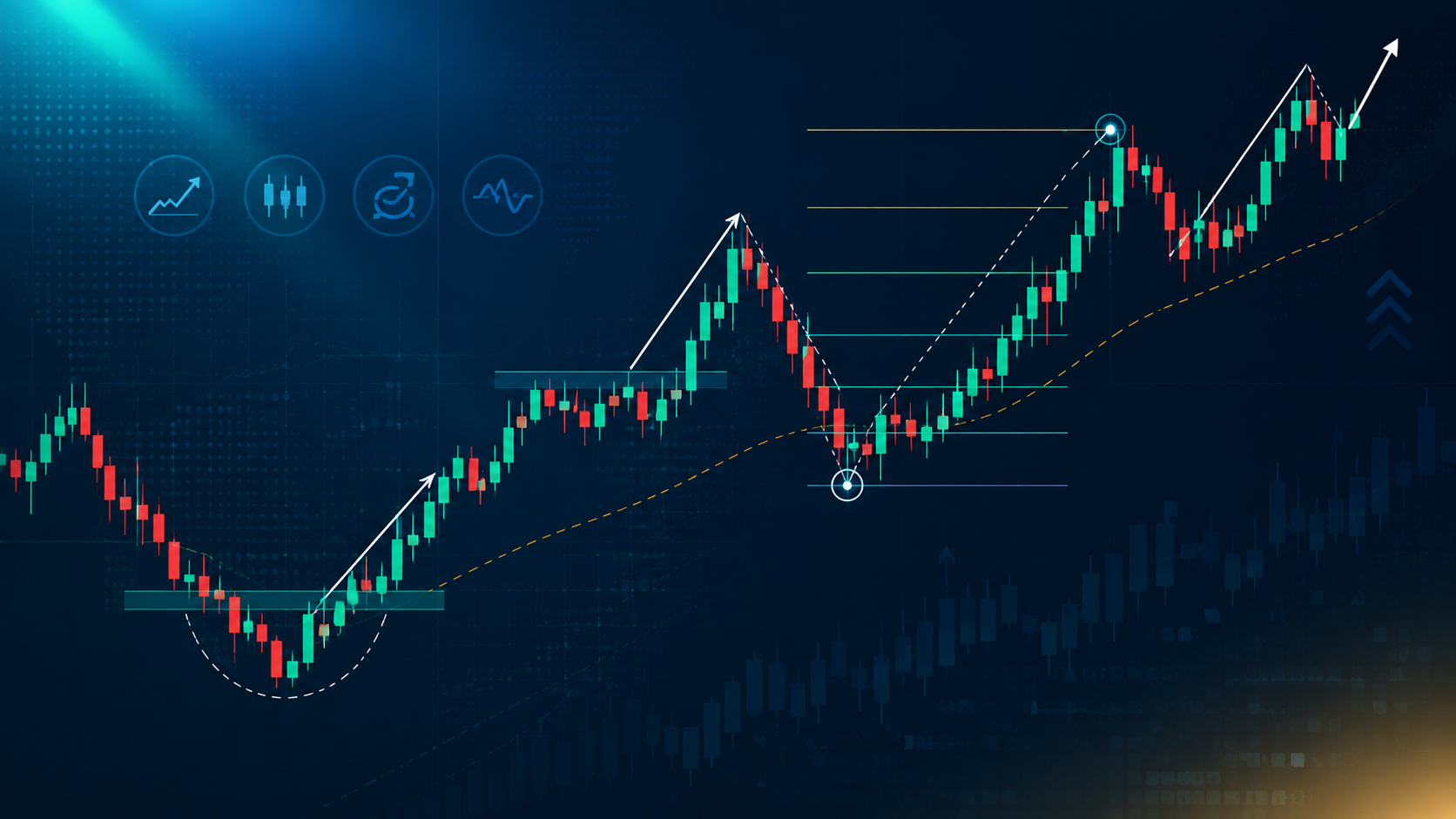
Trend following enters in the direction of an established trend and exits once that trend shows real signs of turning, using moving averages as the main signal (Pepperstone, 2024). Picture a stock that’s climbed steadily above its 50-day moving average for two months: a trend follower buys a shallow dip toward that average and holds until price closes decisively below it.
It’s the most forgiving strategy here, since the trend does most of the work rather than precise timing. Our guide to moving averages for swing trading covers which periods to use.
Breakout
Picture a stock that’s spent three weeks trading between $48 and $52. A breakout trader waits for a close above $52 on above-average volume, betting the move continues instead of stalling, then enters with a stop just under the old resistance (TradingSim, 2026).
Most breakouts don’t hold, though: one widely cited estimate puts the failure rate at 60-70% (TradingSim, 2026), so the stop placement matters as much as the entry itself.
Support and Resistance
Where a breakout trade bets that a range finally gives way, support and resistance trading bets the opposite: that the same $48-$52 range holds a while longer (Pepperstone, 2024). It buys near the floor and sells near the ceiling, repeating the trade each time price revisits those levels.
It only works while the range holds, since a breakout flips the two strategies into betting on opposite outcomes.
Momentum (RSI)
An RSI reading below 30 generally signals oversold, and above 70 signals overbought (Pepperstone, 2024). Momentum trading uses that oscillator, or a similar one like the stochastic, to enter once a stock is gaining speed and exit before it stalls out.
This works best on stocks already moving. Applied to a quiet, sideways stock, RSI just churns near 50 with nothing useful to act on.
Fibonacci Retracement
If a stock rallies from $180 to $210, a Fibonacci trader doesn’t chase the top. They wait for the pullback toward one of a handful of mathematically derived levels, most often 38.2%, 50%, or 61.8% of the prior move (TradingSim, 2026). Support often forms around $198 or $195 before the trade goes back on.
It’s really a trend-following variant. The Fibonacci levels just give a more precise entry than “buy the dip” alone.
| Strategy | Core tool | Typical hold | Best for |
|---|---|---|---|
| Trend following | 20- and 50-day moving averages | Days to weeks | Beginners, markets already trending |
| Breakout | Support/resistance level + volume | A few days | Volatile, high-volume stocks |
| Support & resistance | Horizontal price levels | Days | Sideways, range-bound markets |
| Momentum (RSI) | RSI / stochastic oscillator | Days | Fast-moving stocks with clear momentum |
| Fibonacci retracement | Fibonacci retracement levels | Days to weeks | Pullbacks inside an existing trend |
Not every stock suits every strategy. Liquid, actively-traded names work best across all five, and our guide on selecting stocks for swing trading covers the volume and liquidity thresholds to check first. For a first strategy, trend following has the shortest learning curve: one moving average, one signal, one trend doing most of the work for you.
How Much Should You Risk on a Swing Trade?
Cap it at 1-2% of total account capital on any single position (Pepperstone, 2024), with more conservative traders sticking closer to 1%.
Pepperstone puts the ceiling at 2%, and TradingSim allows up to 4% for more aggressive traders (TradingSim, 2026). Cory Mitchell, CMT, a Chartered Market Technician who has traded professionally since 2005, argues for something closer to 1%. As Mitchell explains it, strategy and market experience can’t make up for poor risk control. Protecting capital is what separates traders who last from those who blow up an account within months (Trade That Swing, 2026).
Position size follows from that percentage, not the other way around. A $10,000 account risking 1% ($100), with a stop-loss $2 below the entry price, caps the position at 50 shares, no more, regardless of how good the setup looks. Stops for long positions typically sit just below the most recent swing low. Stops for short positions sit just above the most recent swing high.
In our experience, the beginners who are still trading a year in are rarely the ones running the most sophisticated strategy. They’re the ones who never skip this step.
Common Mistakes Beginners Make in Swing Trading
When we talk to traders who are just getting started, the same handful of mistakes come up again and again, and almost none of them are about picking the wrong strategy.
- No stop-loss. A trade without a predetermined exit isn’t a swing trade. It’s a hope. Set the stop before entering, not after the position starts moving against you.
- Risking too much per trade. Sizing a position off gut feeling instead of the 1-2% rule above turns one bad trade into a real setback.
- Ignoring gap risk. A stop-loss order doesn’t fill at your exact price when a stock gaps past it overnight. It fills at the next available price, which can land meaningfully worse than planned.
- Chasing a breakout after it’s already moved. Buying a stock that’s already up 8% on breakout day usually means paying for a move that’s mostly over.
- Trading too many positions at once. A stock screener helps narrow the list, but even a good one can’t compensate for holding more open trades than you can actually track.
The Bottom Line on Swing Trading Strategies
Swing trading strategies work by capturing a single price swing over days to weeks. The five approaches here (trend following, breakout, support/resistance, momentum, and Fibonacci retracement) cover most of what a beginner needs to start reading a chart with intent. Which one you pick matters less than whether you consistently cap risk at 1-2% per trade and actually honor your stop-loss. That discipline is what separates traders still trading in a year from those who aren’t.
Start with a demo account, pick one strategy from this list, and give it enough trades to judge fairly before switching to another. If you’re ready to open an account, our Pepperstone review and Interactive Brokers review both cover brokers well suited to swing trading across different markets.
Frequently Asked Questions
1. What’s the best swing trading strategy for beginners?
Trend following is the most common starting point, since it only asks you to read a moving average rather than time a precise breakout or reversal. It won’t do much in a sideways market, though, which is why most beginners check the broader daily or weekly trend before committing to an entry.
2. What’s the difference between swing trading and day trading?
Day traders close every position before the market closes, so they carry no overnight risk but need to watch the screen for hours at a stretch. Swing traders accept overnight and weekend gap risk in exchange for a much lighter time commitment, holding a position for days to weeks instead of minutes to hours (Pepperstone, 2024).
3. How long do you hold a swing trade?
Most swing trades run somewhere between two days and a few weeks. If a position is still open after a month, it has quietly turned into a position trade, whether that was the plan or not. The exit should be decided by price hitting a target or stop-loss, not by how many days have passed on the calendar.
4. How much money do you need to start swing trading?
There’s no fixed minimum to start swing trading stocks, unlike the pattern-day-trading rules that apply to frequent day trades. A few thousand dollars is usually enough to size positions sensibly under the 1-2% risk rule, since anything smaller forces trade sizes so tiny that commissions and rounding eat into any edge the strategy has.
5. Is swing trading profitable?
It can be, but so can any strategy applied with discipline, and so can none of them without real risk management. There’s no independent, audited data on average swing-trader returns the way there is for mutual funds. Regulators have warned that short-term trading strategies carry meaningful risk of loss for retail investors (SEC Office of Investor Education and Advocacy, 2021). The risk rules above matter as much as the strategy itself.
About Author