Alexandra Winters
High-frequency trading firms compete on speed, often placing their computers close to an exchange’s servers. Retail traders sometimes try to use a different advantage: delays in a broker’s price feed. However, brokers may prohibit trading on these price differences, regardless of the strategy used.
Key Takeaways
|
What Is High Frequency Trading?
High-frequency trading (HFT) is a firm’s automated trading built around speed. MiFID II, the EU’s main law on investment firms and trading venues, defines it for EU firms by three features together:
- Lower latency: the firm cuts latency, the delay before an order or price arrives, with tools such as co-location (its servers inside or beside the exchange’s).
- Automated decisions: software makes trading decisions and places, routes, or executes orders without a person making each decision.
- High message volume: the system sends, changes, and cancels a large number of orders and quotes throughout the trading day.
In the US, the Securities and Exchange Commission (SEC) chose no single, precise definition in 2010.
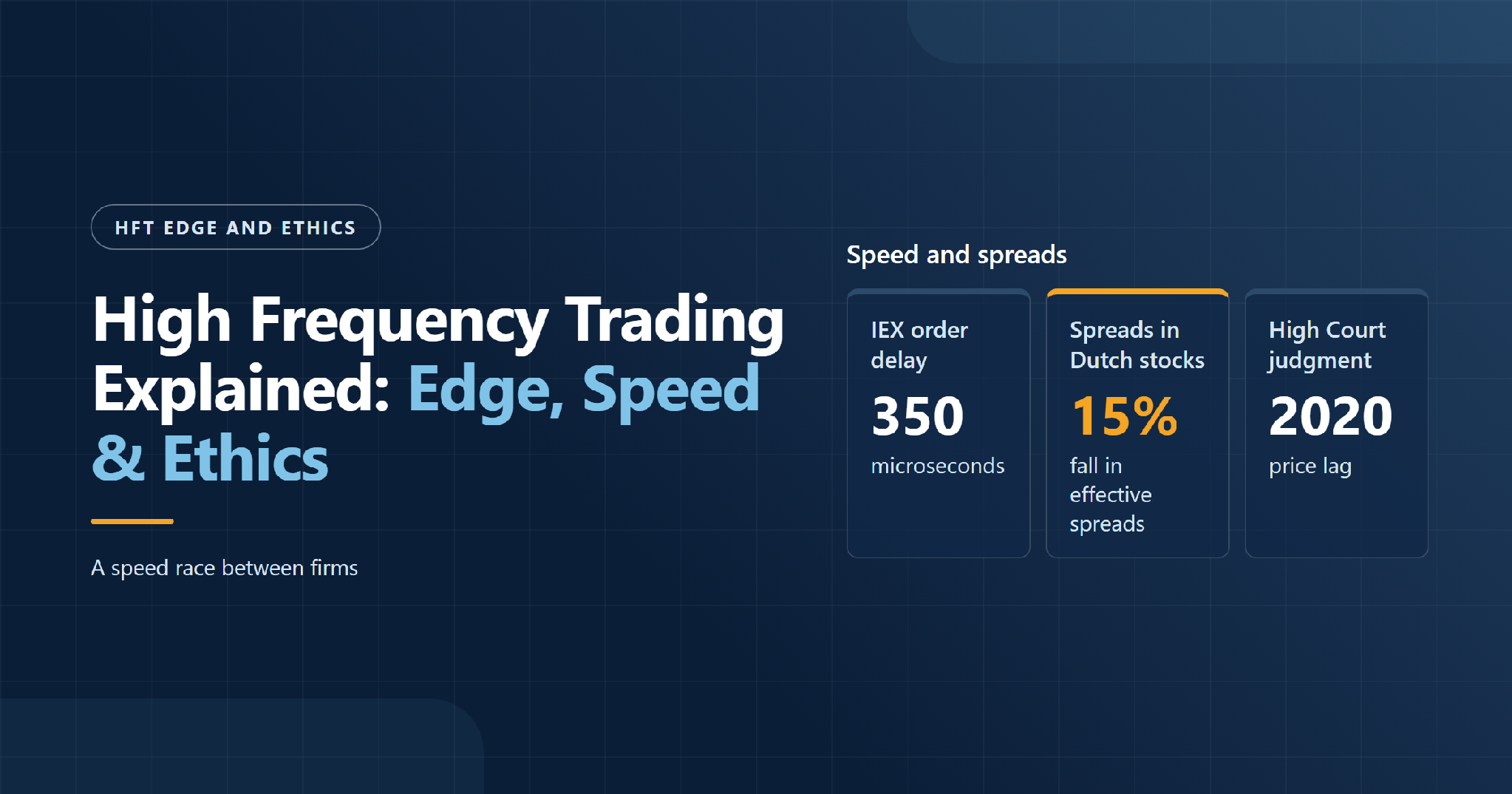
Charles Schwab describes HFT as often measured in milliseconds (thousandths of a second) or microseconds (millionths of a second). For scale, IEX, a US stock exchange, delays non-routable orders by 350 microseconds on the way into its order-matching system and 350 on the way out, a 700-microsecond round trip. In June 2016, the SEC ruled that “immediate” in its quote rule allows delays too short to defeat the rule’s purpose, though it declined to set a numeric threshold. Even this deliberate delay is under one millisecond.
SEC staff note in 2014 that co-location services and individual data feeds offered by exchanges and others are among the characteristics often attributed to HFT. Yet a 2013 study of Nasdaq OMX Stockholm, reported by SEC staff, found numerous non-HFT firms use co-location accounts, so using these accounts does not necessarily mean a participant is an HFT.
Where the HFT edge comes from
SEC staff’s 2014 review describes strategies in US equities. Passive market makers, it says, earn the bid-offer spread, the buy-sell gap you pay, often plus exchange rebates for resting orders left waiting. Others seek price gaps between related products, or trade with venues showing stale prices, quotes that haven’t caught up, where the fastest may be able to profit.
Schwab says HFT systems are often designed to make a tiny profit on each transaction and rely on speed and volume. The review also reports two 2013 Nasdaq studies summarized as finding more than half of HFT activity aggressive, taking resting orders at once, though in one of them the split is nearly even. They disagree: one found passive trading profitable without rebates, the other only with them.
Virtu Financial, a listed market maker, reports in its 2025 Form 10-K company-wide net income, its profit, of $912.3 million on $3.63 billion of revenue, before the noncontrolling interest share. It also runs execution services, so this is not an HFT-only or industry figure.
The fairness debate around HFT
SEC staff’s review draws on studies that do not all point the same way. The table below sets out the five studies this article covers.
| Study | What it found | Points to |
|---|---|---|
| 2011 Nasdaq study | Aggressive HFT can increase costs for slower traders with resting orders | Higher costs for slower traders |
| 2012 Dutch stocks study | Entry of a large, mostly passive HFT firm was associated with a 15% fall in effective spreads, the spread actually paid | Lower costs |
| 2012 Canadian study | After a fee on order messages mainly hit HFT market makers, retail traders’ overall costs stayed flat, but their intraday losses rose and spreads widened | Mixed |
| 2013 Nasdaq study | Aggressive HFT can increase costs for slower traders with resting orders | Higher costs for slower traders |
| 2013 paper | Overall welfare effect unclear, depending on how the benefit of information at some times compares with the cost of excess volatility at others, including in market stress | Unclear |
The higher cost to slower traders arises when a faster trader executes against their resting order just before the market price changes, leaving them with a less favourable trade. That is where the fairness question lies. If HFT narrows spreads, traders pay less to trade; if aggressive HFT raises the cost of resting orders, slower traders carry the price of the speed. The studies support both readings and the net effect is unclear, so the argument turns on whose costs you weigh.
These five studies are of share markets, and most date from 2010 to 2013. None is of forex.
What HFT means at a retail broker
The effects of HFT are most visible in institutional markets. Retail traders face a smaller version of the same issue: whether they can use delays in a broker’s price feed to their advantage. It resembles the stale-price edge described earlier, where a quote has not yet caught up with the market and a faster trader profits, only here the lag is in one broker’s feed rather than at an exchange.
A 2020 High Court judgment describes the prices on ThinkMarkets’ platform as sometimes lagging fractionally behind the market, and says algorithms or robots can trade such differences.
ThinkMarkets told the court that exploiting price latency isn’t unlawful in the UK but is unfair. The court held the Financial Ombudsman Service had misread the clause in its terms that lets the broker revoke such trades, and sent the complaints back to it.
Pepperstone’s education page for its Kenya entity, undated, says:
- Latency arbitrage EAs (Expert Advisors, automated MT4 or MT5 programs) are not allowed.
- Where possible, an EA should send fewer than 30,000 messages a day.
- A hyperactive EA that isn’t fixed may be banned.
Before running a fast EA, find your broker’s clauses on price latency, arbitrage, and message rates, then compare CFD vs futures costs.
The Bottom Line on High Frequency Trading
HFT stays a firm-level race, and its effect on other traders is mixed: spreads can narrow while slower traders’ resting orders cost more. For a retail trader, the nearer exposure is a broker’s price lag, which brokers such as ThinkMarkets and Pepperstone can act against. Check your broker’s feed and terms, and how often you trade.
Frequently Asked Questions
Is high frequency trading legal?
Yes. Neither the EU nor the US bans it; both regulate it. ESMA, the EU regulator, reported in 2021 that no person had been authorized solely for applying an HFT technique when dealing on own account, as they are normally authorized anyway. Abusive tactics are another matter. In the US, spoofing, faking supply or demand with orders you won’t trade, is illegal. The US Justice Department reported in 2016 that Navinder Sarao, one futures trader, admitted to at least 85 spoof orders on 6 May 2010.
How much of the market is high-frequency trading?
It depends on the definition. ESMA put HFT-related volume at around 60% of traded share volume on EU trading venues in the second quarters of 2018 and 2019, for liquid instruments only. Two studies of one US futures market around 2010 found 54% and 34%, because the second defined HFT more narrowly.
Did high-frequency trading cause the 2010 Flash Crash?
Not on the evidence SEC staff cite. The Flash Crash was a fall of about 9% in the Dow Jones Industrial Average within minutes on 6 May 2010, most of it regained the same day. Kirilenko et al. (2011), whose earlier version gave much of the basis for the 2010 CFTC/SEC report’s HFT discussion, concluded HFTs did not trigger it, though their responses to the selling worsened volatility. SEC staff add that its narrow definition left out at least a third of HFT activity in one US futures market. In one single-stock dataset, 6 of 12 HFTs scaled back, which appeared to help drain liquidity.
What safeguards limit fast trading today?
Under US exchange rules the SEC approved in March 2022, S&P 500 falls of 7% or 13% from the prior close before 3:25 p.m. halt US stocks for 15 minutes, and 20% halts them for the day. The limit up-limit down plan’s 2025 report says a stock pauses five minutes if a quote at its price band isn’t executed or canceled in 15 seconds. MiFID II requires EU algorithmic firms to have risk controls.
Does trading very often pay off for a retail trader?
In one large study of US stock accounts, it didn’t. Of 66,465 households in 1991 to 1996, the most active traders earned 11.4% a year against the market’s 17.9%. Barber and Odean, writing in 2000, say overconfidence can explain it.
| RISK WARNING
These instruments are complex and carry a significant risk of loss. This is general guidance, not legal or tax advice. |
About Author