Alex Sterling
Stock market basics come down to three questions: what your order buys, what it costs, and what can go wrong. A share is a small slice of ownership in a listed company. The stock market is the network of exchanges and trading venues where shares change hands, and your broker places your orders there.
The examples use UK rules: the Financial Conduct Authority (FCA) and the Financial Services Compensation Scheme (FSCS). If you are trading from another country, the checks remain the same; swap in your own regulator’s register and compensation scheme.
One trade runs through this guide. You live in the UK, your phone app offers both share dealing and share CFDs, and you want to buy a US company’s stock the day after it reports quarterly earnings. Five checks need to be answered before you place that order. For a wider plan of what to study first, start with how to learn stock trading.
|
How does the stock market work?
Share prices move because buyers and sellers keep changing what they’ll pay. Most large UK companies list on the London Stock Exchange, and most large US companies on the New York Stock Exchange or Nasdaq. Your broker sends your order to a trading venue, where it’s matched with someone on the other side.
Your app shows two prices for every share. The bid is the most a buyer will pay right now, and the ask, sometimes called the offer, is the least a seller will accept. You buy at the ask and sell at the bid. The gap between them is the spread, and you pay it on every round trip, meaning a buy followed by the matching sale.
London trades between 8am and 4:30pm UK time. US exchanges open at 9:30am and close at 4pm New York time, which is 2:30pm to 9pm in the UK for most of the year. US companies usually publish earnings before the open or after the close, so the first trades after a report can start far from the previous day’s price. When the news says ‘the market’ rose, it means an index such as the FTSE 100 or the S&P 500, a basket of large companies’ shares.
Share or share CFD: which one is your app selling you?
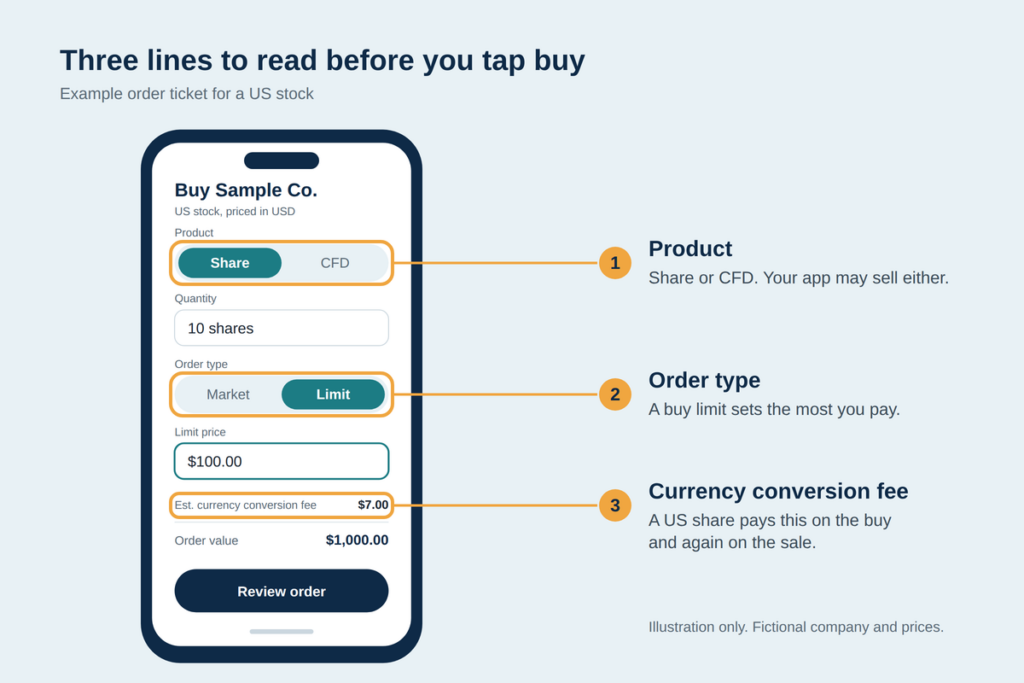
A share makes you a part-owner of the company. A share CFD, short for contract for difference, is an agreement with your broker that pays out on the share’s price movement. The order ticket names the product, and so does the contract note, the confirmation your broker sends after each trade.
| SHARE | SHARE CFD | |
|---|---|---|
| What you own | Part of the company | A contract with your broker |
| Dividends | Paid to you | Usually a cash adjustment set by the broker |
| Money you put up | The full price | A deposit (margin) of at least 20% for UK retail clients |
| Overnight fee | None | Usually charged for each night the position stays open |
| Forced close-out | None | The broker closes positions when your funds fall to 50% of the margin needed |
| Most you can lose | What you paid | Everything in your CFD account |
A buy without leverage doesn’t guarantee you the share. eToro’s fees page says short sells and leveraged stock positions are executed as CFDs, and that ‘due to product restrictions, some non-leveraged BUY positions in stocks are also executed as CFDs.’ Fees won’t settle it either. eToro charges long stock CFDs 6.4% a year plus a benchmark rate, divided by 365 for each day held, yet its overnight fee page says non-leveraged buy positions pay nothing. An overnight charge points to a CFD; a missing one proves nothing. Read the ticket.
| BEFORE YOU OPEN A SHARE CFD
The FCA’s permanent rules for retail CFDs, confirmed on 1 July 2019 and in force for CFDs since 1 August 2019, cap leverage on a single share at 5:1. That’s where the 20% deposit comes from. The same rules force the close-out at 50% of the required margin and stop your losses at the money in your CFD account. Each UK provider must also publish the percentage of its retail accounts that lose money. On IG’s UK site, checked on 2 October 2026, that figure was 70% for spread bets and CFDs. |
For the US stock in our example, buy the share if you plan to hold it for weeks or want the dividends. A share CFD fits only a short trade, sized so that a close-out plus overnight fees stays inside your per-trade limit. That limit is the most you’ll accept losing on one trade, set in advance; many traders use 1-2% of the account, as our guide on how to learn trading explains. For the CFD side of the argument, see CFD trading compared with buying shares
.
Market order or limit order: which should you use?
A market order guarantees a fill. A limit order guarantees your price.
Investor.gov, the SEC’s site for investors, says a market order ‘guarantees that the order will be executed, but does not guarantee the execution price.’ A buy limit can only fill at your limit or lower, and the SEC’s bulletin on order types, updated 18 August 2026, adds that it ‘is not guaranteed to execute’. If the price doesn’t come back to your limit, nothing happens.
At the US open on the morning after earnings, 2:30pm in London, the price you saw may be gone before your order lands, so set a buy limit at the most you’d pay. Keep market orders for busy stocks in normal US hours, when the spread is narrow. Many brokers take only limit orders outside regular hours, as PipPenguin’s guide to US pre-market trading explains.
What does a US share trade cost from a UK account?
You pay on the way in and again on the way out. Compare brokers on that round trip, not on the headline commission.
IG UK’s share dealing charges, which apply from 1 April 2025, give two routes for US shares.
| IG UK, US SHARES | INSTANT CONVERSION (DEFAULT) | MANUAL CONVERSION |
|---|---|---|
| Commission | None* | 3 cents a share, $15 minimum |
| Where else you pay | 0.7% on top of the exchange rate, on the buy and on the sale | The fee on any currency conversion you make |
| $1,000 bought and sold | About $14 in conversion fees | $30 in minimum commissions, before any conversion fee |
Read the footnote behind IG’s asterisk first. On the manual route, any order under 500 shares pays the $15 minimum. IG’s currency conversion page lists 0.7% as its standard fee.
Vanguard’s founder said it about fund fees, and it holds for every trade: what you pay in costs comes straight off your return.
“In investing, you get what you don’t pay for.” – John C. Bogle, founder of Vanguard, title of his keynote at The World Money Show, Orlando, 2 February 2005
Before you buy, add up these lines from the fee schedule:
- Commission on the buy and on the sale, including any minimum charge
- Currency conversion, pounds to dollars on the buy and back again on the sale
- The spread between the buy and sell prices on your ticket
- An overnight fee if the ticket says CFD, or 0.5% stamp duty if you’re buying shares in a UK company
Headline commission is a fair comparison only for UK shares bought in pounds, where no conversion applies.
Why can a stop-loss sell below your stop price?
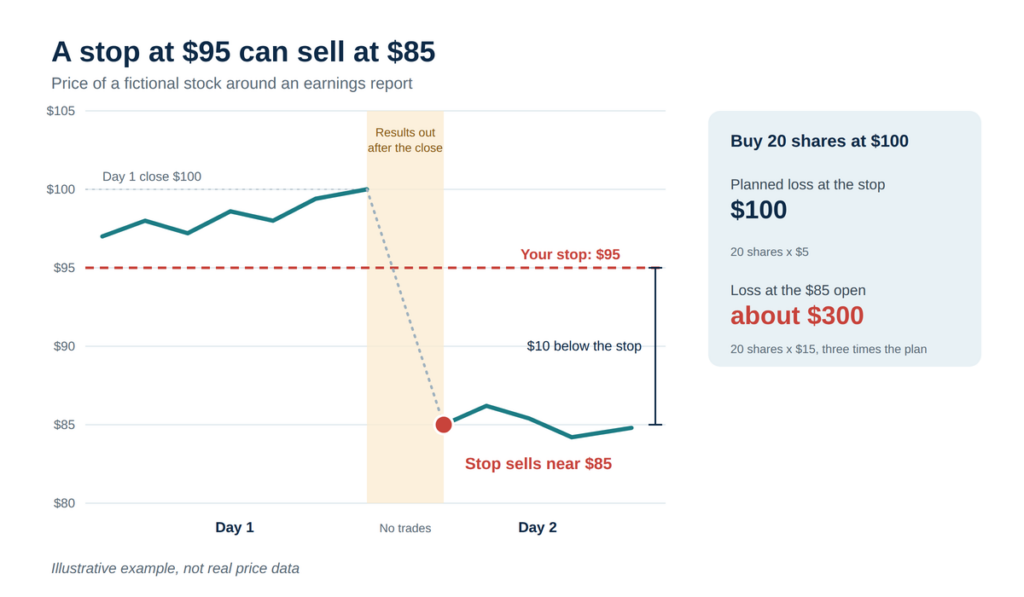
Once your stop price is hit, a stop-loss becomes a market order and sells at the next available price. When a stock opens far below your stop, that price is the lower open.
Fidelity’s stock trading guide, dated 5 June 2026, says a stop ‘can help safeguard you from losing any more than you agree to’, then warns it can result in ‘an execution well below your trigger price.’ Beginners remember the first sentence and learn the second from a statement.
You bought after this quarter’s report, so that gap is behind you. Two remain: an overnight drop on fresh news, and the next report in about three months. Say you buy 20 shares at $100 and set a stop at $95, risking $5 a share, or $100 in all. Weak results come out after the close, and the stock opens at $85. The stop triggers at the open and sells near $85. You lose about $300, three times what you planned.
US exchanges pause a stock for five minutes once its price spends 15 seconds outside a set band, an Investor.gov explains, but the pause doesn’t set the price trading restarts at.
Size the position for the gap you could live with. If a fill at a likely gap price would break your per-trade limit, buy fewer shares or sell before the next report. PipPenguin’s guides to position size and how a stop-loss works go through the arithmetic.
How do you check the firm that holds your account?
Before you deposit, check the legal entity, meaning the company named in your account terms, since one brand can run several companies in different countries.
Is the firm on the FCA register?
Look up that company on the FCA’s Financial Services Register. Three details must match: the legal name, the firm reference number (FRN) and the web address. If any one differs, don’t deposit.
Interactive Brokers (U.K.) Limited, for example, says on its pricing page that it is authorised and regulated by the FCA under reference number 208159. That’s the firm’s own claim; the register confirms it. The web address counts too, because a clone copies everything else. In October 2018, the FCA warned about ‘Wig Markets’, a clone of IG Markets Limited (FRN 195355) that ran its own website, wigmarkets.com.
What do FSCS and SIPC cover if a broker fails?
Both schemes step in when a firm fails and client investments or cash go missing. Neither pays because a share price fell.
The FSCS can pay up to £85,000 per eligible person, per firm, for investment firms that failed after 1 April 2019, though its page warns that ‘some investment products aren’t protected at all.’ In the US, SIPC restores customers’ securities and cash at a failed member firm, up to $500,000 including $250,000 in cash, and ‘does not protect against the decline in value of your securities.’
Cover follows the firm holding your account, so a US share held through a UK firm doesn’t come with SIPC cover. The FCA’s CFD loss limit caps what a trade can lose and repays nothing if the broker goes under. For shares and cash you’ll keep for months, pick a firm whose scheme names your product. See also what happens if a broker goes bust.
Do the basics make short-term trading profitable?
No. Getting the five checks right cuts avoidable costs and surprises, but it doesn’t make short-term trading pay.
Professionals with research teams struggle to beat an index. S&P Dow Jones Indices’ SPIVA U.S. Mid-Year 2026 scorecard, published 17 September 2026, found that 67% of active large-cap US equity funds trailed the S&P 500 in the first half of 2026, after 79% over full-year 2025. That figure doesn’t measure your odds. You pay a round trip on every trade and know less than a fund team does, so nothing suggests yours are better.
Trade short-term only with money you can lose in full. Holding a share for years means paying the round trip once. To pick a holding period, compare the main types of traders.
After your first month, your statements show which check needs work: overnight fees on shares you meant to own, stops filled below their price, limits that didn’t fill, or costs that took the gain.
The Bottom Line
Take the checks in the order you’ll meet them. Before you open and fund an account, confirm the firm on the FCA register, see which compensation scheme covers it, and price the round trip from its fee schedule. Our guide on how to start trading stocks covers opening the account.
At the order ticket, before your first order, read the product line for share or CFD, pick the order type, and size the position so a gap at the next open would stay inside your per-trade limit. If any check is still open, run the same trade, with the same order type and size, on a demo account first. PipPenguin’s list of paper trading platforms compares the options.
Frequently Asked Questions
Is the stock market the same as a stock exchange?
No. An exchange, such as the London Stock Exchange or Nasdaq, is one venue where shares trade. ‘The stock market’ covers all of them, together with the brokers and other venues that route and match orders.
Is £100 enough to start trading stocks?
It can be, if fees don’t eat it. For fractional trades in US shares, Interactive Brokers UK charges the greater of 1% of the trade or $0.01, so about £1 on £100. IG’s default route costs 0.7% each way in currency conversion, about £1.40 for the round trip, and its manual route’s $15 minimum is over a tenth of a £100 order.
Do I pay stamp duty when I buy shares?
Usually, if the shares are in a UK company. GOV.UK’s Tax ‘when you buy shares’ page, updated 30 September 2026, puts the rate at 0.5% of the transaction. It also says you don’t normally pay it on foreign shares bought outside the UK, so the US stock in our example shouldn’t carry it.
When does a US share sale settle?
One business day after the trade. Investor.gov’s settlement bulletin says most US broker-dealer transactions on or after 28 May 2024 settle on T+1, with some exceptions.
About Author