Futures Trading for Beginners: Margin, Tick & Roll Explained
 Robert J. Williams
 Alexandra Winters
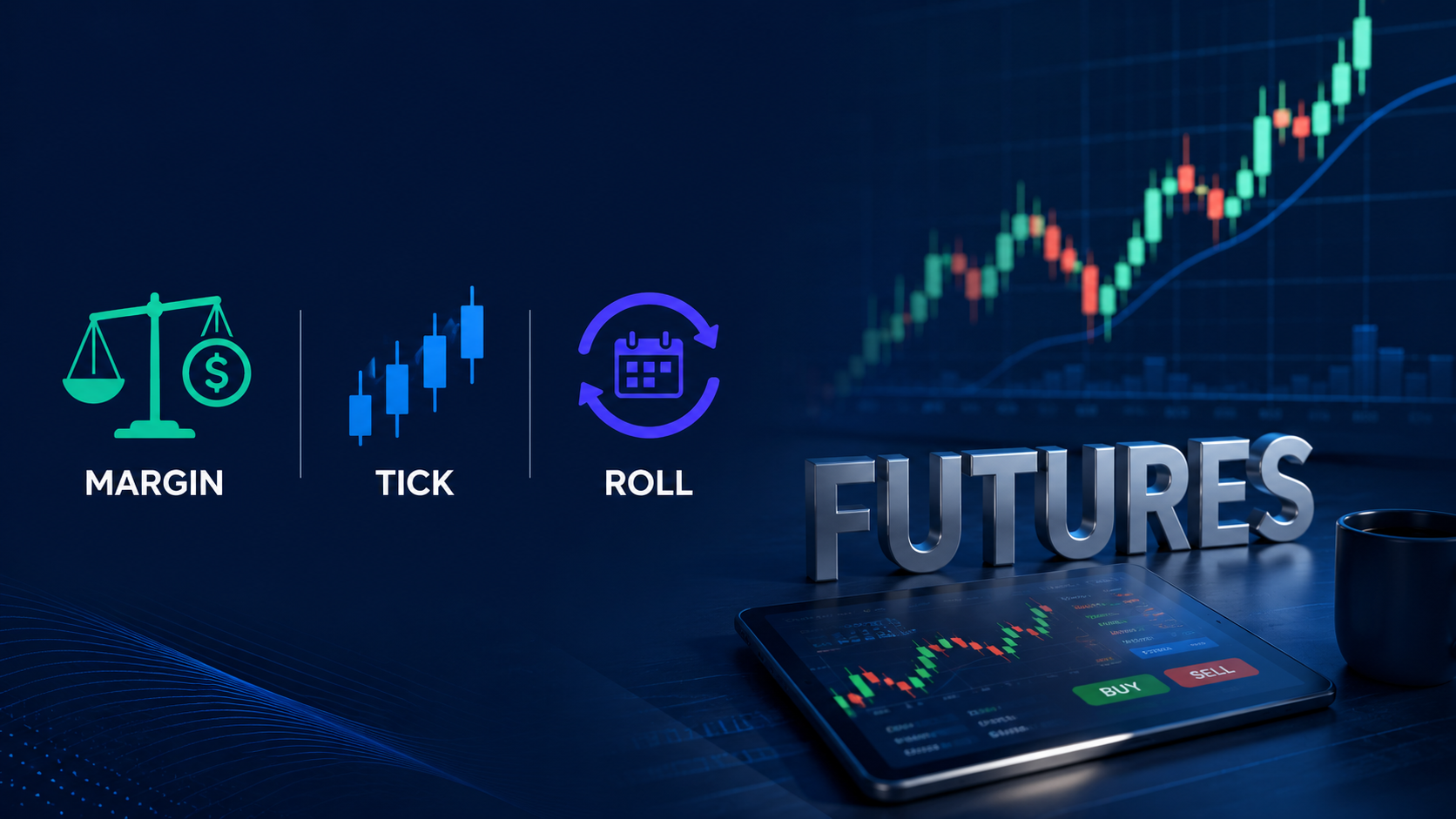
Futures trading for beginners starts with three words that trip up almost everyone new to the market: margin, tick, and roll. We’ve walked new traders through these mechanics dozens of times at Pippenguin, and the pattern is always the same: people understand the concept of “buying a contract” fine, then get blindsided by a margin call or a tick-value miscalculation on their first live trade. This guide covers what those three terms actually mean, with real numbers, plus how to pick a platform and manage the risk that comes with leverage.
Key Takeaways
- Futures margin is a performance bond, not a down payment. Initial margin opens the trade, maintenance margin keeps it open.
- Tick value is the dollar amount a contract moves per minimum price increment; on the Micro E-mini S&P 500 (MES), one tick (0.25 points) equals $1.25.
- Rolling means closing the expiring contract and opening the next one before delivery or expiration cuts off your position.
- There’s no Pattern Day Trader rule in futures, unlike stocks, but intraday margin requirements are usually lower than overnight ones, not “safer.”
- Micro contracts (MES, MNQ, MYM) are the realistic beginner entry point, letting you trade with a few hundred dollars instead of tens of thousands.
If you want the fuller definition of what a futures contract is before diving into mechanics, our futures trading explainer covers that ground first.
Margin in Futures: Initial vs. Maintenance
Futures margin works nothing like a stock down payment. It’s a refundable performance bond that your broker holds to guarantee you can cover losses, and it typically runs 3-12% of a contract’s full notional value depending on the product (CME Group, 2026). Two thresholds matter here. Initial margin is what you need to open the position. Maintenance margin is the lower balance you must keep in your account while the trade is open.
Here’s where beginners get caught out. If your account equity drops below maintenance margin because the market moved against you, your broker issues a margin call. You either wire more cash immediately or the position gets liquidated at whatever price is available, and you’re on the hook for the loss even if it exceeds your original deposit.
As the U.S. Commodity Futures Trading Commission’s mandatory risk disclosure puts it, the leverage available in futures trading “can lead to large losses as well as gains,” and losses “can exceed the amount you originally deposit with your broker” (CFTC, 17 CFR § 1.55). That’s not boilerplate. It’s the single most important sentence in this article.
Tick Size and Tick Value: The Math Behind Every Move
Every futures contract has a minimum price movement called tick size, and multiplying that by the contract’s dollar multiplier gives you tick value, the number that actually determines your profit or loss. Skip this math and you’re trading blind, because “the price moved 4 points” means nothing until you know what a point is worth in dollars.
Take the Micro E-mini S&P 500 (MES) as a worked example. Its tick size is 0.25 index points, and each tick is worth $1.25. A 1-point move equals four ticks, or $5. If the index moves 10 points in your favor on one contract, you’ve made $50 before commissions. Run that same math on the standard E-mini (ES), where tick value is $12.50, and a 10-point move is worth $500, ten times the risk and reward on the identical price movement.
In our experience, this is the calculation new traders skip until their first losing trade, when they suddenly need to know exactly how many dollars per point they’re exposed to. Check the exact tick specs on CME Group’s contract specifications page before you place a single order — they vary by product and change occasionally.
Rolling Contracts: Why Futures Positions Expire
Rolling a futures position means closing your contract in the expiring month and simultaneously opening an equivalent position in the next available month, done to avoid physical delivery or a liquidity drop-off as expiration nears. Index futures like the MES are cash-settled and rarely force delivery, but commodity contracts such as corn, crude oil, and natural gas can require you to take or make physical delivery if you hold through expiration.
Most retail platforms flag your open positions as expiration approaches and some auto-roll on request, but don’t assume yours does. Volume and liquidity typically shift to the next contract month roughly a week or two before expiration, which is also when spreads tend to widen on the expiring contract. Rolling early, while both months are still liquid, generally costs less than waiting until the last few days.
How to Start Trading Futures: A Step-by-Step Beginner Path
Getting into futures for beginners means opening a futures-approved brokerage account, funding it, and starting on a demo before risking real capital.
- Open a futures-enabled account. Not every stock broker supports futures by default, so confirm the account type before funding it.
- Paper trade first. Run at least a few weeks of simulated trades so a losing streak happens with fake money, not real money.
- Start with micro contracts. MES, MNQ, and MYM require a fraction of the capital of their full-size counterparts and let you learn position sizing without ruinous downside.
- Fund conservatively. $500-$5,000 is a commonly cited practical starting range for a single micro contract with room to absorb normal volatility. Treat that as illustrative, not a personalized recommendation, since your risk tolerance and product choice change the math.
- Set a hard stop-loss before entering, not after.
Best Futures Trading Platforms for Beginners
When we’ve reviewed brokers for new futures traders, the ones that hold up combine a clean interface with genuinely usable paper trading, not just a features checklist. NinjaTrader pairs solid charting with a free simulated account that mirrors live execution. Interactive Brokers has some of the lowest per-contract commissions in the industry but a steeper learning curve on its Trader Workstation platform. Optimus Futures focuses specifically on low-cost futures execution with direct broker support, which matters more than it sounds like when you’re stuck on a fill question at 2am.
Tim McCourt, CME Group’s Global Head of Equities, FX and Alternative Products, said that “with over three billion of these contracts traded in less than five years, our Micro E-mini Equity Index futures continue to establish themselves among the most actively traded and deeply liquid index products” (CME Group, December 2024). That scale is exactly why micros are the default beginner entry point today.
Day Trading Futures as a Beginner: What’s Different
Futures markets carry no Pattern Day Trader rule, unlike US equities, so you can open and close multiple positions in a single session regardless of account size, a real structural advantage over stock day trading for a small account. That does not make day trading futures low-risk; it just removes one specific regulatory speed bump.
Intraday margin requirements on futures are also typically lower than overnight margin, sometimes by 50% or more, because the broker’s exposure window is shorter. Lower margin means more leverage per dollar, which cuts both ways: a beginner running intraday-sized positions overnight without adjusting can get hit by a margin call they didn’t see coming.
Risk Management Basics for New Futures Traders
Leverage is the entire reason futures margin is small relative to contract value, and it’s also the reason a beginner account can lose more than its balance in a single bad session. Position size around your stop-loss distance, not around how many contracts you can technically afford. A common professional guideline caps risk at 1-2% of account equity per trade. Micro contracts exist specifically to make that math work with a small account instead of forcing you into E-mini-sized risk before you’re ready.
The Bottom Line on Futures Trading for Beginners
Futures trading for beginners comes down to respecting three mechanics before you place a live order: margin is a performance bond that can trigger a call, tick value determines your real dollar exposure per point, and contracts expire on a schedule that forces a rollover decision. Get comfortable with micro contracts and paper trading first, size positions around a stop-loss rather than an account maximum, and treat the leverage as a tool that cuts both directions. For a deeper look at how that leverage is structured, see our guide on leverage in futures trading.
Frequently Asked Questions
1. Is futures trading good for beginners?
It can be, provided you start with micro contracts and paper trading rather than jumping straight into full-size E-mini or commodity contracts. The leverage that makes futures capital-efficient is the same leverage that makes early mistakes expensive.
2. How much money do you need to start trading futures?
There’s no fixed minimum, but $500-$5,000 is commonly cited as a practical range for trading a single micro contract with a cushion for normal price swings. Your actual number depends on the product, your stop-loss distance, and your broker’s margin requirements.
3. What is the difference between initial margin and maintenance margin?
Initial margin opens the position. Maintenance margin is what you must keep afterward, or you get a margin call.
4. Do futures contracts expire?
Yes. It’s true that every futures contract has an expiration date, after which it either cash-settles or requires physical delivery depending on the product. Traders who want to stay in the position roll to the next contract month before expiration.
5. Can you day trade futures without $25,000, unlike stocks?
Yes. The Pattern Day Trader rule that requires a $25,000 minimum applies to US equities annd not on futures. Futures day traders face margin requirements instead, which vary by broker and product.
Futures trading involves substantial risk of loss and is not suitable for all investors. Leverage can magnify losses beyond your initial deposit. This article is educational and not personalized financial advice.
About Author