Robert J. Williams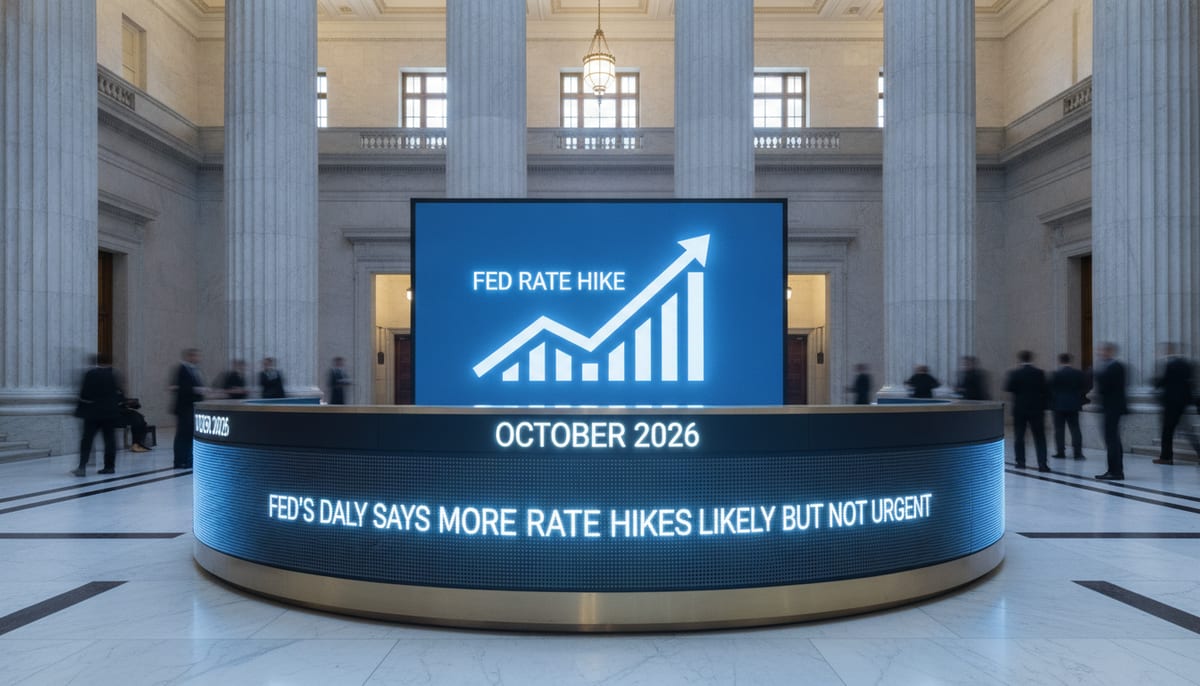
San Francisco Federal Reserve President Mary Daly said the Fed will probably need to raise interest rates again to bring inflation down. She sees no reason to act at the Oct. 27-28 policy meeting, she told Reuters. “We are more likely than not to need additional adjustments, but the timing of those adjustments to me is something we’re still deliberating,” Daly said in an interview published Wednesday, Oct. 14. Her comments followed a September consumer price report that put annual inflation at 3.7%, above the 3.6% economists had forecast. The federal funds target range stands at 3.75% to 4.00% after a quarter-point increase in September.
What did Daly say about the timing of the next hike?
Nothing that pins her to October. “I don’t feel urgent that we have to decide with a limited set of information,” Daly said. “I think we have the time that we need.”
She was sharper on why she’s resisting pressure to move now. “The risk to inflation has gone up more, but risks are not realities, and reacting on risk when you have time to make a good decision, to me, feels imprudent,” she said. On the September figures specifically: “Definitely this data point suggests that the risk to inflation remains elevated.”
Then the line that shows where she sits on the committee. “Why force urgency when you don’t need to have urgency? Why not take the time to be thoughtful and deliberate? And we have more meetings ahead of us,” Daly said.
Reuters published the interview, conducted by Ann Saphir, on Wednesday evening. Daly said core inflation remains sticky, which is roughly what the Fed had expected it to do.
Why did September’s inflation report change the October debate?
Gasoline. Pump prices rose 9.1% in September from August and accounted for more than half the month’s entire increase in the consumer price index. The broader energy index gained 5.2%.
| US consumer prices, September 2026 | Actual | Consensus | August |
|---|---|---|---|
| Headline CPI, year on year | 3.7% | 3.6% | 3.4% |
| Headline CPI, month on month | 0.6% | 0.4% | 0.4% |
| Core CPI, year on year | 2.6% | 2.4% | 2.4% |
| Core CPI, month on month | 0.3% | 0.2% | 0.3% |
Seasonally adjusted. Source: Bureau of Labor Statistics data for September 2026, released Oct. 14.
Strip out food and energy and the picture softens, though not by much. Core prices rose 0.3% on the month and 2.6% on the year, up from 2.4% in August. The Fed targets 2%. Rates at this level already show up in household borrowing costs, with Reuters putting mortgage rates around 7.5%.
How did markets reprice the October meeting?
Fast, then part of the way back. Odds of an October hike implied by fed funds futures sat near 20% before the 8:40 a.m. ET release. They jumped to between 40% and 45% afterwards, based on LSEG pricing. By the time Daly spoke that evening, Reuters put the market at roughly 40%.
The front end did the heavy lifting. Two-year Treasury yields climbed 12 basis points on Wednesday against 7 bps on the 10-year, narrowing the gap between them by 5 bps. Short-dated yields track what traders expect over the next few meetings, and they moved close to twice as much as the long end.
December is carrying more of the expectation than October. CNBC reported traders pricing close to even odds that the Fed delivers half a percentage point of tightening by the December meeting, through either one move or two.
How much Fed commentary is left before Oct. 27?
Two days. Under the FOMC’s policy on external communications, the blackout opens at midnight Eastern on the second Saturday before a meeting. It lifts at 11:59 p.m. Eastern on the Thursday after the meeting ends. A meeting starting Tuesday, Oct. 27 puts that window from Saturday, Oct. 17 through Thursday, Oct. 29.
Daly spoke three days before it shuts. Whatever else policymakers want on the record about an October move has to be said by Friday, Oct. 16. After that, traders work with the data alone.
Analyst Take
Daly’s message splits cleanly in two, and the halves point different ways. “More likely than not” is a commitment on direction. “I don’t feel urgent” is a refusal on timing. Only the second half can be traded before Oct. 28, which is why pricing settled back toward 40% instead of holding the post-CPI spike.
Forty percent is the uncomfortable number. Too high to write October off, too low to treat a hike as the base case. Pricing parked there means every release between now and the meeting carries outsized weight, and the dollar follows the move in two-year yields rather than the headline probability.
The composition of the September report argues for Daly’s patience more than against it. Gasoline drove over half the monthly gain, and energy moves reverse. Core at 2.6% is the figure behind her line about inflation risk going up. An acceleration of 0.2 percentage points in a single month is thin ground for a rate rise.
One limit is worth stating. A regional president’s interview is not a committee decision, and Daly’s own framing leaves her free to change position on the data that arrives before Oct. 27. The curve is leaning toward December, and Thursday’s releases are the next thing that can shift it.
What comes next for the dollar and Fed policy?
US producer prices are due Thursday at 12:30 UTC, with retail sales and weekly jobless claims the same day. Those are the last scheduled US releases before Fed officials go quiet on Saturday. The transmission into currency markets runs through rate expectations. A repricing of the October and December meetings moves short-dated Treasury yields, and that yield gap against other G10 markets moves the dollar. Markets have only half-priced an October move, which leaves room to react in either direction once the committee signals its intent on Oct. 28. Our forex news coverage and economic news track each release as it lands.
Frequently asked questions
Did Mary Daly say the Fed will raise rates in October 2026?
No. Daly said additional increases are more likely than not. She told Reuters she feels no urgency to decide at the Oct. 27-28 meeting, and that the committee has the time it needs.
What is the current US federal funds rate?
The target range is 3.75% to 4.00%, after the Federal Reserve raised it by a quarter point in September 2026. The Fed’s inflation target is 2%, and September consumer prices ran at 3.7%.
What were the market odds of an October 2026 Fed rate hike?
Fed funds futures priced roughly 20% before the September CPI release on Oct. 14 and 40% to 45% afterwards, based on LSEG data. Reuters put the figure near 40% at the time of Daly’s interview that evening. Those probabilities move with every release, so the mid-October number is not what traders will be working from on Oct. 27.
Why did US inflation rise to 3.7% in September?
Gasoline. Pump prices rose 9.1% from August and accounted for more than half the monthly increase in the consumer price index, with the overall energy index up 5.2%. Core inflation, which leaves out food and energy, rose 2.6% on the year against 2.4% in August.
When does the Fed blackout period start before the October meeting?
Saturday, Oct. 17, 2026. FOMC policy opens the blackout at midnight Eastern on the second Saturday before a meeting and lifts it at 11:59 p.m. Eastern on the Thursday following. For the Oct. 27-28 meeting it runs through Thursday, Oct. 29.
Sources
- Reuters, Exclusive: Fed’s Daly says rate hikes likely needed, but not urgently, by Ann Saphir, Oct. 14, 2026 — investing.com
- ActionForex, Fed’s Daly warns inflation risks have risen, but resists October hike pressure, Oct. 14, 2026 — actionforex.com
- Bureau of Labor Statistics, Consumer Price Index, September 2026, released Oct. 14, 2026 — bls.gov
- TradingKey, US September CPI rises to 3.7%, Oct. 14, 2026 — tradingkey.com
- Investing.com, Fed October hike odds hit 45% as 2-year Treasury yield rises 12 bps, Oct. 14, 2026 — investing.com
- CNBC, Fed may now have to hike twice or increase by a half point in December, traders bet, Oct. 14, 2026 — cnbc.com
- Federal Open Market Committee, Policy on External Communications, blackout period definition — stlouisfed.org
Interest rate probabilities and yields cited are from the Oct. 14, 2026 US session and will have moved since publication. This article reports monetary policy and market developments and does not recommend any trade or position.
About Author