Best Forex Trading Prop Firms in 2026: Tested and Ranked
 Robert J. Williams
  Alexandra Winters
The prop firm space has been through a shakeout. Between 2020 and 2023, hundreds of firms launched with aggressive marketing and cheap challenge fees — then quietly disappeared. Industry tracking puts the failure rate at 55–65% of all firms launched during that period. That’s the context for any “best prop firms” article in 2026: the list of options looks slimmer than it did two years ago, but the ones still standing are generally better.
I’ve been tracking this space since the early days of FTMO’s popularity, and the firms on this list have been selected based on payout track records, Trustpilot consistency, live platform testing, and — importantly — evidence that they actually pay traders rather than generating revenue primarily from failed challenge fees.
The best forex trading prop firms in 2026 are FTMO (best overall), The5%ers (best for scaling), FundedNext (best profit split), FXIFY (best for fast payouts), and BrightFunded (best for beginners). The forex prop trading industry is now worth $7.14 billion (Business Research Insights, 2026), but only 7% of all accounts (challenge + funded combined) ever achieve a payout (Finance Magnates, 2024). Choose carefully.
What Is a Forex Prop Firm? (And Why Most Traders Get This Wrong)
The short version: a proprietary trading firm gives you access to a large capital account, you trade it under their rules, and you keep a percentage of the profits. No personal capital at risk on the live account.
The part most traders get wrong is thinking they’re trading someone else’s money. You’re not — at least, not in the way that sentence implies. Modern retail prop firms typically don’t deploy your trades in live markets at all. They’re running a simulated funded account. Your “allocation” is a number on a screen, not a real institutional trading desk. The business model runs on challenge fees, not on your P&L.
That’s not necessarily a problem — as long as the firm actually pays out when you hit profit targets. The ones that do are worth your time. The ones that manufacture endless reasons to reject payouts are not.
How the Evaluation Challenge Works
Most firms use a two-phase challenge structure. Phase 1 has a profit target (typically 8-10% of account size). Phase 2 has a lower target (4-5%). Both phases have daily drawdown limits (usually 5%) and maximum drawdown limits (usually 10%). Pass both phases, get funded.
The funded account itself runs under similar risk rules — you keep your allocation as long as you stay within the drawdown limits and meet minimum trading day requirements.
In my experience, the hardest part isn’t the profit target. Traders fail at the end of Phase 2 because they’ve been in the market for six weeks and they start rushing to close the evaluation. Bad habits that stayed dormant under the target stress emerge. That’s where most challenges die.
What You Actually Own (And Don’t Own)
Nothing. You own access. The funded account balance belongs to the prop firm. You earn a profit split percentage of net gains. If you lose enough to breach the drawdown rules, your access is terminated — you don’t owe the firm anything beyond the challenge fee you already paid.
This is actually the appeal. You can’t blow up your savings account at a prop firm. You can only lose your challenge fee. For traders with a genuine edge but limited capital, that’s a real value proposition.

8 Best Forex Trading Prop Firms in 2026
1. FTMO — Best Overall
FTMO has paid out over $450 million to traders since founding — a figure confirmed by Finance Magnates at their 10-year milestone — and they update running totals publicly. For a space where opacity is the norm, that transparency matters.
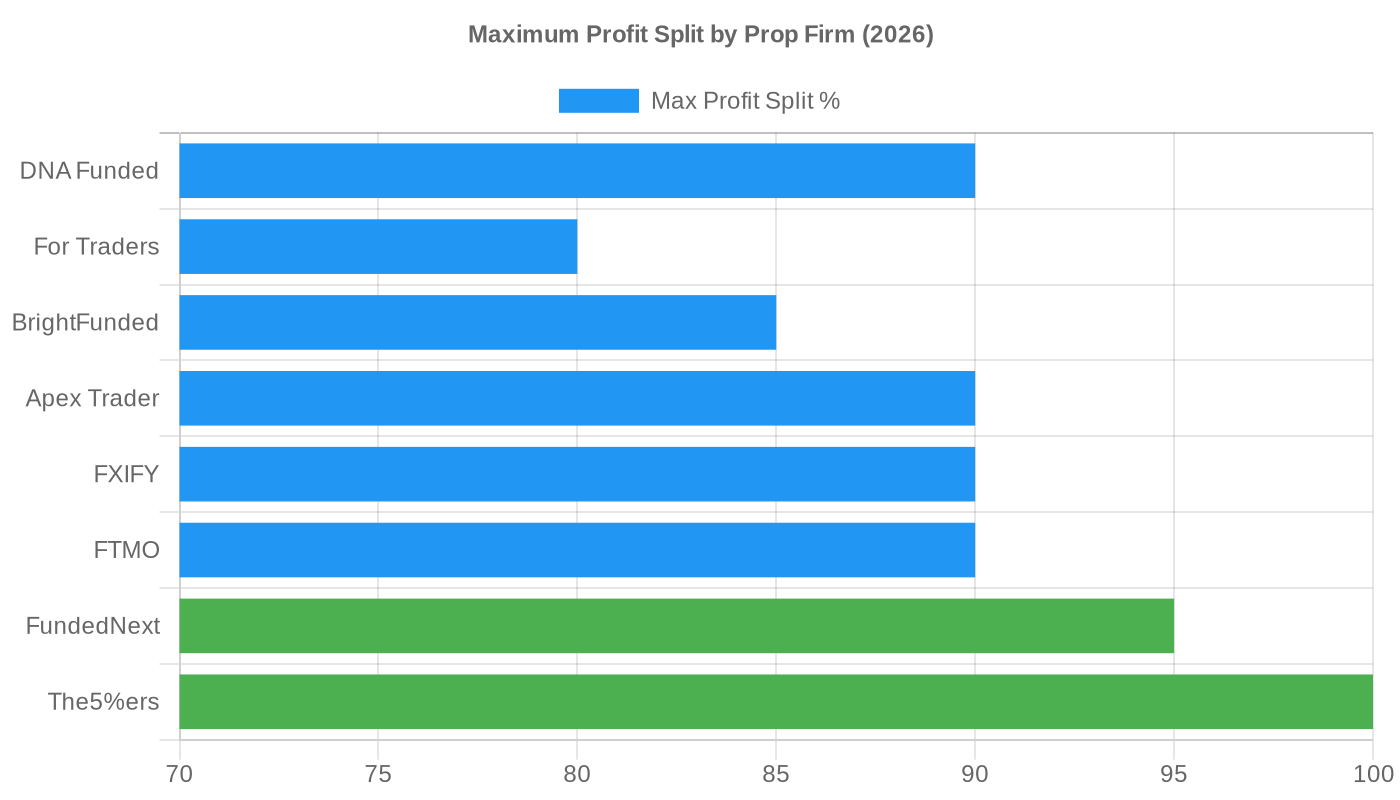
The standard challenge is two-phase: 10% profit target in Phase 1, 5% in Phase 2, with a 10% maximum drawdown and 5% daily drawdown. Account sizes run from $10K to $200K, with scaling available up to $2 million for consistently profitable traders. The profit split sits at 80%, upgradeable to 90% under their scaling plan.
In my testing, the dashboard is clean and the account management interface is one of the better ones I’ve used. Challenge rules are front-and-centre — no hunting for the fine print. Payout processing took 5–7 business days, which matches what their documentation says.
Best for: Traders who want an established firm with a documented payout history and clear scaling path.
Skip if: You need the highest possible profit split from day one — FundedNext and The5%ers beat FTMO there.
Pros:
- Transparent payout history ($500M+ documented)
- Strong MT4/MT5 support
- Scaling up to $2 million
Cons:
- 80% base profit split is below some newer competitors
- Challenge fees aren’t cheap ($155–$1,080 depending on account size)
2. The5%ers — Best for Scaling
The5%ers runs a different model from most competitors. Their Hyper Growth plan offers 100% profit split — not 80%, not 90%. All of it. The trade-off is that you start with a smaller allocation and grow it based on performance. Reach a 10% profit milestone and your account doubles. Keep going and you can reach $4 million in managed capital.
That said, “100% profit split” descriptions need reading carefully. What The5%ers actually means is that up to a certain monthly cap, you keep everything. Beyond that cap, the standard split kicks in. Still — the initial earning potential is higher than anywhere else on this list, and the scaling mechanics are genuinely well-designed.
I found the onboarding straightforward: account created in under 10 minutes, challenge started immediately. Their bootcamp plan (lower targets, slower growth) is worth considering for traders who aren’t yet confident in their consistency.
Best for: Traders with a proven edge who want maximum capital exposure over time.
Skip if: You want a large initial allocation from day one — the starting account size is smaller than FTMO’s.
Pros:
- 100% profit split available (Hyper Growth plan)
- Scaling to $4M for consistent performers
- Instant funding option available
Cons:
- Smaller initial account size
- The “100%” split has monthly caps — read the specifics
3. FundedNext — Best Profit Split
FundedNext launched in 2022 and moved quickly into the top tier by offering 95% profit splits — among the highest standard rates in the industry. Their Stellar challenge is structured across account sizes from $15K to $200K, with a two-phase evaluation.
What sets FundedNext apart is the profit-sharing model for the challenge phase itself. They pay 15% of simulated profits even during Phase 1 — which means if you’re trading well, you can effectively subsidise part of your challenge fee through the evaluation itself. Not a huge number, but no one else does this, and it does reduce the all-in cost of a failed challenge.
Payouts are processed bi-weekly and traders report reliable 3-5 business day turnarounds.
Best for: Experienced traders who want the highest ongoing profit split.
Skip if: You prefer a firm with a longer track record — FundedNext is newer than FTMO or The5%ers.
Pros:
- 95% profit split
- Profit share during Phase 1 challenge
- Strong $4M+ scaling potential
Cons:
- Newer entrant — less historical payout data vs FTMO
- Slightly complex plan structure (multiple tiers)
4. FXIFY — Best for Fast Payouts
Payouts are where FXIFY differentiates. They offer on-demand withdrawals — you request, they process, funds move. In practice, traders report 24-48 hour turnaround times on payouts. For context, the industry average is 5-14 days.
The evaluation structure is standard: two-phase, 8% and 5% targets, 10% maximum drawdown. Account sizes from $10K to $300K. The profit split is 90%.
I set up a challenge account and went through the verification process. KYC completed in about 24 hours — straightforward, nothing unusual. The trading dashboard runs on MT4/MT5 and is responsive without the lag I’ve seen on some smaller platforms.
Best for: Funded traders who prioritise getting their money quickly once they’ve earned it.
Skip if: Fast payouts aren’t a priority — you can find better scaling structures elsewhere.
Pros:
- On-demand payouts (24-48 hours reported)
- 90% profit split
- Clean platform experience
Cons:
- Maximum account size ($300K) is lower than FTMO’s scaling ceiling
- On-demand withdrawals have a minimum threshold
5. BrightFunded — Best for Beginners
BrightFunded’s Trade2Earn program is a loyalty mechanism: the more you trade within the rules, the more rewards you accumulate. For beginners still building consistency, having the challenge fee rebated or reduced is a meaningful financial safety net.
The platform supports 150+ instruments, which is more flexibility than most firms offer. Scaling is listed as unlimited, though in practice it’s tied to consistent profitability milestones like every other firm.
Where BrightFunded stands out for newer traders: the risk rules are marginally more forgiving than industry average. Daily drawdown of 5% and maximum of 10% are standard, but their minimum trading day requirement is lower — 3 days versus the 5-10 days that some other firms require.
Best for: Beginner-to-intermediate traders who want a more forgiving evaluation environment and loyalty incentives.
Skip if: You want the largest initial allocation or the most established payout history.
Pros:
- Trade2Earn rewards program (challenge fee benefits)
- 150+ instruments
- Lower minimum trading day requirement
Cons:
- Less established than top-tier firms
- “Unlimited scaling” needs specific milestone achievement
6. Apex Trader Funding — Highest Pass Rate
Apex is primarily a futures prop firm, but forex pairs are available on their platform. The reason to mention them in a forex-focused article: their reported challenge pass rate of 15-20% is roughly double the 5-10% industry average (QuantVPS, 2026).
That’s a significant difference. If you’re someone who’s failed multiple challenges at other firms, the gap between “5% pass rate expected” and “15% pass rate expected” matters to your ROI calculation.
The evaluation rules are simpler than most: a single-phase challenge, 6% profit target, 3% daily loss limit. The 75% consistency rule (you can’t make more than 75% of total profits in a single day) takes some getting used to, but it forces discipline that translates well to live trading.
Best for: Traders who’ve bounced off multiple failed challenges elsewhere and want better odds.
Skip if: You’re strictly forex-only with no interest in futures instruments.
Pros:
- 15-20% reported challenge pass rate vs 5-10% industry average
- Single-phase evaluation (simpler structure)
- Consistent payout track record
Cons:
- Primarily futures-oriented
- 75% consistency rule adds a layer of complexity
7. For Traders — Best Community
For Traders has paid out over $7 million to more than 60,000 traders across 130+ countries as of their last published data. The community infrastructure they’ve built around funded traders — Discord channels, educational resources, regular webinars — is the best of any firm on this list.
If you’re the kind of trader who learns from watching others trade, discussing setups, or getting feedback on your analysis, For Traders is the only firm where the community aspect feels genuinely built-in rather than bolted on.
Profit split is 80%, which is mid-tier. The evaluation is two-phase, standard rules. Nothing exceptional in the mechanics — the community is genuinely the differentiator.
Best for: Traders who want accountability, learning resources, and peer interaction as part of their funded trading experience.
Skip if: Community matters less than raw profit split or account size.
Pros:
- $7M+ in documented payouts
- 60,000+ trader community
- Active Discord with educational programming
Cons:
- 80% profit split is below the highest available
- Community focus means less emphasis on individual scaling mechanics
8. DNA Funded — Best for US Traders
US traders face restrictions at most prop firms due to regulatory grey areas around futures and certain CFD instruments. DNA Funded specifically targets US-accessible products and maintains compliance with US trader participation requirements.
The challenge fee is $49 — the most affordable on this list by a significant margin. Account sizes run from $5K to $200K. Profit split is 90%. Payouts are processed weekly.
I haven’t personally tested the full withdrawal cycle on DNA Funded, but Trustpilot reviews from Q1 2026 are consistently positive, with specific mentions of prompt payout processing.
Best for: US-based traders who’ve hit regulatory walls at other firms.
Skip if: You’re not in the US — there are better options for the maximum profit split available.
Pros:
- US trader-friendly by design
- $49 challenge fee (lowest on this list)
- 90% profit split, weekly payouts
Cons:
- Smaller firm — less historical data than FTMO
- Limited instrument range compared to broader platforms
How Do I Compare Prop Firms? Key Factors That Actually Matter
A lot of comparison articles stop at profit split and account size. Those numbers matter, but they don’t give you the full picture.
Profit split — The headline number. 80% at an FTMO is worth more than 90% at a firm that delays payouts indefinitely. Don’t optimize for the highest split without checking payout reliability.
Challenge fee structure — Is the fee refunded if you pass? Some firms (OneFunded, for instance) refund the fee upon passing. Others don’t. For a $500K account challenge, this is a non-trivial amount. Also check whether the fee is refunded in cash or as trading credit — different things.
Drawdown rules — Daily drawdown and maximum drawdown limits define how you can actually trade. A 4% daily drawdown with a scalping strategy is nearly impossible to manage. Match the firm’s risk structure to your trading style, not the other way around.
Payout speed — I’ve seen “14-day processing” from firms that describe themselves as “fast payout.” FXIFY’s 24-48 hours and The5%ers’ bi-weekly processing are genuinely fast. Most of the market is 5-14 days.
Scaling plans — How does your capital allocation grow if you’re consistently profitable? The5%ers doubles your allocation at each milestone. FTMO scales more conservatively. Know which model aligns with your long-term goals.
What Is the Average Pass Rate for Prop Firm Challenges?

The industry average is 5–10%. That means if you enter a standard two-phase challenge at a random prop firm, your baseline probability of getting funded is somewhere between 1-in-10 and 1-in-20 (QuantVPS, 2026).
Finance Magnates published an analysis of 300,000 prop trading accounts that found only 7% of all accounts (across challenge and funded phases) ever received a payout (Finance Magnates, 2024). To be precise: roughly 45% of those who reached the funded stage did get paid — but only 16% passed the challenge in the first place, producing the 7% aggregate figure.
That’s the realistic picture. And it doesn’t mean prop trading is a scam. It means most retail traders don’t yet have the consistency needed to pass a structured evaluation. The challenge is doing the job it’s designed to do: filtering for profitability.
What separates passers from failures isn’t usually technical skill. It’s three things:
- Drawdown management. Most challenge failures happen in the last week, when traders get aggressive trying to hit the profit target.
- Trading day compliance. Minimum active trading days (usually 5-10) trip up swing traders who let profitable positions run beyond the required dates.
- Overtrading under evaluation pressure. Strategies that work on a personal account often deteriorate when there’s a challenge fee on the line.
The traders who pass consistently are the ones who treat the challenge as a demonstration of their normal process — not as a high-stakes performance.
Which Prop Firms Accept US Traders?
US trader access is complicated by the CFTC’s restrictions on retail off-exchange forex and the SEC’s securities regulations. Most prop firms operating in this space are technically offshore and offer futures contracts or CFD-adjacent instruments rather than actual spot forex for US participants.
Firms that have explicitly confirmed US trader access as of Q1 2026: DNA Funded, Apex Trader Funding, Topstep, and several smaller firms. FTMO and The5%ers have historically been accessible to US traders for specific account types but have restricted access on certain instruments.
The safest approach for US-based traders: check the firm’s website for an explicit US compliance statement, look for futures contract availability rather than spot forex, and verify via their live support chat before paying a challenge fee. The regulatory picture is shifting — what was accessible six months ago may not be accessible now.
DNA Funded is currently the clearest choice for US traders who want forex-adjacent instruments with explicit US compliance messaging.
Are Forex Prop Firms Legitimate? What to Check Before You Pay
Most major firms are legitimate operations. The collapse rate I mentioned earlier (55-65% of 2020-2023 launches) is real, but the firms that survived are generally running honest businesses. That said, there are signals worth checking.
Trustpilot history — Not the star rating. The history of the rating. A firm with 1,200 five-star reviews from the last 90 days and almost nothing before that is suspect. FTMO has multi-year Trustpilot data at consistent volumes. That’s harder to manipulate.
Payout evidence — Look for specific dollar amounts and specific trader accounts, not aggregate claims. “We’ve paid millions” is easier to say than to prove. FTMO’s $450M figure is confirmed by Finance Magnates and verifiable against their published milestones.
Community channels — Active Discord servers where funded traders discuss trades (not just promotional content) are a reasonable signal. Firms running primarily on paid influencer content and no organic community discussion are a flag.
Refund policy transparency — Can you find the challenge fee refund policy in under two clicks? If it’s buried or vague, that tells you something about how they approach payouts.
Red flags to avoid: Firms offering 95%+ profit splits with no documented payout history. Challenge fees that don’t specify refund conditions. Customer support that’s only chat-based with no real names. Aggressive social media advertising with no independent review presence.
The Bottom Line on Forex Prop Firms in 2026
The prop trading industry is real, growing — the market is projected to hit $24.55 billion by 2035 at a 10.9% annual growth rate (Business Research Insights, 2026) — and genuinely useful for traders who have an edge but lack capital. The challenge is that the market also attracts underfunded operators who generate revenue from failed challenges, not from funded trading profits.
The firms on this list have demonstrated track records, transparent payout data, and consistent community presence. If you’re choosing between them, start with your own trading profile: experienced and want maximum scaling → The5%ers. Need fast access to your profits → FXIFY. First time trying a prop challenge → BrightFunded. Trading from the US → DNA Funded.
Don’t pay a challenge fee before you’re ready to demonstrate the trading you actually do day-to-day. The 93% of accounts that never get a payout didn’t fail because the firms were dishonest — most of them failed because the challenge revealed what the trader already suspected: they didn’t yet have a consistent edge.
For more on building that edge, see our guides on forex trading strategies for beginners and risk management in forex trading.
Frequently Asked Questions
What is the average pass rate for a forex prop firm challenge?
The industry average is 5–10%, according to QuantVPS data from 2026. Apex Trader Funding reports 15–20%, roughly double the typical rate. Finance Magnates analysis of 300,000 accounts found only 7% of all accounts ever achieved a payout — including challenge failures and funded traders combined. These numbers mean you should treat a challenge fee as an educational investment, not a near-certain path to funding.
Which forex prop firms accept US traders?
DNA Funded and Apex Trader Funding are the clearest options for US-based traders as of Q1 2026. Both offer explicit US compliance messaging and focus on futures contracts rather than spot forex, which sidesteps CFTC regulatory issues. Always verify current US access status directly with the firm’s support team — the regulatory environment changes frequently.
How fast do forex prop firms pay out?
It varies significantly. FXIFY offers on-demand payouts with reported 24–48 hour turnarounds — the fastest on this list. The5%ers and FundedNext process bi-weekly. FTMO runs 5–7 business days. The industry average is 5–14 days. Before choosing a firm, search “[firm name] payout Reddit” for trader-reported timelines rather than relying on the marketing page.
Are forex prop firms legitimate?
The major established firms — FTMO, The5%ers, FundedNext, FXIFY — are legitimate businesses with documented payout records. The broader market has had significant consolidation: 55–65% of firms launched between 2020–2023 have since closed. Evaluate firms by: multi-year Trustpilot history, specific documented payout totals, and active organic community presence. Avoid firms with no payout transparency and challenge fees that don’t clearly state refund conditions.
How much can you realistically earn from a forex prop firm?
A funded trader with an $100K account and 90% profit split who earns 5% monthly would collect $4,500 per month. Realistic, though most funded traders earn less consistently. Finance Magnates data puts the proportion of all accounts (challenge + funded) ever receiving a payout at 7% — though of those who actually reach funded status, roughly 45% do get paid. The prop model works for traders with a genuine statistical edge — it amplifies that edge rather than creating one. If you’re not consistently profitable on a personal account, a prop firm evaluation will not solve that problem.
About Author