Robert J. Williams
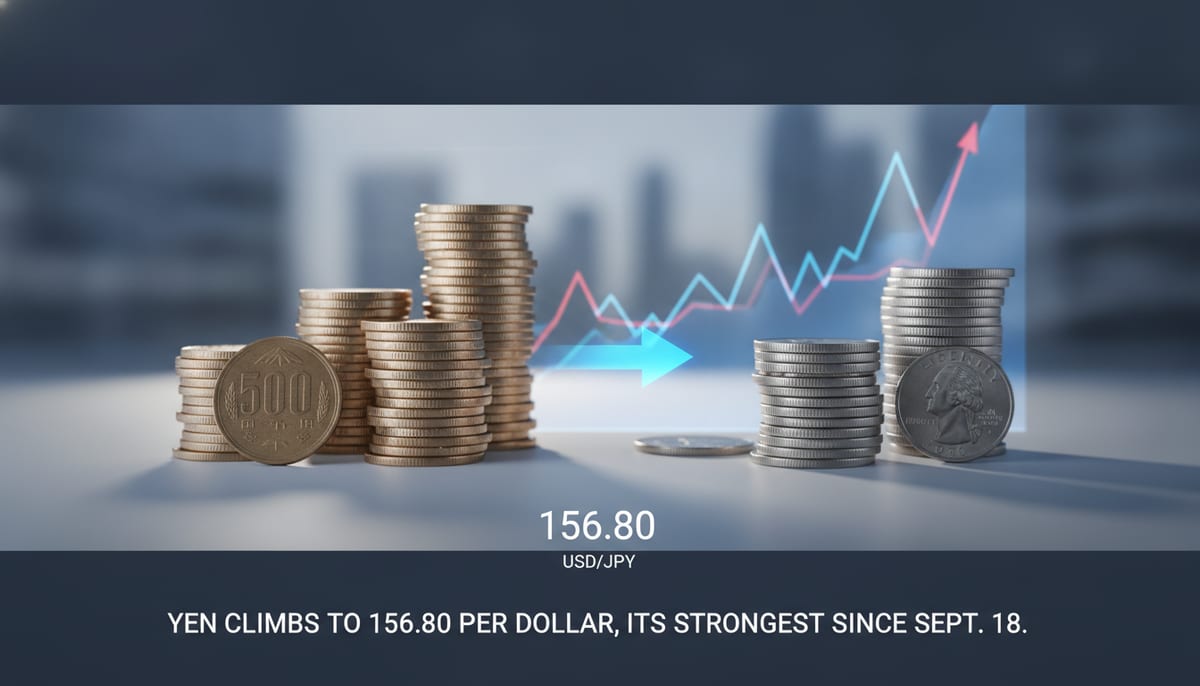
Why did the yen jump on Thursday? A sell-off in artificial-intelligence stocks pushed money out of the dollar, and USD/JPY fell to 156.80 on October 22, 2026, the yen’s strongest level since September 18, according to Investing.com. The U.S. Dollar Index slipped 0.2% to 101.61 as traders positioned for central-bank meetings next week.
What Happened to the Yen and the Dollar?
A lower USD/JPY number means a stronger yen. At 156.80, one dollar buys fewer yen than it has at any point in the past five weeks. The move came with the dollar near a three-week low, so the yen’s gain was partly the dollar’s loss.
Other majors did not follow. The euro slipped 0.2% to $1.1213 and the Australian dollar shed 0.1% to $0.7018, Investing.com data showed. The dollar’s slide was most visible against the yen.
| Market | Level | Move |
|---|---|---|
| USD/JPY | 156.80 | Yen strongest since September 18 |
| U.S. Dollar Index | 101.61 | -0.2% |
| EUR/USD | $1.1213 | -0.2% |
| AUD/USD | $0.7018 | -0.1% |
| S&P 500 | 7,663.43 | -1.21% |
| Nasdaq Composite | 26,008.86 | -2.60% |
| Dow Jones Industrial Average | 52,867.98 | +0.02% |
Source: Investing.com, October 22, 2026. Index figures are from the latest session Investing.com reported.
Why Did the AI Sell-Off Move Currencies?
The split between indexes tells the story. The Nasdaq lost 2.60% while the Dow was flat, which points at technology, not the whole market.
Meta Platforms nudged up its capital-spending forecast and announced a new class of nonvoting stock to raise money for its AI plans, Investing.com reported. That sharpened worries about how much debt the companies building AI infrastructure will have to issue.
When that worry spreads, institutional money tends to move toward bonds and non-dollar currencies, which weakens the dollar. The yen was the clearest beneficiary.
What Are Central Banks Expected to Do?
The Bank of Japan (BOJ) is expected to hold rates at its upcoming meeting. Money markets have fully priced that in, Investing.com said. Attention is on Governor Kazuo Ueda’s updated inflation projections. Swap markets increasingly price the BOJ’s next rate increase for early next year.
At the Federal Reserve, Chair Kevin Warsh is expected to speak after next week’s meeting. Deutsche Bank analysts led by Matthew Luzzetti wrote that “Warsh is likely to signal that recent inflation data reinforce expectations from the September meeting that further tightening will likely be needed over time.”
The European Central Bank also meets next week.
Elsewhere, Reserve Bank of Australia Deputy Governor Andrew Hauser said Australia’s inflation outlook has worsened, partly because of higher crude oil prices. His remarks strengthened expectations that the RBA keeps rates higher for longer than its peers, Investing.com reported.
What Is Happening in Bond Markets?
France adds a second source of strain. The French 10-year government bond yield rose above 5.00%, its highest since 2002, as protests over public-service cuts underlined how hard it is for President Emmanuel Macron to narrow a budget deficit of 5.4% of GDP.
The euro still lost 0.2% on the day, so the French bond move and the dollar’s slide did not translate into a euro rally.
Analyst Take: A Yen Rally Built on Rotation, Not Rate Hikes
The BOJ is priced to do nothing. So the yen’s move did not come from Tokyo. It came from the other side of the pair.
That matters for durability. A yen rally driven by a Japanese rate hike has a policy anchor. One driven by a dollar sell-off tied to tech stocks lasts only as long as tech stays under pressure. If the Nasdaq steadies, the dollar bid can return quickly, and 156.80 sits only five weeks from the last time the yen was stronger.
The Fed is the swing factor. A Warsh message that tightening is still on the table cuts against dollar weakness. A softer tone would extend it. The data on October 22 shows markets are not yet sure which one is coming.
Also worth tracking: whether Ueda’s projections move the timing of that early-next-year hike, how the Fed chair frames inflation, and whether the Nasdaq’s 2.60% drop repeats.
What Traders Are Watching Next
- The BOJ decision and Ueda’s inflation projections
- The Fed meeting next week and Warsh’s press remarks
- The ECB meeting next week
- Whether the French 10-year yield holds above 5.00%
- Direction of AI-related stocks, which drove Thursday’s flows
This article is for information only and is not financial advice. Trading foreign exchange carries a high level of risk and you can lose more than your deposit. Figures are from Investing.com and were current on October 22, 2026.
About Author