Dollar Edges Higher as Traders Rethink Fed Rate-Cut Timeline
 Robert J. Williams
 Alexandra Winters

The U.S. dollar strengthened against its major counterparts on Wednesday, 21 May 2026, as a batch of mixed economic data forced a rethink on when the Federal Reserve might start cutting interest rates.
Short-term Treasury yields climbed in the session, lending fresh support to the greenback. The euro and Japanese yen both lost ground. The dollar index, which measures the currency against a basket of six peers, held near its recent highs, according to Reuters.
Mixed Data Pushed Rate-Cut Bets Further Out
Markets came into 2026 expecting rate cuts. The data keeps getting in the way.
Wednesday’s releases painted a picture of an economy that won’t sit still long enough for the Fed to act. Resilient enough to keep tightening fears alive, mixed enough to prevent any clean read on direction. For dollar bulls, that’s sufficient. Uncertainty about when cuts arrive tends to favor the currency that pays the highest carry.
The repricing didn’t happen overnight. It’s been a grinding adjustment over weeks, with each data release nudging the timeline further out. Traders who entered the year positioning for mid-2026 cuts are now staring at a calendar that looks far less cooperative.
How Yields Are Driving the Dollar Higher
The mechanism is straightforward. When traders push back rate-cut expectations, short-term U.S. bond yields rise. Higher yields make dollar-denominated assets more attractive relative to euro or yen equivalents. Money flows toward the better return.
That yield gap has been the dominant force behind G10 currency moves for months. On Wednesday, it tilted further in the dollar’s favor.
The euro felt the pressure directly. The European Central Bank (ECB) has already started its easing cycle, which means the rate differential between the U.S. and the eurozone is widening. That’s a headwind for EUR/USD that isn’t going away soon.
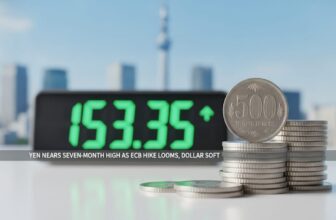
The yen, already weakened by the Bank of Japan’s (BOJ) cautious approach to policy normalization, slipped further. USD/JPY remains a carry trade favorite — borrow in yen, park in dollars, collect the spread. As long as U.S. yields stay elevated, that trade keeps working.
Why the Fed Hasn’t Moved Yet
The Federal Reserve hasn’t cut rates in 2026. Chair Jerome Powell has repeatedly signaled patience, waiting for what he called “clear and convincing” evidence that inflation is heading sustainably toward the 2% target.
Wednesday’s data didn’t deliver that evidence. Not clearly, anyway.
The CME FedWatch tool, which tracks market-implied rate probabilities, has shown a steady erosion of confidence in near-term cuts throughout the spring. Traders have pushed the most likely first cut further into the second half of the year.
The economy isn’t weak enough to justify emergency cuts. Inflation isn’t cool enough to justify early ones. The Fed sits. And while it sits, the dollar collects yield.
What Does This Mean for EUR/USD and USD/JPY?
EUR/USD faces a structural problem. The ECB is easing while the Fed holds. Every week without a Fed cut widens the policy gap and adds pressure on the pair. Short of a sharp reversal in U.S. data, the path of least resistance points lower for the euro against the dollar.
USD/JPY is a different story but the same conclusion. The BOJ has barely begun tightening, and its pace has been glacial compared to what markets expected a year ago. The yen carry trade remains crowded, and unwinding it requires either a BOJ surprise or a U.S. recession scare. Neither looks imminent.
Analyst Take
This dollar move isn’t about strength. It’s about the absence of a reason to sell.
Traders aren’t rushing into the greenback because they love the U.S. economy. They’re holding it because the alternatives offer less. The euro has an ECB that’s already cutting. The yen has a BOJ that barely started tightening. The British pound has its own mixed data problem. By default, the dollar wins the beauty contest — and “least ugly” has been enough to keep the index elevated for weeks.
The risk? A single clean inflation print could unwind this entire positioning shift in a session. The dollar’s strength is built on the absence of clarity, and clarity cuts both ways.
What to Watch Next
The next catalyst worth watching is Friday’s flash PMI data for the U.S. and eurozone. A strong U.S. reading would reinforce the “higher for longer” rate narrative and extend the dollar’s bid. A weak one could revive rate-cut bets fast.
Beyond that, the Fed’s next policy meeting and the updated dot plot will set the tone for the rest of the quarter. Until then, the dollar holds its ground on any data that keeps the rate-cut timeline murky.
This article is for informational purposes only and does not constitute financial advice. Trading foreign exchange carries significant risk, and you may lose more than your initial investment.
About Author