Trump’s 48-Hour Iran Ultimatum Rattles Energy Markets
 Robert J. Williams
  Alexandra Winters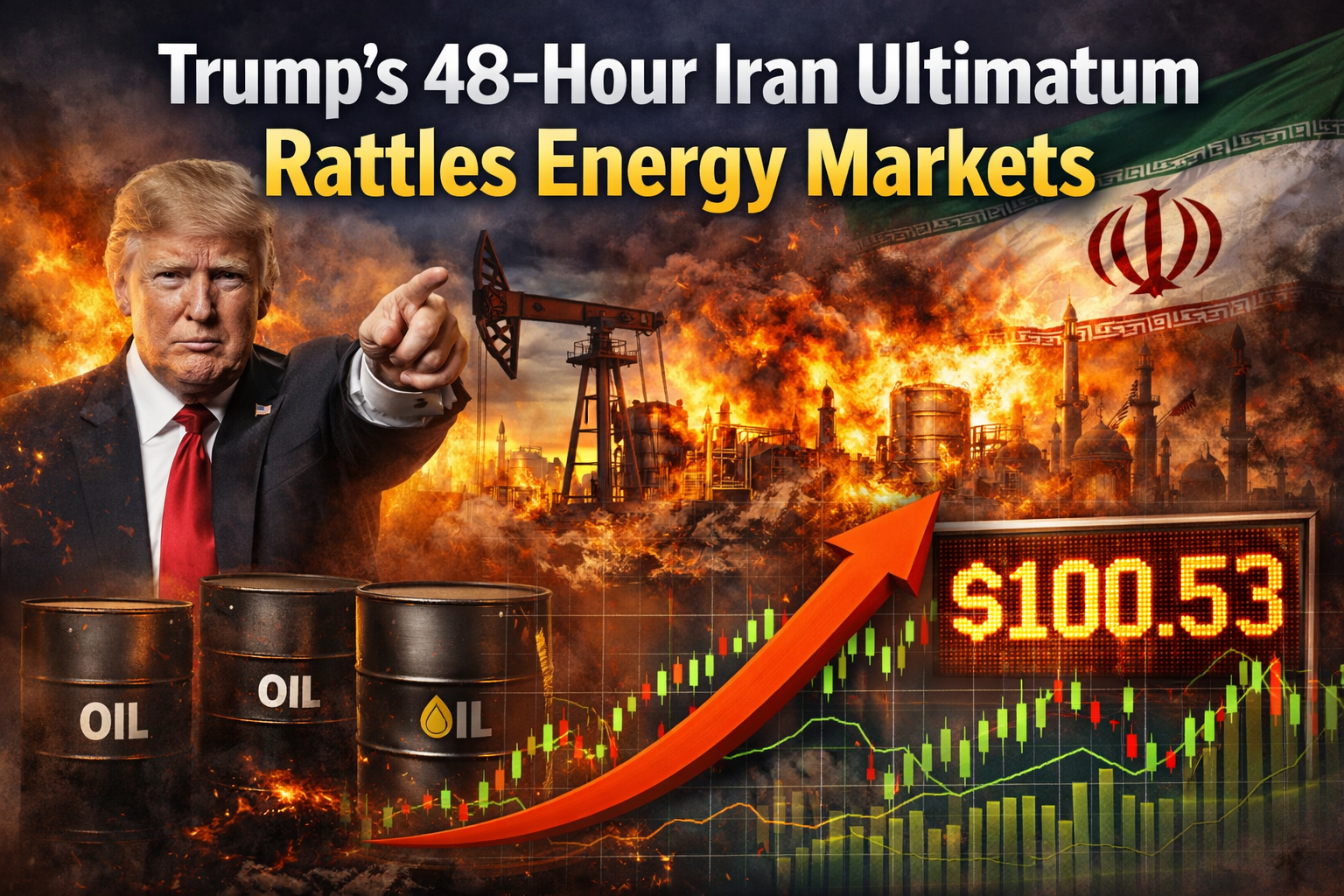
One commodity just became far more volatile: crude oil surged as President Trump issued a stark 48-hour ultimatum to Iran on March 22, demanding Tehran fully reopen the Strait of Hormuz or face US strikes on Iranian power plants.
The standoff marks a critical escalation in the month-long US-Israeli conflict with Iran, which began on February 28 following the assassination of Supreme Leader Ayatollah Ali Khamenei. According to the European Press Agency, Trump’s ultimatum came hours after Iran’s Joint Armed Forces Command threatened to target US energy infrastructure in retaliation for any American strikes on Iranian power facilities.
Energy Chokepoint Under Fire
The Strait of Hormuz carries approximately 20 percent of global crude oil exports, making disruption to this waterway potentially catastrophic for energy markets. Since Iranian Revolutionary Guard actions against US and Israel-linked vessels began, tanker traffic has plummeted sharply. According to reporting on March 18, 2026, traffic through the strait has dropped significantly since hostilities commenced, directly disrupting global oil flows and contributing to rising energy costs worldwide.
Iran’s parliament speaker warned that critical Middle East infrastructure could face destruction if Iranian power plants are attacked. The Islamic Republic simultaneously vowed to shut down the Strait of Hormuz indefinitely, escalating what military analysts describe as a escalating tit-for-tat cycle.
Market Reckoning
Financial markets are pricing in extended conflict. Energy stocks face headwinds as crude volatility spikes. Investors are repositioning away from economically sensitive sectors. Oil futures reflect expectations of sustained supply disruption through May.
Trump has appealed to NATO allies and Asian partners—Japan and South Korea among them—to support strait-opening operations. None has committed military assets thus far. The 48-hour deadline creates a binary outcome: either Iran capitulates or military escalation intensifies dramatically.
“The Strait of Hormuz, the only maritime link between the Persian Gulf and the Indian Ocean, carries about 20 percent of global crude oil exports, making it one of the world’s most critical energy chokepoints. Since the conflict began, actions by Iran’s Revolutionary Guard against vessels linked to the United States and Israel have sharply reduced tanker traffic through the strait, contributing to rising global oil prices” (European Press Agency, March 22, 2026).
What Happens Next
The conflict has already killed over 2,000 people as of March 23, 2026. A power plant strike would likely trigger Iranian retaliation against regional desalination plants and US-linked IT infrastructure. Each escalatory step raises the probability of accidental strikes on commercial shipping.
Washington signaled resolve this week with strikes on Iran’s underground coastal arsenal, which military officials said stored anti-ship cruise missiles and degraded Tehran’s maritime capabilities. Yet Iran’s demonstrated longer-range strike capability suggests the conflict may expand beyond the strait itself.
Alexandra Winters’s Take
Trump’s ultimatum effectively puts energy markets on a 48-hour clock. If Iran blinks, markets stabilize temporarily. If hostilities expand to power infrastructure, oil could breach $120 per barrel. The real wildcard: whether either side miscalculates during this critical window, potentially triggering uncontrolled escalation across the region.
About Author