What Should be Your Forex Trading Plan for 2026?
 Alexandra Winters
  Robert J. Williams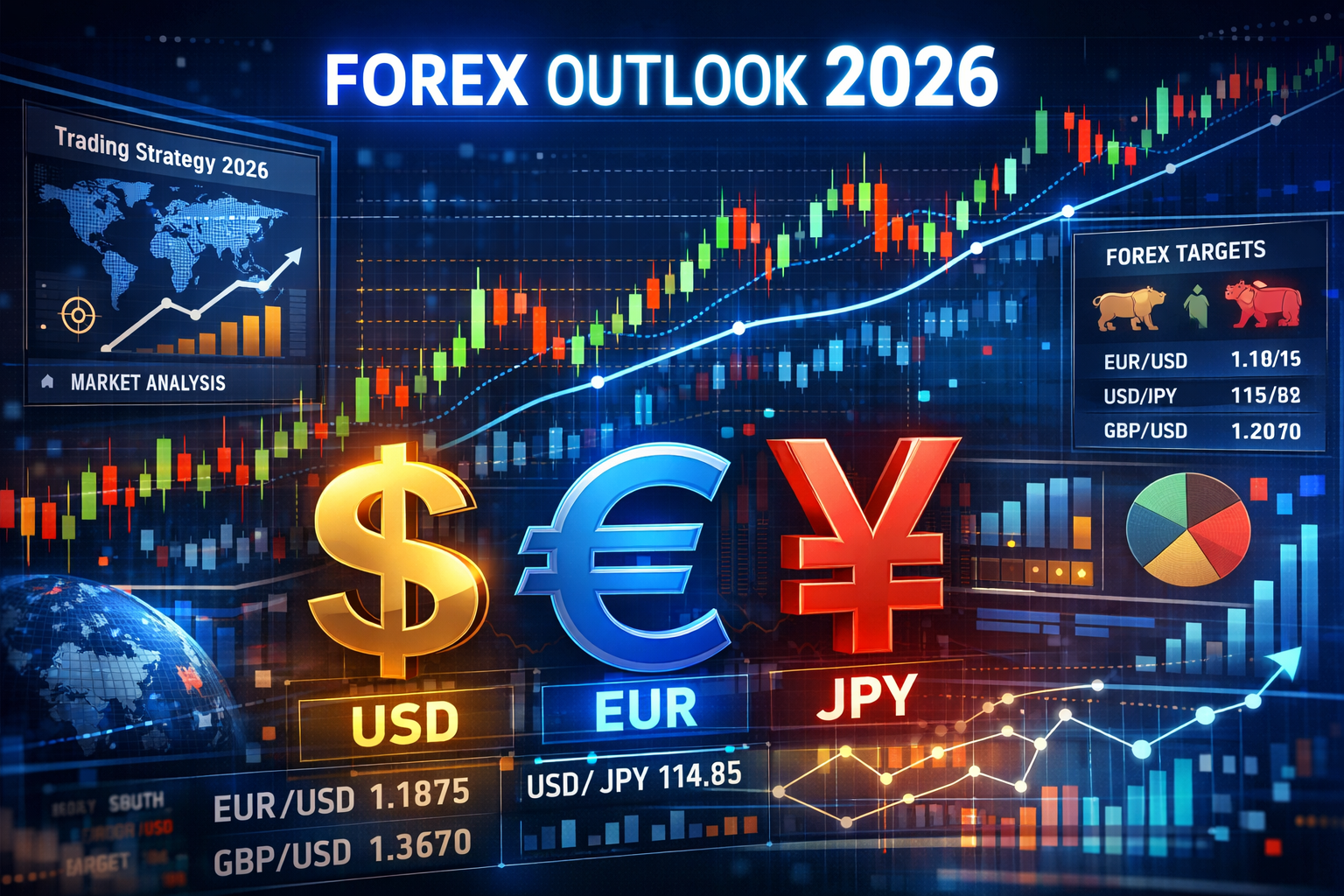
In 2026 we expect a shifting macro backdrop: the US Federal Reserve will likely finish an easing cycle (terminal policy ~3–3.25%) while other major banks (ECB at ~2.0%, BoJ normalizing toward ~1.0%) remain data-dependent. A structurally weaker US dollar is widely forecast, driven by lower US interest rates, softer growth, and a rising political risk premium (2026 US elections). The Eurozone should benefit modestly (ECB pause, German fiscal stimulus) but watch French politics. The Japanese yen is expected to appreciate as BoJ tightens and yield gaps narrow. Commodity-linked FX (AUD, NZD, CAD) may do well in a risk-on growth environment, while FX volatility likely stays relatively low (favoring carry trades). Key geopolitical risks include US election uncertainty, trade tensions (US–China tariffs, Iran sanctions), and the Ukraine war – events that can trigger safe-haven flows into USD/JPY/CHF and sudden volatility.
Market Outlook (2024–26)
After the inflation spikes of 2022–2024, global growth is moderating to ~3–3.5% with central banks easing policy. Markets forecast the Fed cutting by ~1.00% (100 bps) in 2024 and reaching neutral (~3.25%) by early 2026. The ECB/BoE pause at ~2.0% and gradual BoJ normalization (toward ~1.0% in late-2026) will leave G10 rates near neutral.
In FX, the DXY index is expected to drift lower. The EUR/USD is viewed constructively: dollar weakness and German fiscal spending could lift EUR to ~1.19–1.21 by year-end 2026. USD/JPY is likely to decline as BoJ tightening supports yen strength. AUD/USD should gain due to weaker USD (atleast it looks like so), commodity support, and relatively resilient Australian rates. On the other hand as we look, GBP/USD may stay range-bound or modestly higher on carry, but UK growth and fiscal concerns add risk. Emerging market (EM) FX are mixed to be honest: resilient CNY should bolster Asian currencies, while political risk (e.g. LatAm elections, Middle East) will cause episodic swings.
| Pair | 2025 Trend | 2026 Outlook | Key Drivers |
|---|---|---|---|
| EUR/USD | Strong (+12.9% in 2025) | Modest gains to ~1.19–1.21 by YE2026 | USD cuts vs ECB hold; German stimulus; French fiscal risk |
| USD/JPY | Flat (–1.0% YTD 2025) | Bearish: fall to ~146–148 by YE | BoJ tightening vs Fed cuts; yen carry unwinding |
| AUD/USD | Up (~+7% in 2025) | Bullish: 0.69 area by mid-2026 | Weaker USD; commodity prices; RBA vs Fed rates |
| GBP/USD | Strong (+10% in 2025) | Narrow range; potential vulnerability | USD down but UK growth and fiscal pressures |
| USD/CAD | Weak (-6% in 2025) | Mixed: upside risk if oil prices surge | BoC vs Fed, oil price swings |
| NZD/USD | Up (+5.5% in 2025) | Favored: carry and commodity-linked | RBNZ policy; global growth |
| EM FX | Varied | Mixed depending on political risk | Fed/China policy; commodity cycles |
Paul Tudor Jones, legendary hedge fund manager, emphasized disciplined trading:
“The most important rule of trading is to play great defense, not great offense.”
This philosophy lies at the heart of any sustainable Forex Trading Plan.
Geopolitical Risks
Traders should monitor elections (US 2026 midterms, EU climate, etc.), Ukraine war developments (the world is one fire to be honest!), US–China trade policy, and Middle East tensions. Conflicts tend to lift safe-havens (USD, JPY, CHF). Tariffs or sanctions can pressure exporting-currency FX. Supply shocks in energy or critical materials will also drive volatility.
Trading Objectives & Timeframes
A solid 2026 plan starts by defining your goals and style. Common time horizons are:
- Scalping: The first thing is to target small gains (1–5 pips) on short-term volatility. This requires ultra-fast execution and tight risk controls (use low-latency platform, minimal slippage) from your end.
- Day Trading: Buckle up and monitor Open/close positions intraday. This is very good for reacting to intraday news or momentum. Set daily profit/loss caps.
- Swing Trading: Capture intermediate trends (Do it!). Use technical setups (breakouts, retracements) on 4H–daily charts. Allows deeper fundamental filters.
- Position Trading: Ride major trends or carry, aligned with macro themes. Be prepared for wider stops and overnight risk.
Recommended Objective: For 2026, a balanced approach is wise: use day/swing trading for active opportunities (e.g. trading around Fed/ECB announcements) and a portion of capital for carry/position tarades on major trend ideas (e.g. long AUD/JPY on carry). Adapt timeframe to your availability and risk tolerance.
Strategy Frameworks
Build strategy around market regimes. We recommend diversifying across these core frameworks:
Trend-Following (Momentum): Seek sustained moves. Entry: Breakout or pullback in an existing trend, confirmed by indicators (e.g. price >20-period SMA, MACD crossing, ADX >25). Exit: Trailing stop (e.g. ATR multiple), or opposite signal (e.g. price closes below MA). Indicator: 50/200 MA cross, ADX for trend strength. Setup Example: Buy EUR/USD on a 4H break above recent swing high with RSI<30 at entry, place stop below recent low, trail above rising 20-SMA. Trend systems excel in trending markets. Pros: Captures big moves, simple logic. Cons: Whipsaws in choppy markets, needs wider stops.
Mean-Reversion (Range-Fading): Trade exhaustion. Entry: Fade extreme moves (price far from moving average or Bollinger Bands, RSI>70 or <30). Exit: When price returns to mean (e.g. 20-SMA). Indicator: RSI, Bollinger Bands, VWAP. Setup Example: Sell GBP/JPY when 1H RSI>70 and price hits upper Bollinger Band, set TP at mid-band. Pros: Works in range markets, high win rate on small moves. Cons: High drawdown if trend resumes (chop). Note: IG and Axiory note that mean-reversion is effective when markets are calm.
Carry Trade: Profit from interest rate differentials. Entry: Buy a higher-yield currency funded by a lower-yield one. Mechanism: You earn the interest rate gap (swap). Example: Long NZD/JPY or AUD/JPY if NZD/AUD rates > JPY rate. Exit: Manage on fundamentals (central bank meetings) or when CNY-led contagion risk appears. Indicator: Monitor interest rate spreads, CFTC positioning. Pros: Generates carry income in low-volatile, high-rate environments (2026 neutral-rate environment). Cons: Vulnerable to violent reversals (e.g. sudden USD/JPY spikes). Use with tight stops and hedges.
News/Volatility Strategies: Trade around events. Entry: Before and after important data (NFP, CPI). You can use straddle options strategies, like buying a straddle on CAD during the BoC if you’re not sure which way it’s going. Mechanics: If you want to trade news, think about using bracket orders to catch a move in either direction or trading breakouts after the market calms down. For example, buy EUR/USD after the ECB meeting if it breaks out of range, with a wide stop and take-profit. Economic calendar and implied volatility indices are tools. Pros: Can make money from spikes. Cons: High chance of slippage; needs experience.
Strategy Comparison
| Strategy | Timeframe | Entry/Exit Rules | Key Indicators | Pros/Cons |
|---|---|---|---|---|
| Trend-Following | Swing / Position | Breakouts or MA crosses (Keep an eye!) | Moving Averages, ADX, MACD | Captures large moves but struggles in ranges |
| Mean-Reversion | Scalping / Swing | RSI or Bollinger extremes (Locate it out!) | RSI, Oscillators, VWAP | High win rate but risky in strong trends |
| Carry Trade | Position | Long high-yield vs low-yield | Interest rate differentials | Earns interest but vulnerable to reversals |
| News Trading | Intraday | Breakouts around releases | Economic calendar | Large move potential but high slippage |
Risk Management
- Position Sizing: Risk a fixed % of equity per trade (commonly 1–2%). Calculate position size so that if the trade hits your stop-loss, you lose no more than this %. Use pip-value calculators or Excel. Example: On a $50,000 account, a 1% risk allows $500 max loss. If your stop is 50 pips on EUR/USD, size = ($500)/(50 pips*$10)=1 lot.
- Stop-Losses: Always define a stop level (e.g. recent swing high/low, or ATR-based distance). Alphaex recommends placing stops at logical points (last swing) rather than arbitrary pip counts. Maintain at least a 1:2 or 1:3 reward-to-risk in trending setups (Swissquote example: for a 10‑pip stop, aim ~30‑pip target in a trend).
- Leverage: Use moderate leverage. High leverage magnifies both profits and losses. Swissquote warns that “100:1 leverage amplifies moves 100x” and advises adjusting leverage to your analysis confidence. For beginners, keep leverage low (e.g. ≤20:1).
- Drawdown Limits: Set daily/weekly loss limits. A common rule is stop trading for the day if losses reach ~1% of equity. For account preservation, consider a 5–10% max drawdown limit; if hit, pause trading and analyze. Use smaller lot sizes on volatile pairs. Scale down or halt trading after 2–3 consecutive losses to avoid emotional overtrading.
- Correlations: Beware correlated trades. E.g. avoid holding long EUR/USD and long GBP/USD at full size (both are USD shorts). Aggregate your total USD exposure.
- Total Exposure: Do not use full margin at all. Keep some equity as buffer. If trading multiple pairs, cap total risk (e.g. no more than 10% of equity risked across all open positions).
Money Management & Journaling
Maintaining a trading journal helps evaluate performance objectively for yourself and trust me it’s very important even. Each entry should record trade details that you do, reasoning, market context, and emotional state. Also, regular reviews reveal patterns and help refine strategy execution.
Backtesting & Forward Testing
Historical data from different market conditions should be used to test strategies. The most important metrics are the win rate, the Sharpe ratio, the profit factor, and the maximum drawdown. After backtesting, demo accounts are used for forward testing to make sure that real-time execution is reliable.
Technology & Tools
- Brokers: Pepperstone, IC Markets, OANDA, IG, Saxo Bank, Interactive Brokers
- Platforms: MetaTrader 4, MetaTrader 5, TradingView, cTrader
- Data Sources: OANDA, Dukascopy
- Analytics Tools: TradingView, Autochartist, Myfxbook
Regulation & Tax Considerations
Forex trading is regulated globally and everyone is aware of it especially. Traders should ensure their broker is licensed by reputable authorities. Tax treatment of profits varies by country, so accurate records and professional tax advice are recommended.
Implementation Roadmap (90-Day Plan)
- Days 1–30: Market research and strategy development.
- Days 31–60: Backtesting and demo forward testing.
- Days 61–90: Begin live trading with small positions and evaluate results.
Conclusion
Macro trends suggest the possibility of a weaker US dollar in 2026 while several major currencies may strengthen depending on central bank policies. Traders should diversify strategies across trend-following, mean-reversion, carry, and event-driven approaches. Strict risk management—limiting risk to around 1–2% per trade—is essential. Thorough testing through backtesting and forward testing should precede live trading. Finally, disciplined execution, proper tools, and consistent review of performance remain fundamental to long-term trading success.
FAQs
About Author