Robert J. Williams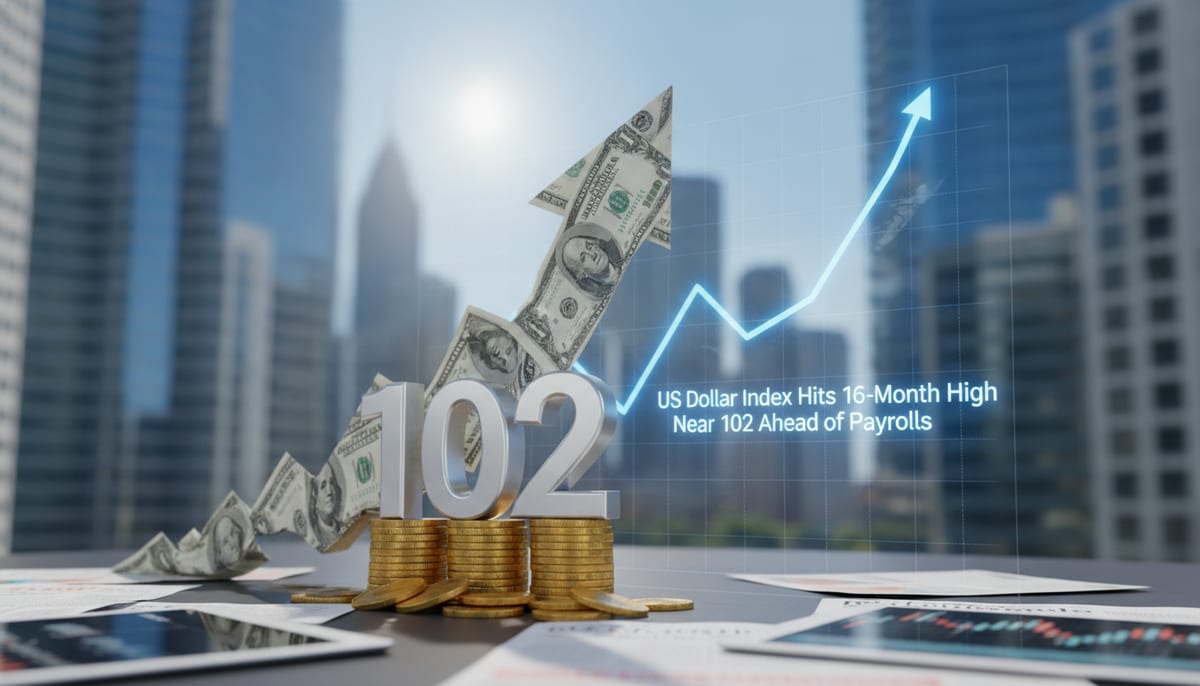
Why is the dollar rising into a jobs report that’s expected to be soft? Because US Treasury yields sit near their highest levels since 2002, and that has pushed the US dollar index (DXY) to its strongest level since May 2025.
The index traded near 102 in Asian hours on Friday, 2 October 2026, investingLive reported, citing MUFG. Trading Economics put DXY at 101.81 on 1 October, up 2.18% over four weeks. The US nonfarm payrolls report for September is due at 8:30 a.m. ET (12:30 GMT) today.
Some early coverage called this a three-month high. The level goes back further than that: the index last traded here in May 2025, about 16 months ago.
Where Do the Dollar and Yields Stand Before Payrolls?
| Market | Latest reading | Source and date |
|---|---|---|
| US dollar index (DXY) | 101.81, highest since May 2025 | Trading Economics, 1 Oct |
| DXY in Asian trade | Briefly near 102 | investingLive citing MUFG, 2 Oct |
| US 10-year Treasury yield | Peaked at 5.34%, the highest since 2002, then eased to 5.29% | investingLive, 1 Oct |
| EUR/USD | Slipped below 1.1300 | investingLive, 1 Oct |
| Brent crude | Settled above $102 on Thursday | investingLive, 2 Oct |
| Gold | Dipped to around $4,140/oz before recovering | investingLive, 2 Oct |
Why Are Treasury Yields Lifting the Dollar?
A 10-year Treasury paying more than 5% is the main reason. The yield peaked at 5.34% this week, its highest since 2002, and Trading Economics cited wider interest-rate gaps in the dollar’s favour.
The Federal Reserve debate has also turned toward hikes, not cuts. Dallas Fed President Lorie Logan said rates need to rise by at least another 50 basis points (bps), investingLive reported. Goldman Sachs pushed its forecast for the next Fed hike to December.
Inflation data don’t settle it either way. Headline PCE inflation held at 3.4% year on year, MUFG’s Lloyd Chan wrote in an Asia FX note on 1 October. He described the US data as showing “softer inflation but still-resilient labour demand.” The ISM manufacturing prices-paid gauge jumped to near 78 from about 71 in September. With Brent above $102, that number has little reason to cool quickly.
What Is Expected From the September Jobs Report?
Economists expect payrolls growth of about 90,000 and an unchanged unemployment rate of 4.1%, according to investingLive. That’s a low bar.
The run-up data were firm. Initial jobless claims fell to 197,000, and a private-sector payrolls measure rose by 90,000 in September, MUFG noted. The ISM manufacturing index barely moved, slipping to 54.5 from 54.6.
How Could Payrolls Move Asian Currencies?
MUFG’s view splits on the headline number. A weaker-than-expected print could pull US yields lower and let stronger regional fundamentals come through. The bank named tech-linked currencies: the South Korean won, the Taiwan dollar, the Malaysian ringgit and the Singapore dollar.
Continued labour-market strength would do the opposite, MUFG said. It would reinforce expectations of tighter US policy, keep yields and the dollar supported, and cap gains for those currencies.
The regional numbers are strong on their own. South Korea’s exports rose about 84% from a year earlier in September, well above the roughly 63% expected. Manufacturing PMIs stayed in expansion in South Korea (53.9), Japan (54.1) and Vietnam (51.9). Asian currencies slipped anyway. Good local data hasn’t been enough while US 10-year yields sit above 5%.
What Are Traders Watching After 12:30 GMT?
- The headline payrolls figure against the 90,000 consensus, and whether unemployment holds at 4.1%.
- The US 10-year yield, which eased to 5.29% after its 5.34% peak.
- Whether DXY can hold near 102 once the data are out.
- USD/KRW and USD/TWD, the pairs most tied to MUFG’s soft-payrolls scenario, along with EUR/USD around 1.1300.
Analyst Take
A soft headline on its own probably won’t end the dollar’s run. The Fed’s own officials are still arguing for higher rates, and a prices-paid gauge near 78 gives them cover to look past one weak month. For the dollar to turn, yields need to fall, and that likely takes a miss on both jobs and unemployment.
The cleaner reaction may come in Asia rather than in EUR/USD. Korea’s export surge and PMIs above 50 are already in the data. A drop in US yields would remove the main weight on the won and Taiwan dollar. The euro has no comparable tailwind sitting in its own numbers.
One limit on all of this: MUFG’s scenario gives direction, not size. Neither the bank nor anyone else cited here put a figure on how far Asian currencies could move.
FAQ
Why did the US dollar index hit a 16-month high?
US Treasury yields drove it. The 10-year yield peaked at 5.34% this week, its highest since 2002, and Fed officials such as Dallas Fed President Lorie Logan have argued for further rate hikes. That combination pushed DXY to its highest level since May 2025, near 102.
When is the September 2026 US payrolls report released?
Friday, 2 October 2026, at 8:30 a.m. ET (12:30 GMT).
What is the consensus for September nonfarm payrolls?
About 90,000 new jobs, with the unemployment rate expected to stay at 4.1%, according to investingLive. Other recent labour data were firm, including initial jobless claims at 197,000.
Which Asian currencies could gain from a weak jobs report?
MUFG named the South Korean won, Taiwan dollar, Malaysian ringgit and Singapore dollar. Its reasoning: a weaker-than-expected print could pull US yields lower, letting strong regional data, such as South Korea’s 84% jump in September exports, support those currencies. A strong print would likely keep them under pressure.
Related: Dollar hits two-month high on oil, Treasury yields and Fed hike odds
—
This article is for information only and is not investment advice. Trading currencies on margin carries a high risk of loss.
About Author