Alexandra Winters
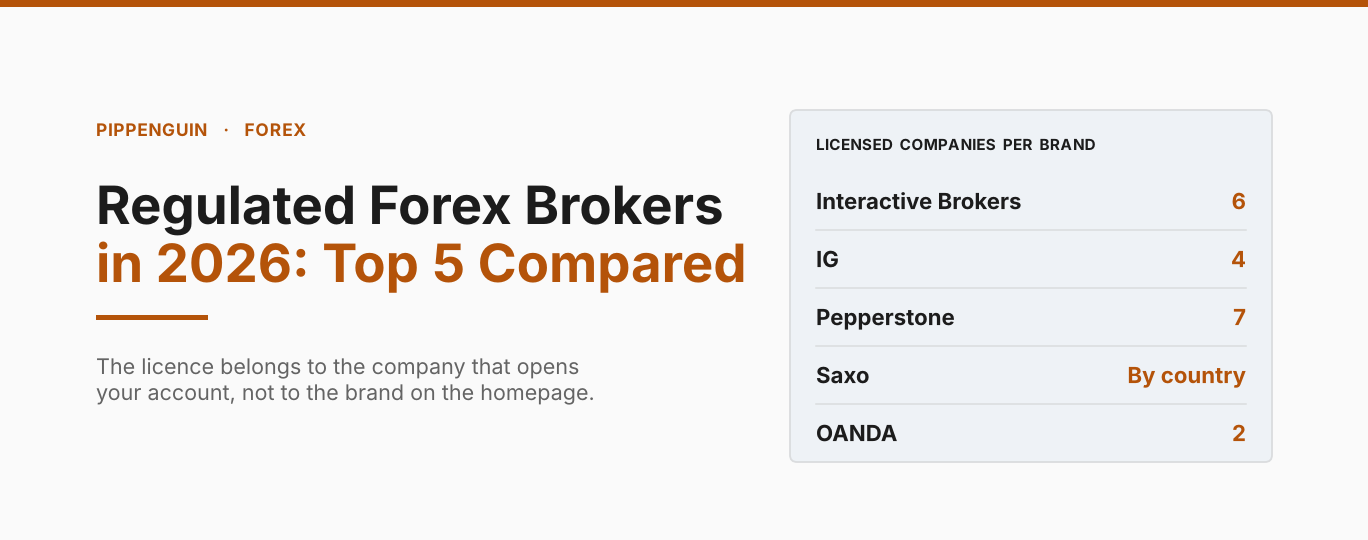
Every regulated forex broker holds a licence. The one that protects you belongs to the company that opens your account, and where you live usually determines which company that is.
This guide compares five brokers (Interactive Brokers, IG Markets, Pepperstone, Saxo, and OANDA) by: who regulates it, whether it can take you as a client, what a trade costs, and what you get back if the firm fails.
Key Takeaways
|
What a licence gives you, and what it does not
Regulation attaches to a company, not to a brand. Pepperstone runs separately licensed companies in the Bahamas, the UK, Cyprus, Germany, Australia, Dubai and Kenya, and publishes a different retail loss figure for several of them. Saxo puts the same point in its own terms, saying client agreements are made with the Saxo entity for your country of residence. The protections below travel with the company, so read them against the one that would hold your money, as our Pepperstone review sets out.
- Client money held separately: Your deposit sits apart from the firm’s own funds, so the firm’s creditors cannot reach it.
- Capital floor: The regulator sets the minimum the firm must hold, which lowers the chance it fails at all.
- Complaints route: If the firm will not settle, an ombudsman or an arbitration body takes the case.
- A compensation scheme, sometimes: Some regulators pay out when a firm fails. Others do not cover forex at all.
Two things a licence does not do: It does not make a trade safer, because losing money on a position is not a regulatory failure. And it does not guarantee honesty: the US Commodity Futures Trading Commission warns that registration and a clean disciplinary record “won’t protect you from fraud”, while adding that most scams involve unregistered firms.
Five regulated forex brokers and the company behind each
Each row names the company behind the brand, the licence it holds, the markets it can serve you in and what a trade costs. Every figure is the firm’s own published statement and a licence number appears wherever the firm publishes one.
| BROKER | COMPANY AND REGULATOR | MARKETS SERVED | WHAT A TRADE COSTS |
|---|---|---|---|
| Interactive Brokers | Interactive Brokers LLC, SEC and CFTC. Separately licensed in the UK (FCA 208159), Ireland (C423427), Australia (AFSL 453554), Canada and Singapore | Most major markets, through the local company | 0.20 basis points of trade value, minimum USD 2.00 per order |
| IG | IG Markets Ltd (FCA 195355) for CFDs and IG Index Ltd (FCA 114059) for spread bets in the UK; IG International Ltd, licensed by the Bermuda Monetary Authority; tastyfx, LLC in the US, NFA 0509630 | The UK and much of the world; the US through tastyfx | EUR/USD from 0.6 points, no commission; 0.8% to convert a trade into another currency |
| Pepperstone | Pepperstone Markets Ltd in the Bahamas, SCB SIA-F217, on the global site. Also licensed in the UK, Cyprus (CySEC 388/20), Germany, Australia (AFSL 414530), Dubai and Kenya (CMA 128) | Most markets, but not the US | USD 3.50 per lot per side on a Razor account, so USD 7.00 round trip, from 0.0 pips |
| Saxo | Saxo Bank A/S in Denmark, with the client agreement made by the Saxo entity for your country of residence | Through your country’s Saxo entity | Varies by entity and tier; take the figures from your own country’s Saxo site |
| OANDA | OANDA Corporation in the US, a CFTC-registered futures commission merchant and retail foreign exchange dealer, NFA 0325821; OANDA TMS Brokers S.A. in Poland, licensed by the Polish Financial Supervision Authority | The US and Europe, through separate companies | No commission; the cost sits in the spread |
These five were picked because each runs more than one licensed company, which is what the comparison is about. The table ranks nothing on price, because the cost column mixes basis points, per-lot commission and spreads, and two of the five publish no single figure at all.
Two things worth noticing: Interactive Brokers charges a minimum of USD 2.00 per order, a large share of the cost on a small trade. Pepperstone’s row makes the case for this whole article: its Bahamas company reports that 80% of retail accounts lose money, against 76.1% in Germany, 74.1% on its CySEC licence and 73.6% on its FCA one. One brand, four companies, four different sets of odds. IG does the same for its 0.8% conversion charge.
What each regulator caps, and what it pays if the firm fails
A licence is worth what its regulator will do for you. The four below set different ceilings on what you can trade with, and different floors under what you get back.
| PROTECTION | FCA (UK) | CYSEC (CYPRUS) | ASIC (AUSTRALIA) | CFTC AND NFA (US) |
|---|---|---|---|---|
| Retail leverage cap | 1:30 to 1:2 | 1:30 to 1:2 | 1:30 to 1:2, under an order that runs to 23 May 2027 | Roughly 50:1 on majors, 20:1 on the rest, through a margin floor |
| Negative balance protection | Yes | Yes | Yes | Not set by rule; ask the dealer |
| If the firm fails | FSCS, up to £85,000 per eligible person, per firm | Investor Compensation Fund, the lower of 90% of the claim or €20,000 | CSLR covers advice, credit and securities dealing up to A$150,000; derivatives dealing is not on that list | No forex compensation scheme, and SIPC does not cover forex |
| Where a complaint goes | Financial Ombudsman Service | Financial Ombudsman of Cyprus | AFCA | NFA arbitration |
The caps and the Cyprus fund apply to retail clients only, and the FSCS limit is per person and per firm, so two accounts with one company share a single limit. If your company is outside these four, as Pepperstone’s Bahamas entity and Saxo’s non-EU entities may, none of what the above table covers you. Ask that company in writing which compensation scheme and which complaints body cover your account.
Two regional rules that catch traders out
The first is American. US-regulated forex brokers work to a margin floor rather than a leverage cap. Under 17 CFR 5.9, CFTC-regulated forex brokers must collect at least 2% of notional value on major currency pairs and 5% on everything else, which works out at roughly 50:1 and 20:1. This is looser than the 1:30 ceiling in the UK, the EU and Australia, so a US account is not automatically the better protected one. Before opening one, search the company in NFA BASIC, the National Futures Association’s public database.
The second is Australian, and it has a date on it. ASIC-regulated forex brokers work under a product intervention order that sets the leverage caps, the margin close-out rule and negative balance protection, and it expires on 23 May 2027. On 12 October 2026, ASIC proposed extending it to 1 April 2031 and tightening it, and the consultation closed on 16 November 2026. Until a decision is published, plan against the caps above. The FCA and CySEC caps carry no equivalent end date.
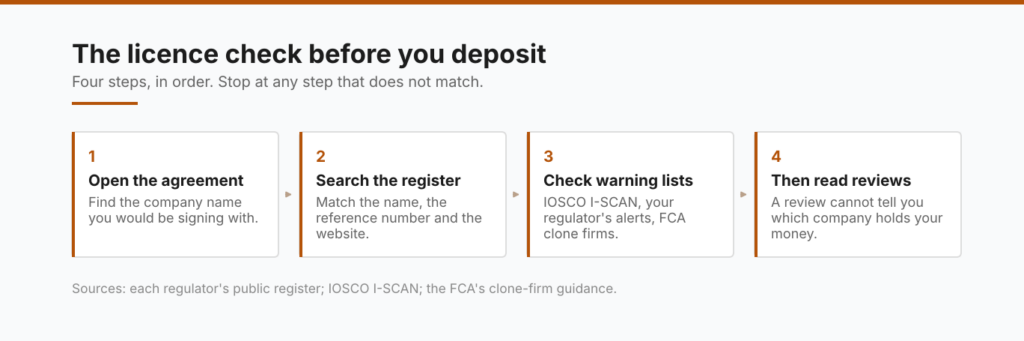
How to check a broker licence in four steps
All five brokers above serve different countries through different companies, so this is the only reliable way to learn which one you would get, wherever you live. Our Interactive Brokers review shows how far one brand’s arms can differ.
- Open the client agreement, not the homepage: The company you contract with is named in it. If that name differs from the brand you searched for, that is normal, and it is the name you check.
- Search that name on the regulator’s own register: Three things have to match: the company name, its reference number, and the website address.
- Search the warning lists: IOSCO’s I-SCAN carries alerts from regulators worldwide. The FCA led seventeen regulators in a week of action on illegal financial promotions in April 2026, and 66% of the adverts it found came from firms or people already on its Warning List.
- Read reviews in the end: A review tells you about a brand. It cannot tell you which company would hold your money, or what that company owes you.
The FCA warns that clone firms copy a genuine firm’s name and reference number, and often its address, so make sure to do all the above checks. The website address is the item clones most often get wrong.
The Bottom Line on Regulated Forex Brokers
Choose the company first and the price second. Start from where you live, because that decides which of a brand’s companies you get, and that company sets your leverage, your compensation, and your complaints route. Only once that is settled does the cost column mean anything, and our guide to low-spread brokers covers it. Whichever you pick, open the client agreement, find the company name, and match it to the register before you move money.
Frequently Asked Questions
How do I check that a forex broker is really regulated?
Find the company name in the client agreement, then look it up on the register of the regulator it names. All three of the name, reference number, and web address have to line up. Clones reproduce the first two convincingly, so the address is the real test.
Can I use a broker regulated in another country?
Often yes, through that broker’s licensed company for your region, though some countries restrict it and some brokers decline certain nationalities. The protections change with the company, so check the table above for the regulator you would sit under.
Which regulator gives retail traders the most protection?
On paper, the FCA and CySEC, because both cap leverage at 1:30, require negative balance protection and run a compensation scheme. ASIC matches the first two, but its scheme excludes derivatives dealing, and the US runs no forex scheme at all. The best regulated forex brokers for you are the ones whose company for your country sits under one of the first two.
Are my funds safe if a regulated forex broker fails?
Partly, and it depends on the regulator. An eligible UK client can claim up to £85,000 from the FSCS, and a client of a CySEC-licensed firm can claim the lower of 90% of the claim or €20,000. Australia’s scheme covers advice, credit and securities dealing but not derivatives dealing, and there is no equivalent scheme for US forex accounts. Ask your company in writing which scheme covers you.
Do all regulated forex brokers offer the same leverage?
No. The FCA, CySEC and ASIC cap retail forex leverage between 1:30 and 1:2, while US rules allow roughly 50:1 through a margin floor. An offshore company of the same brand may advertise far more, and that number tells you which regulator you are under.
Does regulation stop a broker from losing my money?
No. A licence governs how a firm handles your money, not whether your trade works. Pepperstone publishes a separate loss figure for each licensed company, running from 73.6% on its FCA licence to 80% on its Bahamas one, and Saxo Bank A/S reports 66%. Those are regulated firms’ own numbers for their own retail clients.
About Author