Is Swing Trading the Sweet Spot for Forex Traders?
 Alexandra Winters
  Robert J. Williams
In my years covering forex education, swing trading comes up more than almost any other strategy — and for good reason. It sits between the frenetic pace of scalping and the slow grind of position trading, offering something that actually fits around a normal life. But the gap between understanding swing trading as a concept and executing it profitably is wide. Most traders land on one side of that gap.
This guide breaks down how swing trading works in the forex market, which strategies hold up under scrutiny, and what the data actually says about who profits from it. No hype about “financial freedom” — just the mechanics, the math, and the trade-offs.
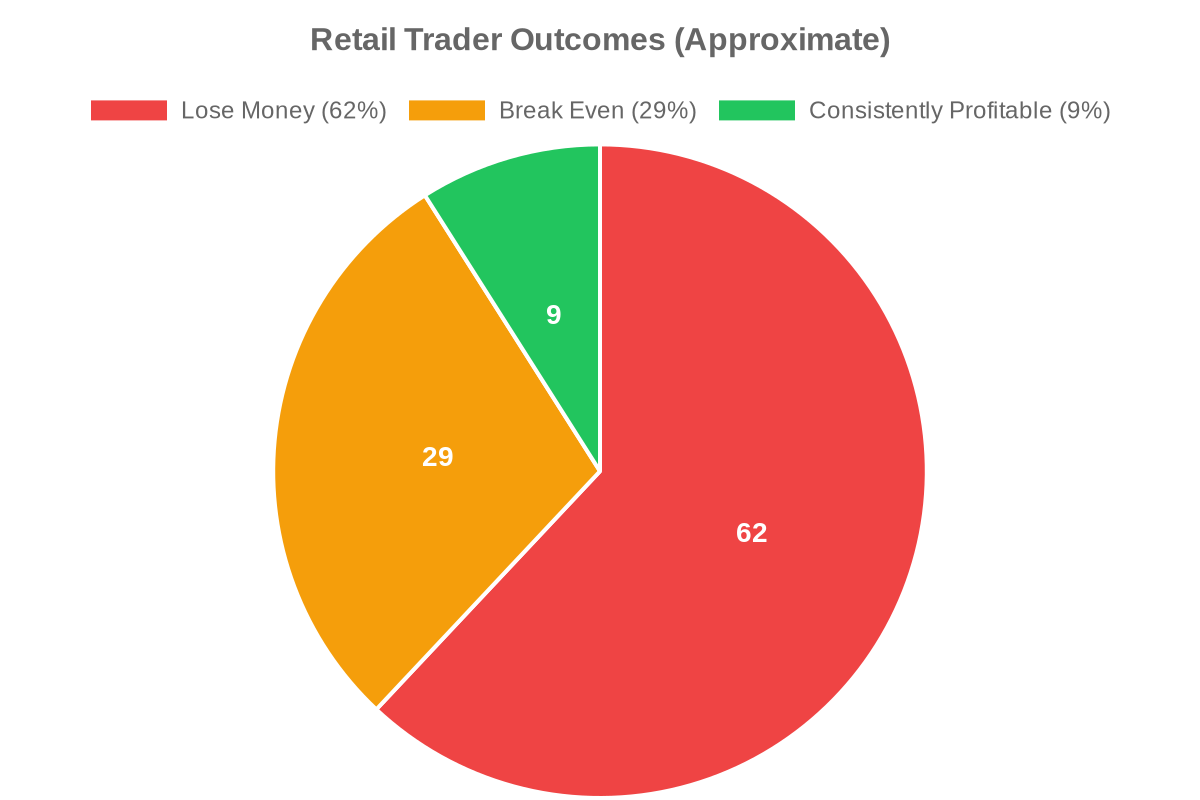
Swing trading in forex targets price moves over days to weeks using technical analysis on daily and 4-hour charts. The forex market’s $9.6 trillion daily volume (BIS Triennial Survey, 2025) creates ideal conditions for this style, but 62% of retail CFD accounts still lose money — strategy and risk management separate the profitable minority.

What Is Swing Trading in Forex?
According to the 2025 BIS Triennial Survey, daily forex trading volume reached $9.6 trillion — up 28% from $7.5 trillion in 2022 (BIS, 2025). This liquidity creates frequent, tradeable price swings that form the basis of swing trading. Retail traders account for roughly 2.5% of that daily volume, but the tight spreads and deep order books benefit swing traders specifically.
Swing trading means holding a forex position for days — sometimes a couple of weeks — to ride a single price swing from start to finish. Not every move. One good one. If you’re new to forex trading entirely, start there before diving into strategy specifics.
Day traders close everything before the session ends. Swing traders hold. Days, sometimes weeks — long enough for a setup to mature, short enough to avoid the months-long commitment of position trading. Enter with a plan, a defined stop-loss, and a target. Hit it or cut the trade when the thesis breaks.
How Swing Highs and Swing Lows Drive the Strategy
A swing high forms when price hits a ceiling and reverses. The candle’s high sits above the candles on either side — buying pressure ran out at that level. Swing lows look different in practice. Panic selling carves sharper bottoms than the slow grinds that form tops, so the reversal point tends to be more obvious on the chart.
In an uptrend, a swing trader watches for the price to pull back to a swing low, then enters long, targeting the next swing high. In a downtrend, the logic reverses. Sounds mechanical. In practice, identifying these points in real time — and distinguishing a genuine swing low from the start of a trend reversal — is where the skill lives.
How Does Swing Trading Differ From Day Trading and Scalping?
A 2010 study by Barber, Lee, Liu, and Odean found that fewer than 1% of day traders were consistently profitable over five years. Swing trading’s longer holding periods reduce the impact of spread costs and give trades more room to develop, though direct performance comparisons across styles are scarce.
The differences aren’t just about timeframes — they’re about lifestyle, capital efficiency, and psychological load.
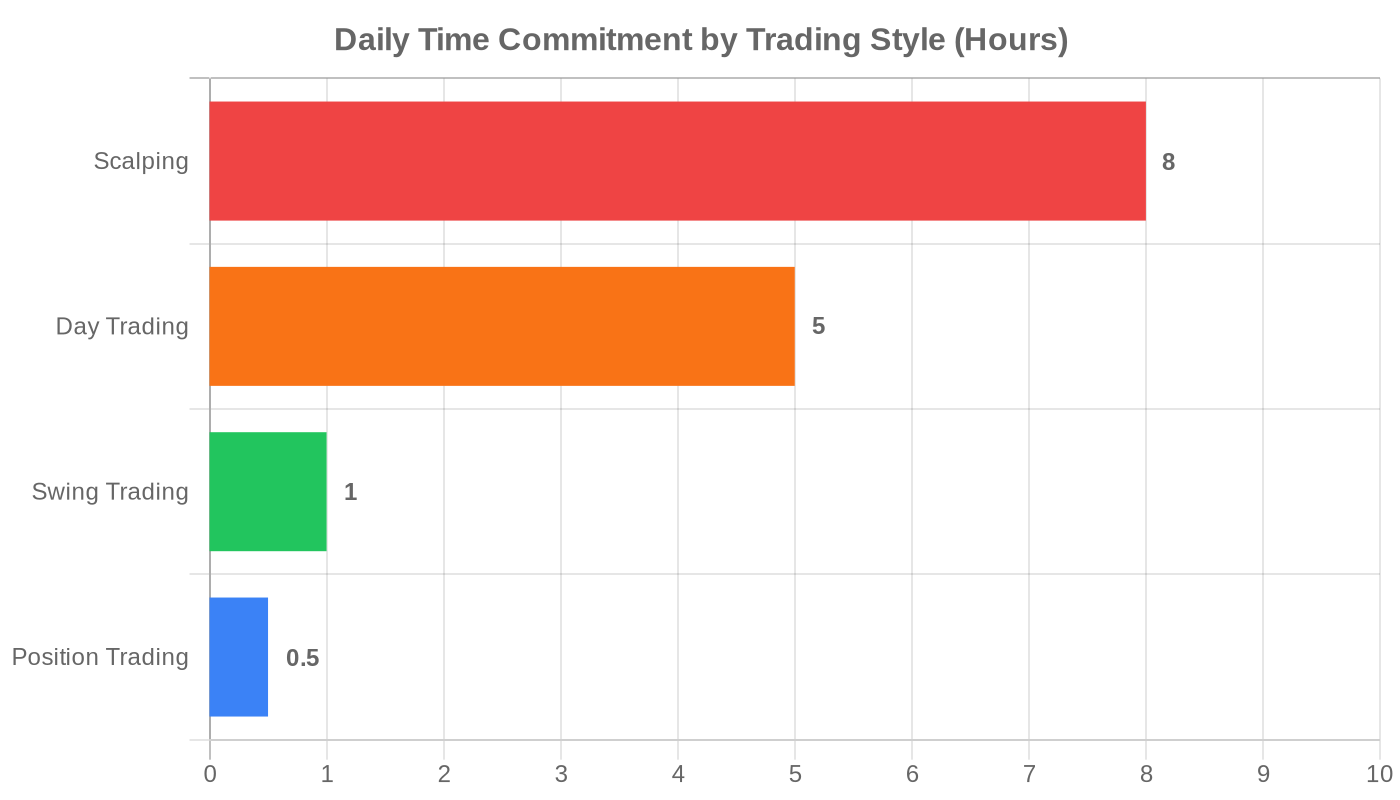
| Trading Style | Holding Period | Daily Time Needed | Trades Per Month | Capital Efficiency | Psychological Demand |
|---|---|---|---|---|---|
| Scalping | Seconds to minutes | 4-8 hours | 100+ | Low per trade | Very high |
| Day Trading | Minutes to hours | 3-6 hours | 40-80 | Moderate | High |
| Swing Trading | Days to weeks | 30-60 minutes | 5-15 | Higher (larger moves) | Moderate |
| Position Trading | Weeks to months | 15-30 minutes | 1-5 | Highest per trade | Low-moderate |
The time commitment is the decisive factor for most traders. Someone with a full-time job can realistically manage swing trades with 30-60 minutes of evening analysis. Try that with scalping. If that comparison interests you, our breakdown of day trading strategies covers what that side of the spectrum actually demands.

What Are the Best Forex Swing Trading Strategies?
Swing traders using daily and 4-hour charts consistently report better risk-adjusted returns than those on shorter timeframes, largely because higher timeframes filter out the noise that generates false signals. Three strategy families dominate forex swing trading — and they work because currency pairs respect technical levels more reliably than most asset classes.
For a deeper breakdown of execution details, see our dedicated guide to forex swing trading strategies.
Trend Trading
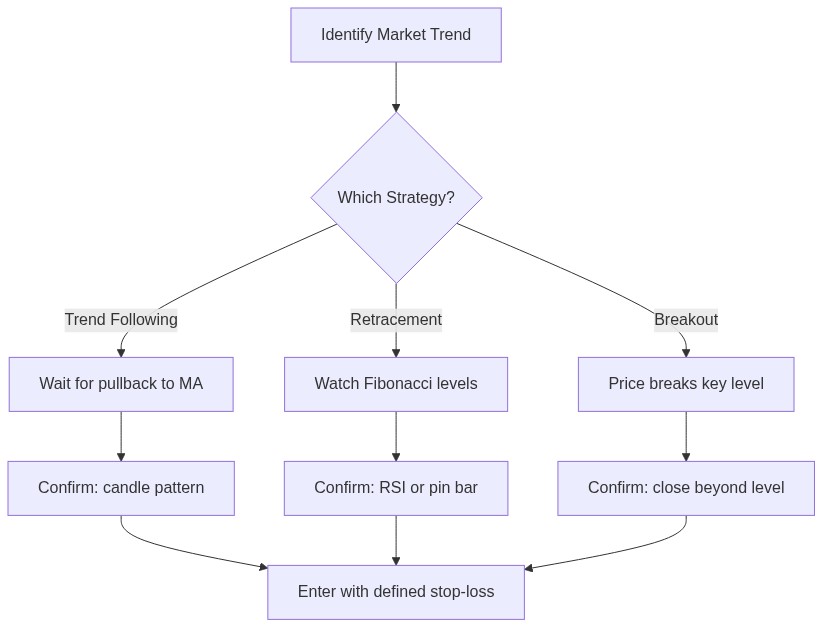
The most straightforward approach. Identify the prevailing trend direction using a 50-period or 200-period moving average, wait for a pullback toward the moving average or a key support level, then enter in the trend’s direction.
Works best on EUR/USD, GBP/USD, and other major pairs with clean trending behavior. The difficult part isn’t the entry — it’s resisting the urge to take profits early when the trend is still healthy.
Retracement (Pullback) Trading
Pullback trading refines the trend approach using Fibonacci retracement levels. After a strong impulse move, traders watch for price to retrace to the 38.2%, 50%, or 61.8% level. If price holds that level and shows a reversal signal — a pin bar, engulfing candle, or RSI divergence — they enter.
Risk is defined clearly: stop-loss goes below the swing low (for longs) or above the swing high (for shorts). This gives precise risk-reward calculations before entering.
Breakout Trading
Breakout traders wait for price to break through a defined resistance level (for longs) or support level (for shorts), then enter on the assumption that momentum will carry price further.
The catch: false breakouts. Price breaks a level, triggers entries, then reverses. One filter that helps — require the breakout candle to close beyond the level, not just wick through it. Volume confirmation matters too, though forex volume data is less reliable than equities since there’s no central exchange.
Best Indicators for Forex Swing Trading
No single indicator predicts price direction reliably — if one did, everyone would use it and it would stop working. What indicators do is help swing traders confirm setups they’ve already identified through price action analysis. The useful ones add context without adding confusion.
Here’s what actually gets used in practice:
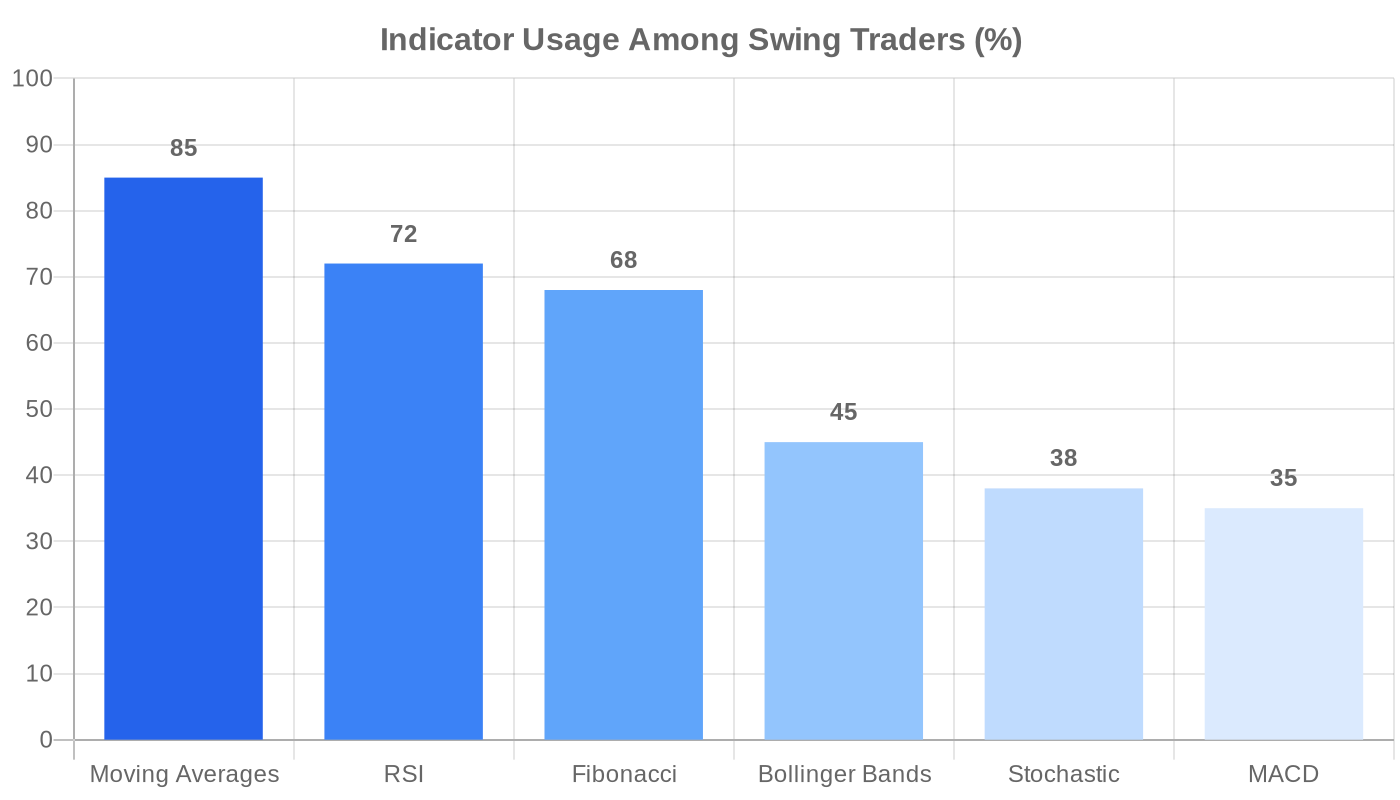
Moving averages (50-period and 200-period) define trend direction. Price above both = bullish bias. Price below both = bearish. The crossover between them (the “golden cross” or “death cross”) generates signals, but those signals lag — they confirm trends, not predict them. See our moving averages guide for swing trading for specific setups.
RSI (Relative Strength Index) measures momentum on a 0-100 scale. Readings above 70 flag overbought conditions; below 30 flags oversold. For swing traders, the real value is RSI divergence — when price makes a new high but RSI doesn’t. That disagreement often precedes reversals.
Fibonacci retracement levels map likely pullback zones within a trend. The 38.2%, 50%, and 61.8% levels act as magnets where price frequently stalls or reverses. Not magic — just self-fulfilling because enough traders watch the same levels.
Bollinger Bands measure volatility by plotting bands 2 standard deviations above and below a moving average. When bands squeeze tight, a breakout is brewing. When price touches the outer band, it often reverts toward the middle. The stochastic oscillator does something similar — flagging overbought and oversold extremes — but reacts faster to price changes.
For a broader look at forex trading indicators and how they layer together, we’ve covered that separately.
What Is the Best Timeframe for Swing Trading?
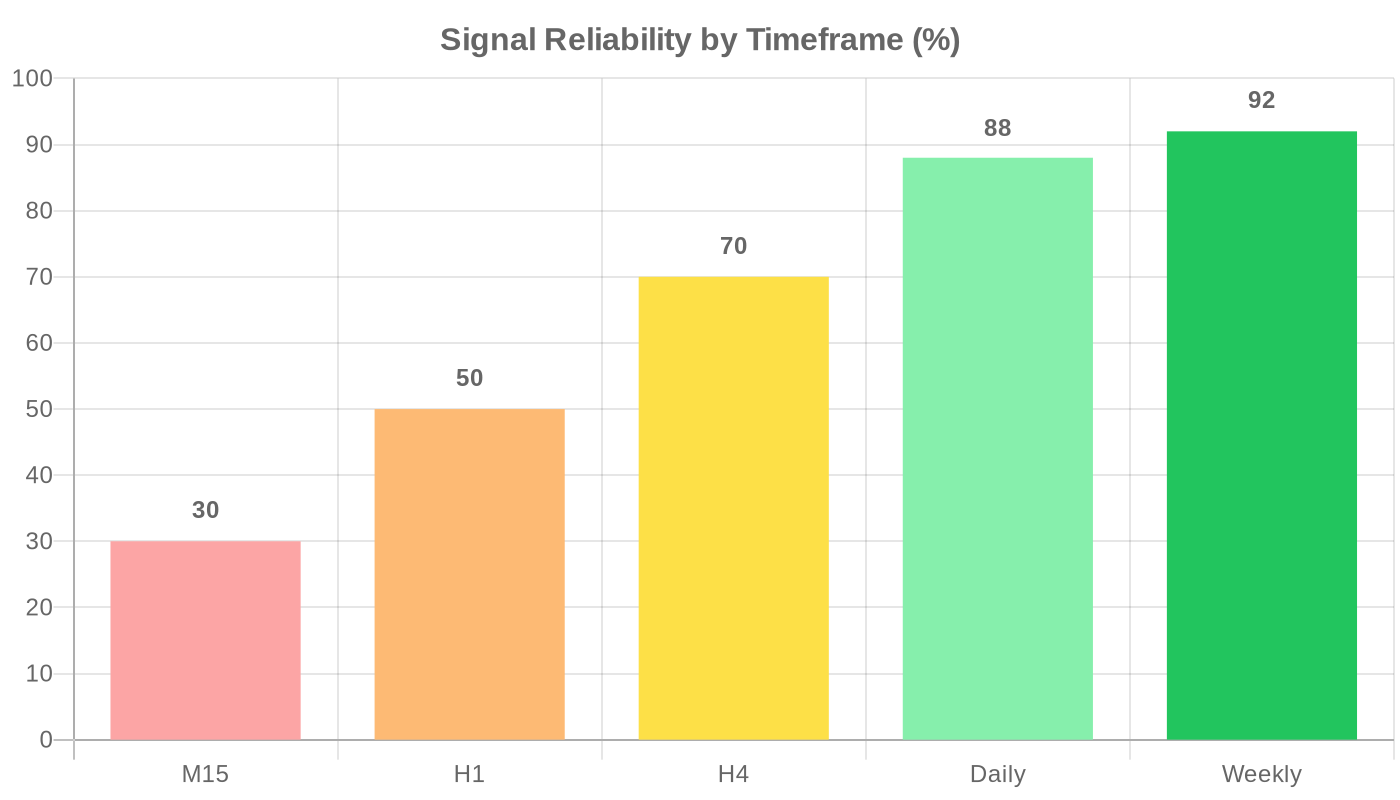
The daily chart is the backbone of forex swing trading. Patterns that appear on the daily timeframe carry more weight than anything on an M15 or H1 chart because more market participants are watching — and acting on — those levels. Fewer false signals. Cleaner structure. More time to think.
The 4-hour chart works as a secondary frame for refining entries. A trader might identify a setup on the daily chart, then drop to the 4H to pinpoint a tighter entry — saving a few pips on the stop-loss without changing the overall trade thesis.
Weekly charts have their place for context. They show the dominant trend direction that daily swings operate within. But few swing traders hold positions long enough to trade weekly patterns directly.
What doesn’t work well: anything below H1. The noise on 15-minute or 5-minute charts generates more false signals than usable setups for swing trading specifically. If you find yourself checking the M15 chart mid-trade, you’re probably not swing trading anymore — you’re anxious. Our best timeframe for swing trading guide covers the timeframe hierarchy in more detail.
How Do You Manage Risk as a Forex Swing Trader?
According to regulatory disclosures required by the FCA and ESMA, approximately 62% of retail CFD accounts lose money. That figure doesn’t distinguish between trading styles, but it underscores a simple truth: without structured risk management, the odds are against retail traders regardless of strategy.
Position Sizing and Risk-Reward Ratios
The standard rule — risk no more than 1-2% of account equity per trade — exists because losing streaks happen even with a sound strategy. At 1% risk per trade, a ten-trade losing streak costs roughly 10% of the account. Painful, but recoverable. At 5% per trade, that same streak wipes out nearly half the account.
Risk-reward ratio determines whether a strategy survives long-term. With a 1:2 ratio (risking 50 pips to target 100 pips), a trader only needs to win 33% of the time to break even. At 1:3, the breakeven drops to 25%. This is the mathematical edge that makes swing trading viable — larger targets relative to stops.
PipPenguin’s position size calculator automates the math. Plug in account size, risk percentage, and stop-loss distance — it gives the lot size.
Stop-Loss Placement and Overnight Gaps
Stop-losses in swing trading sit below the recent swing low (for longs) or above the recent swing high (for shorts). Placing them tighter — inside the swing structure — saves capital on paper but leads to getting stopped out by normal volatility.
Overnight gaps are a real risk. Major economic news — central bank decisions, employment data, geopolitical events — can cause price to gap past your stop-loss at market open. The resulting slippage means the actual loss exceeds what you planned. This is unavoidable in swing trading. The mitigation is position sizing, not hoping it won’t happen. Our forex risk management guide covers gap risk specifically.
Swap Costs and Rollover Fees
Every forex position held past the daily rollover time (typically 5 PM EST) incurs a swap fee — the interest rate differential between the two currencies in the pair. Some pairs pay positive swaps (you earn interest); most cost you money overnight.
For swing trades lasting days to weeks, swaps compound. A negative swap of $2/day on a standard lot becomes $14 over a week — eating into profit or widening a loss. Traders can check swap rates on their broker’s platform before entering, and some brokers offer swap-free accounts for traders who need them.

Is Swing Trading Profitable?
A 2024-2025 study by SEBI (Securities and Exchange Board of India) found that 91% of retail traders incurred losses. That statistic covers all trading styles — but it frames the conversation honestly. Swing trading doesn’t exempt anyone from the base rate of failure.
So what separates the other 9%?
The data points cluster around a few factors. Traders who use daily and 4-hour charts, maintain strict risk-reward ratios of 1:2 or better, and limit risk to 1-2% per trade show significantly better outcomes than those trading shorter timeframes with loose risk controls. None of this is surprising. It’s also not easy.
Dr. Alexander Elder, author of Trading for a Living, has argued for decades that intermediate-term trading succeeds because it forces patience and structured analysis. Swing trading’s pace naturally imposes the discipline that day traders have to manufacture artificially.
Realistic expectations: a consistently profitable swing trader might target 1-2% monthly account growth after accounting for losses, commissions, and swaps. That compounds to 12-24% annually — strong by professional standards, but a long way from the “quit your job” fantasy. If anyone promises more with certainty, they’re selling something.
Swing Trading: Advantages and Drawbacks
Advantages:
- Time-efficient. Thirty to sixty minutes of evening analysis is genuinely enough. No staring at screens all day.
- Better risk-reward potential. Targeting 100-300 pip moves with 30-80 pip stops creates favorable ratios that shorter-term trading can’t consistently match.
- Lower transaction costs. Fewer trades means fewer spreads paid. A swing trader making 10 trades per month pays a fraction of the spread costs a scalper does.
- Reduced emotional pressure. Decisions happen on higher timeframes, which reduces impulsive behavior. There’s time to think.
- Compatible with other work. This is the main reason most people gravitate toward it.
Disadvantages:
- Overnight exposure. Gaps happen. You accept this risk the moment you hold a position past session close.
- Patience required. Setups don’t appear every day. Sitting on your hands while waiting for a valid signal is harder than it sounds.
- Swap costs accumulate. Multi-day holds on high-differential pairs erode profits quietly. Check the numbers before entering.
- Slower feedback loop. A swing trade might take two weeks to play out. For traders who want fast validation (or fast learning from mistakes), that pace can frustrate.
The Ideal Forex Swing Trader Profile
Swing trading works best for traders who prefer structure over speed. If you can look at a daily chart, identify a setup, place the trade with predefined risk, and then walk away until the next session — this approach fits.
Part-time traders with full-time jobs are the natural audience. The time commitment is realistic. Beginners can start here too, as the slower pace gives more time for learning and analysis — but the prerequisite is still education in technical analysis and risk management. Swing trading with real money and no training is just a slower way to lose capital.
Traders coming from day trading who’ve burned out on screen time often transition to swing trading successfully. The analytical skills transfer. What changes is the pace, the position sizing, and — critically — the patience required.
If you’re still finding your approach, our guide to choosing the best forex trading strategy maps the options against different trader profiles.
Risk disclosure: Trading forex involves substantial risk and is not suitable for all investors. Past performance does not guarantee future results. Only trade with capital you can afford to lose.
Frequently Asked Questions
What is the best timeframe for forex swing trading?
The daily chart. It filters out intraday noise and produces more reliable signals than anything on a shorter timeframe. The 4-hour chart works as a secondary frame for refining entries, while weekly charts provide trend context without generating direct trade signals.
Is swing trading good for beginners?
Better than scalping or day trading, yes — the slower pace gives more time for analysis before committing to a trade. But “beginner-friendly” doesn’t mean “easy.” The prerequisite is solid knowledge of technical analysis, chart patterns, and risk management. Start on a demo account for 2-3 months minimum before putting real money on the line. Most traders who skip that step don’t last long.
How much money do you need to start swing trading forex?
Most forex brokers allow accounts starting from $100-500 with micro lots (0.01). Practically, $1,000-2,000 gives enough margin for proper
position sizing at 1-2% risk per trade. Smaller accounts force either oversized positions relative to the account or stop-losses too tight to survive normal volatility.
Can you swing trade forex with a full-time job?
Absolutely. Check charts once in the evening, place pending orders with defined stops and targets, review open positions. That’s 30-60 minutes. The daily candle close at 5 PM EST is the natural checkpoint.
What is a swing high and swing low?
A swing high is a price peak — the candle’s high sits above the candles on either side, marking where buyers ran out of steam. Swing lows are sharper and often easier to read: a price trough lower than adjacent candles where sellers exhausted themselves and buyers stepped back in. Swing traders enter near the lows and exit near the highs — or the reverse in a downtrend.
About Author